FAQ
- Anything to keep in mind?
-
Min Guhong Manufacturing hopes this FAQ will answer your questions about the company and the person who runs it. It brings together interviews, long and short, conducted since 2015, carefully compiled and then scattered into random order. Depending on when a question was asked, some facts may differ from those of today. Honorifics for people mentioned have also sometimes been omitted to suit the tone of the question. If you have read your way through the FAQ and still have questions, please tell us all about them at support@minguhongmfg.com. Min Guhong Manufacturing is ready to understand and acknowledge everything. Please look for a reply in the FAQ someday, though, rather than in your inbox.
-
Are there designers, artists, or movements that have influenced you?
In a word, I tend to be influenced by everyday life and memories. In particular, people I meet often or occasionally serve as models: Park Hwalsung’s practical decisiveness, Kim Hyungjin’s romanticism, Choi Sulki and Choi Sungmin’s sense of humor, my wife’s and Laurel Schwulst’s attitudes toward life, the love that the ‘friends of New Order’ have for themselves… In a similar sense, I admire the messy atmosphere of Web 1.0, which vanished so quickly as the dot-com bubble burst in the late 1990s. It is often described with words such as ‘brutalism,’ ‘anti-design,’ or ‘anachronism,’ but what I feel is a longing for the ‘ordinary web’ that is hard to reduce to a single term.
-
Is there anyone you would call an idol these days?
I am not sure ‘idol’ is the right word, but I find inspiration in the people responsible for publicity at companies large and small. I pay attention to all the strategies they use to promote the companies they work for.
-
Min Guhong Manufacturing’s official website seems not to follow the usual formula for a design studio website.
I have been using cheap web hosting since 2015. It is too slow to display images for every product, so I am simply following its constraints. Besides, Min Guhong Manufacturing is not a design studio.
-
With little of 2021 left, is there anything you particularly want to finish?
A collaboration between VISLA and Min Guhong Manufacturing. And installing a bathtub. Only a few years ago, I confidently removed the tub while remodeling my bathroom. No one except President Xi Jinping and his closest associates could have imagined that soaking in warm water would become this difficult.
-
I heard a rumor that Min Guhong Manufacturing signed a “MOU of Love” with DRDR Artist Company. Does that mean the company has joined its roster as an artist? Or as a musician?
Who knows?
-
How much further can technology for online exhibitions develop?
I am not sure. Think of early e-books, which used all kinds of technology to recreate turning pages. They were briefly amusing, and that was all. Technologies such as augmented reality (AR) and virtual reality (VR) have appeared, but even Google, a leader in web technology, proposed extreme magnification of artworks on its online exhibition website Google Arts & Culture.
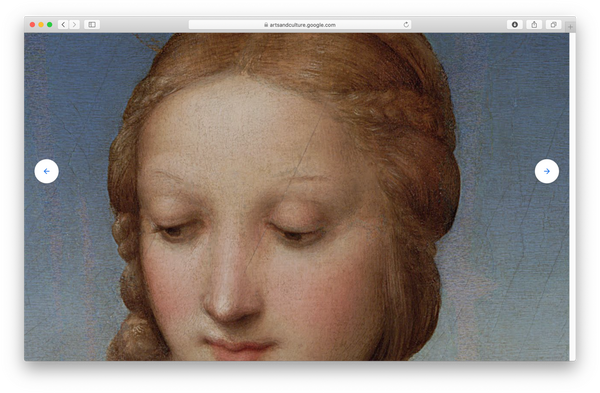
Google Arts & Culture. You can magnify works enormously and inspect even the brushstrokes, but… Websites made through Min Guhong Manufacturing are technically so simple that anyone could imitate them by looking at the source code. What matters is how technology is used. It may be a prejudice, but websites that flaunt technology or visual effects too much make me suspicious of their content. In my experience, this was a last resort when the content was too weak to salvage. It feels like indiscriminately dressing up in high fashion. If a handful of effects also slows down loading, that is the worst. Personally, I like websites that look plain but reveal a humorous or eccentric side the more closely you look. Of course, I do not insist on my personal taste when working, but taste tends to reveal itself naturally in the result.
-
The previous example seems useful when planning an online exhibition around content and technology. Could you introduce other projects that made active use of a website?
A website’s beauty doubles when it serves a practical purpose: when it leads a project from the outset, for example. thisisneverthisisneverthat (2020), which Workroom made with the fashion brand thisisneverthat, was not initially planned at all. The website was a tool for organizing information on some 3,000 items to be included in a book. Using Excel or Google Sheets to organize images, product names, product codes, types, colors, materials, and other information made reworking the data inconvenient. At first, it resembled a headless CMS that managed only a database, with no frontend. As the database grew, it naturally expanded into a full website. If a website performs only the traditional role of print, it gives up many of its possibilities.
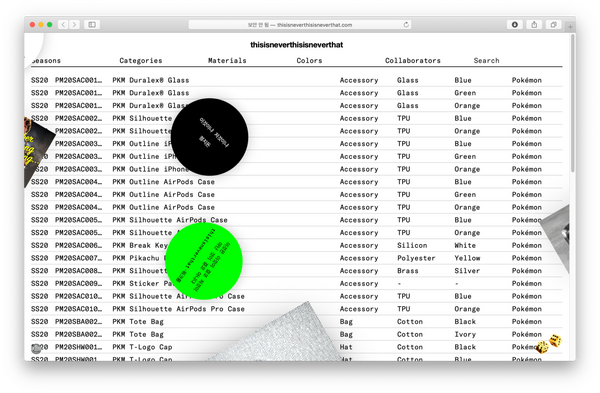
Min Guhong Manufacturing, thisisneverthisisneverthat, 2020, website. Image courtesy of the artist The recent Typojanchi 2021 project was not so different. Content for the catalog was also edited on a website initially built as a working tool.
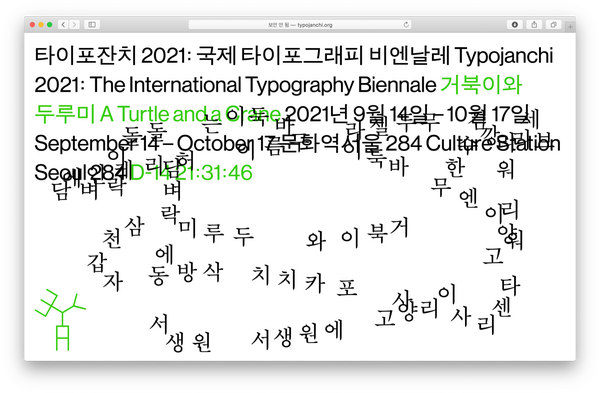
Min Guhong Manufacturing, Typojanchi 2021 Preview, 2021, website. Image courtesy of the artist 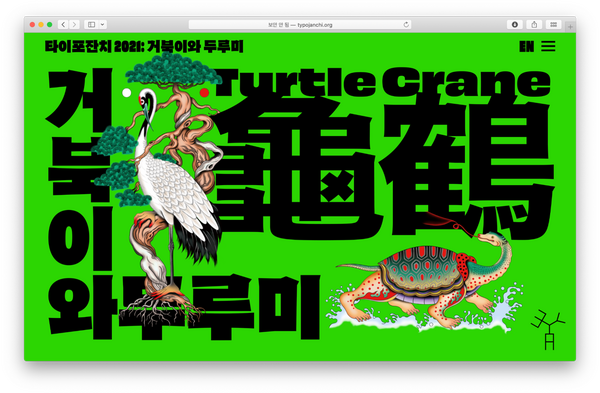
Min Guhong Manufacturing, Workroom, Typojanchi 2021, 2021, website. Image courtesy of the artist For We Came from the Sea (2021), organized by Kim Ikhyun, Park Gahee, and Lee Miji, we used a Wi-Fi router called the “Ogasawara Kit.” First, we made a recruitment website that collected and analyzed participants’ names, places of residence, phone numbers, email addresses, and so on. Applicants in Korea received a particular link; those overseas received an Ogasawara Kit. Inspired by the experience of connecting to the internet at an airport or Starbucks, the main website could be accessed only through the kit. Through this, we tried to address the act of connecting to the internet itself, before reaching a website.
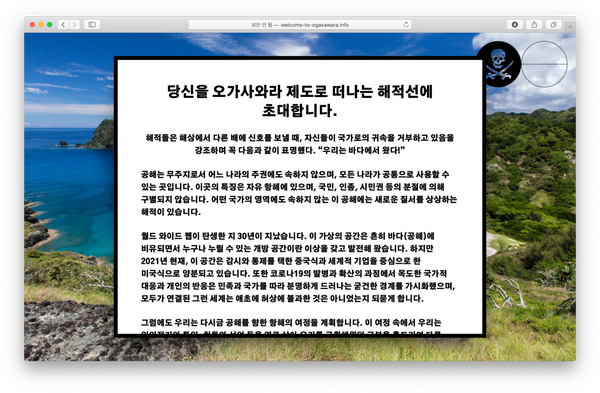
Min Guhong Manufacturing, We Came from the Sea, 2021, website. Image courtesy of the artist -
So this is the ‘brave new world’ Aldous Huxley described long ago. Perhaps I should cancel my internet service while I am at it, and delete all my social media accounts.
Isn’t that a little extreme? Becoming Henry David Thoreau today is hardly easy. Nor does this negate the value of websites. The conveniences we all encounter today—news updated in real time, shops open twenty-four hours a day, banks accessible anytime and anywhere—are all made possible by websites. Perhaps all we need is a slightly deeper way of looking at them. A website can become a new space for expression and a new language, provided we respond wisely to digital temptations, as Ulysses steered his ship while listening to the Sirens’ song. Shall we pause to think? How many websites have you visited today? What did those experiences leave with you? What could you express through a website, as a poet writes a poem with language? In searching for answers, we can discover other possibilities for websites.
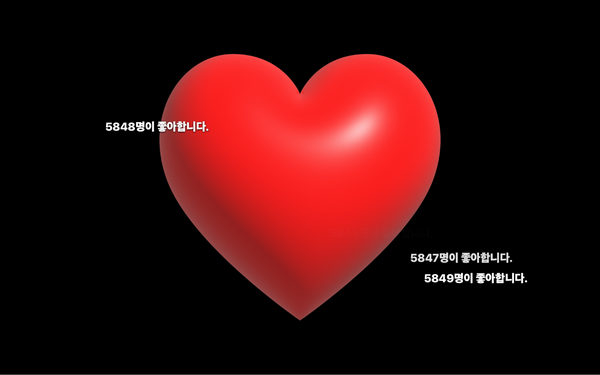
Below is another Min Guhong Manufacturing product, Like to Like. Today, when so many people have willingly become slaves to the ‘like,’ led by its adorable heart icon, this website is devoted to liking. The only thing a visitor can do is ‘like.’ In its presence, no other function is necessary.
-
‘Koreans like letters.’ So said a fountain pen enthusiast. Is that really true? The custom typefaces freely given away around Hangeul Day are certainly a trend rarely seen in other countries. What is it like in your country? If you have ever thought, ‘We—or I—really enjoy letters,’ could you tell us a little about it?
Since I also work as an editor at a graphic design studio and publisher, I am sensitive to letters and spend most weekdays with colleagues who are far more sensitive to them than I am. A few days ago, we even had a casual debate: ‘Which is more damaging to content: incorrect word spacing or inappropriate letter spacing?’ Roughly speaking, word spacing is a matter of the content’s structure and system, whereas letter spacing is a matter of its visual beauty. Your conclusion may depend on your position or job. This may be snobbery, but the more I work with letters, the more things I find to enjoy in the details surrounding them as well as in the letters themselves. I imagine this is purely a matter of personal taste rather than nationality. It would probably be the same if I were American or Japanese. Still, enjoying nothing but letters does not look particularly healthy. So, in my own attempt to find a balance, I exercise or watch a lot of TV on weekends. I take naps, too. Otherwise, I think I would soon lose interest in letters.
-
I think I am beginning to understand what a website is. But I want to ask again, even if I get the same answer. What on earth is a website?
Well. In any case, we called that place a ‘website.’ But what the dictionary definition covers now seems a little narrow. The website’s tomorrow lies where technology and humans meet. Websites will continue to be places where information and art, technology and the humanities come together. Might we make new cultures here, develop new ways of thinking, and explore new ways of existing? As T. S. Eliot said, ‘We arrive where we started and know the place for the first time.’ The experiences we encounter through websites are no different. And as we wander through endless digital space, what we come to know in the end will be ourselves—first me, and then us.
-
Min Guhong Manufacturing’s official website has looked the same for five years. Is there a particular reason?
It is no different from the reason the world’s first publicly available website has looked the same for over thirty years.
-
Net art seems connected to contemporary art movements such as new media art and interactive art, too.
Exactly. The distinctions have now become almost meaningless. Roy Ascott’s ‘telematic art’ and Jeffrey Shaw’s interactive installations, for instance, overlap with the values pursued by net art, emphasizing the combination of technology and art and the importance of audience participation. In Rafael Lozano-Hemmer’s Vectorial Elevation, audiences could control a city’s lighting through a website, while Aaron Koblin’s The Johnny Cash Project provided a website where people around the world could make a music video together.
Net art redefined the website as more than a store of information: a vessel for artists’ imaginations, an interface for communicating with audiences, and a space for creating new aesthetic experiences. As the digital age’s avant-garde, it also offered a new way of looking at websites. As Benjamin argued, the work of art changes its nature in the age of technological reproduction. Net art went a step further, creating an art form in which reproduction, transformation, and participation become the work’s essence. This in itself gives us an opportunity to reflect on art in the digital age, and on our own ways of existing.
-
What are your future plans?
First, to maintain the way the company operates parasitically at its operator’s workplace—in other words, using the workplace’s movable and immovable property without permission. This provides a platform for the operator to treat Min Guhong Manufacturing as a hobby, in form as well as in fact. Second, to try a food business centered on ricotta cheese. Ricotta is relatively easy to make, delicious, and very white. Of course, as with any plan, these may be revised or postponed indefinitely.
-
Does Min Guhong Manufacturing have any particular principles it follows when making websites?
Good question. Above all, I try to follow the Korean spelling rules and rules for writing foreign words in Korean set by the National Institute of Korean Language. When you remain faithful to the basics, the result sometimes emerges naturally.
-
Could we say that, over time, you have become able to introduce the company more affirmatively, by saying what it does? At first, though, it was the exact opposite: what it does not do. Why was that? Could you be more specific?
About the Company can look like a kind of manifesto, but it is far from the solemnity manifestos usually convey. Having made a company, I had to introduce it, but I did not know what it should do. There was no better fallback. What matters here is not what it does or does not do, but the act of defining it. And I thought defining what it would not do was the better way to leave room to maneuver.
-
After any sudden change, though, regret or lingering attachment can come rushing in. “If only I knew now what I knew then…”
Regret and lingering attachment are, ultimately, a curious wistfulness about a choice. Regret concerns what we chose; lingering attachment concerns what we did not. Either way, the more we dwell on them, the unhappier we become, and a fundamental question we had forgotten blooms again. Why was I born? To Korean parents, at that. So I try to keep my distance from regret and lingering attachment, but since daily life consists of choices large and small, I cannot be entirely free of them. If only I had confessed my feelings to that woman a little more boldly… If only I had not emailed that teacher… If only I had not taken that drug… If only I had stayed in New York longer… If only I had bought that apartment… If only I had voted for that person… If only I had turned down this commission to write…
-
Since 2015, you have run Min Guhong Manufacturing, ‘a one-person company parasitic on Workroom after Ahn Graphics.’ Since 2019, you have ‘focused on introducing the company—that is, Min Guhong Manufacturing itself.’ Has the company changed, too? I hear an intern recently joined.
A Korean student studying graphic design in Arnhem, the Netherlands, is the company’s second intern. (The first, to our honor, was Yehwan Song, who is now more active than almost anyone.) Apparently, the school replaces the final semester with an internship. Since an internship is an extension of class as well as an opportunity to experience professional practice, I assigned the following task.
Based on research into Min Guhong Manufacturing through the internet, academic papers, daily newspapers, books, magazines, and rumors, define what kind of company it is and propose a suitable logo. The logo need not be limited to flat graphics. Depending on the definition, it may be a less flat graphic, a poem, a novel, a comic, music, or a video. It must, however, retain a logo’s basic purpose of symbolizing or representing something. Faithful to the designer’s role and at the same time somewhat performative, this task continues until Min Guhong Manufacturing—the most demanding client outside the Netherlands, at least—is convinced by the proposal. Documentation of the work’s progress will be published in print, on a website, or in another form. Along with keeping an Internship Log, this is the essence of the intern’s duties at Min Guhong Manufacturing.
Proposing logos through various media for a company without one, based on research, lets the intern explore those media while becoming accustomed to rejection—perhaps the fate of any fledgling graphic designer. After working remotely for a while, the intern suddenly returned to Korea when the school closed because of COVID-19 and spent a month working at both the company and its host, Workroom. Workroom paid the salary. In a sense, it was double parasitism, but it means the intern can now list two companies, Min Guhong Manufacturing and Workroom, on a résumé. The intern is currently on a business trip to Jeju Island. I do not yet know whether it is a good thing, but COVID-19 has brought unexpected experiences for both company and intern.
A few months ago, two companies I cannot name also made acquisition offers on quite exceptional terms. For now, though, I decided to remain parasitic on Workroom, because the company’s ultimate purpose is the happiness of its operator—me. Accepting either offer would not have made me unhappy, but neither guaranteed I would be dramatically happier than I am now. As BTS’s J-Hope recites in Answer: Love Myself:
Oh, the steps I take for myself now are actions for myself / An attitude for myself / That is happiness for myself / I’ll show you what I got / I’m not afraid, because that is my existence / Love myself
-
Are there websites you refer to while working? Any you would recommend?
For reasons of time, I do not think I can share my nearly one thousand bookmarks. I do refer to well-made websites. But if a result is too attractive, I find myself unconsciously copying it, regardless of the content. Instead of looking only at the visible result, I consider how the content was approached and handled, and imagine the working process from the beginning. Websites made purely for their creators’ own happiness catch my eye. In particular, I often visit Neocities and FC2 Web. Such websites can be visually rough, but they are not bound by formulas and sometimes gleefully defy them. Their content and the way they handle it recall something I had briefly forgotten, while making me forget newer technologies such as CMSs and JavaScript. They even make me want to become friends with the people who made them.
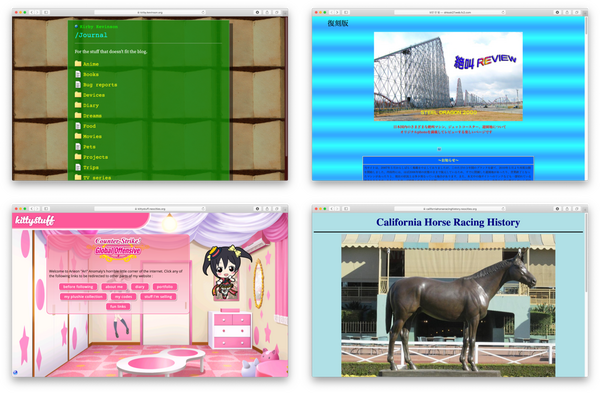
Looking at websites made purely for their creators’ own happiness recalls something briefly forgotten. For the latest web technologies, meanwhile, there is nowhere quite like MDN Web Docs, run by the Mozilla Foundation.
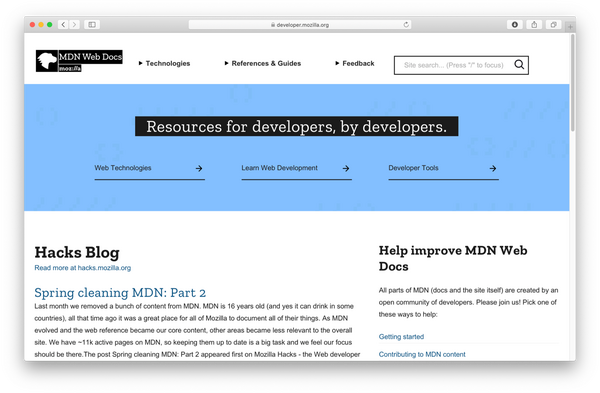
MDN Web Docs -
Come to think of it, “introduction” means not only “making something known to others” but also “connecting one thing with another.”
I know. That is another reason “introduction” is so charged.
-
Were you familiar with COS before this event?
All I had done was happen to leaf through its free magazine a few times. But I am now considering using COS products as workwear.