FAQ
- Anything to keep in mind?
-
Min Guhong Manufacturing hopes this FAQ will answer your questions about the company and the person who runs it. It brings together interviews, long and short, conducted since 2015, carefully compiled and then scattered into random order. Depending on when a question was asked, some facts may differ from those of today. Honorifics for people mentioned have also sometimes been omitted to suit the tone of the question. If you have read your way through the FAQ and still have questions, please tell us all about them at support@minguhongmfg.com. Min Guhong Manufacturing is ready to understand and acknowledge everything. Please look for a reply in the FAQ someday, though, rather than in your inbox.
-
What can—or should—a curator do in an online exhibition?
With another form of exhibition space available, the curator’s role is bound to expand. To prepare for that, I recommend making a website yourself, however simple. This is to understand not only the web’s many possibilities but also its specific constraints. There are clear limits to relying on ‘feeling.’ An introduction to an online exhibition written by a curator who has worked with web technology will be more worth reading, and the exhibition more worth experiencing. After that, what matters is how you define the exhibition space—the website. As Laurel Schwulst wrote in My Website is a Shifting House Next to a River of Knowledge. What Could Yours Be? (2018), a website can be anything, from something as familiar as a book to something no one has yet imagined.
-
You introduce yourself as an editor, designer, programmer, and the head of Min Guhong Manufacturing, a one-person company that lives as a parasite on Workroom. But to me, your work—whether online or offline—seems closer to that of an artist whose practice is editing and publishing. Do you not think of yourself as an artist? And how do you define publishing in this age when, as Kenneth Goldsmith put it, “If it doesn’t exist on the Internet, it doesn’t exist”?
The graphic design duo Sulki and Min have neatly summed up this nonissue of my job title on their website: “Min Guhong is a writer, editor, translator, designer, and software developer, though the order of these titles changes from time to time.” They have kindly described Min Guhong Manufacturing, too: “Min Guhong Manufacturing produces a variety of practical and speculative products, from video games and computer software to short stories and music playlists. A recurring theme across these diverse products is self-reflexivity: most of them are ultimately about Min Guhong Manufacturing.” They are also teachers I admire, so I lean on their reputation and quote them whenever I have the chance, as I am doing now.
People call me many things, but above all I like the dryness of “editor.” It comes from the uncertain scope of the act of editing, which can be very broad or very narrow. I am sometimes called an artist, but I basically think of myself as making work through editing. Incidentally, Neil Tennant, the singer of the British synth-pop duo Pet Shop Boys, worked as an editor before his debut, didn’t he? Since editing involves working with rules and constraints, I think that experience had a considerable influence on their music. Of course, being called an editor is only my preference. I would rather leave it to other people to decide what I am. I enjoy hearing an unexpected title and finding that my attitude toward the person changes accordingly. Depending on who that person is, I might be an editor, an artist, a teacher, or even a husband or lover. In one interview, the American serial killer Charles Manson answered a reporter’s question like this: “I’m nobody. I’m a tramp, a bum, a hobo. I’m a boxcar and a jug of wine… And I’m a straight razor if you get too close to me.” Of course, my attitude has nothing to do with Charles Manson.
If publishing means drawing attention to something and introducing it widely, it no longer necessarily happens on paper, as The Floorplan shows. Thanks to the World Wide Web, publishing has a greater impact and a far broader reach. Content has traveled from the scroll through the codex and back to the scroll. It is hard to find a medium whose purpose overlaps so completely with that of publishing as the website, an “evolved book.” In these circumstances, a company devoted to introducing—that is, publishing—itself has every reason to love a medium as practical as the website.
-
Have you always had such a flair?
Perhaps it is something you naturally pick up by spending time at Workroom.
-
You studied computer programming—though you prefer to call it ‘literature and linguistics in a narrow sense’—at the School for Poetic Computation, or SFPC, in New York. Why did you choose that school? What did you mainly learn?
Around the time I left Ahn Graphics after about five years, I happened upon it while posting a press release online for An Essay on Typography, which I had edited and designed. I liked that it was in central New York and that the course was short. Above all, its name was wonderful: ‘poetic’ and ‘computation,’ two words that seemed unlikely companions. Unlike the school’s outwardly freewheeling atmosphere, its name seemed carefully chosen. Without even knowing how competitive admission was, I thought it might make a nice holiday. I was also excited that the American poet Kenneth Goldsmith had taught there.
I was lucky enough to be accepted, and the school was much stranger—in a good way—than I had imagined. Students included a white-hat hacker, a graduate student in criminal justice, an architect, a dancer, and an electronic musician. My teacher in coding conventions, incidentally, was Hélène, who had worked as a baker in France. Conceptual and practical classes in art theory and computer theory ran from 9 a.m. to 6 p.m., sometimes later on days with lectures or workshops. (New York’s subway runs twenty-four hours a day.) I spent most weekends at school, too, absorbing in a short time what would take several semesters to learn and consider at an ordinary university. I was especially committed to the classes taught by Nick Montfort, the American poet and MIT professor of digital media.
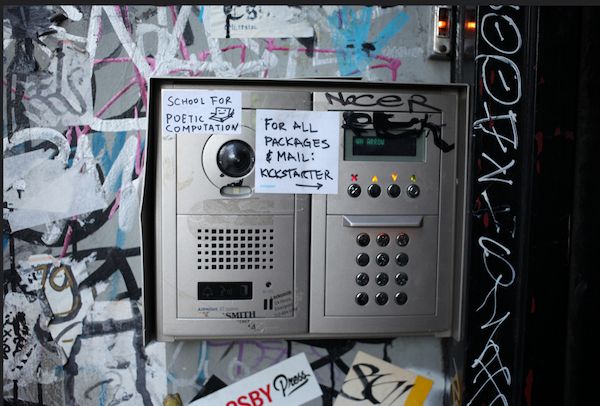
One point to emphasize is that this is not a school that kindly teaches you each technical skill from the beginning. To exaggerate a little, teachers functioned as ‘search-term suggestion engines,’ offering hints for solving the problems you faced. Students used those suggested terms as signposts, wandering the internet, recognizing their desires and technical limits, and devising ways around them. This approach is meaningful because what matters is not the technology itself but which technology you use and how.
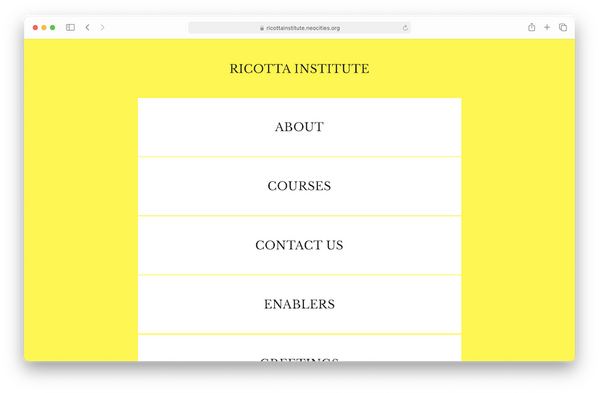
The final class was about making your own school: a chance for students to reverse roles and consider education from a teacher’s position. My proposal was the Ricotta Institute, where ricotta would be the focus for learning cooking, writing, coding, design, and marketing. New Order, which I run every Friday, is a prototype for the Ricotta Institute that will open someday. (You can experience the main concerns of this ‘liberal arts course for people today’ in New Order, presented at Art Sonje Center.)
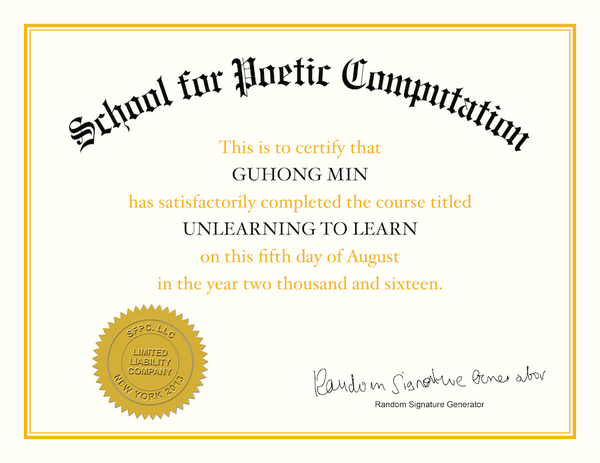
The school did not, however, have a proper diploma. What was the point of traveling across the Pacific to study if I had nothing to prove it? So, as my graduation project, I made a diploma generator and awarded diplomas to myself and my friends on the school’s behalf. In the place for the school’s official seal was each recipient’s own signature, randomly generated by Random Signature Generator.
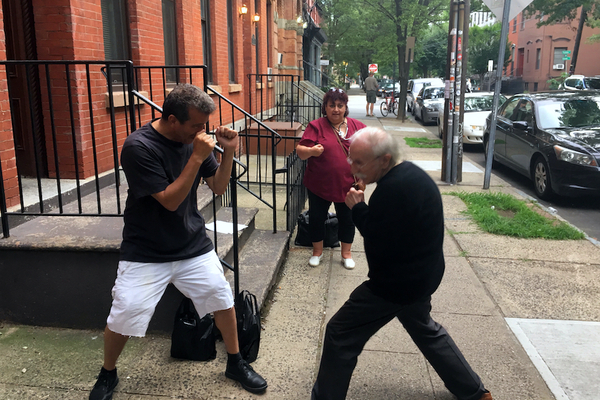
It was also a great stroke of luck to meet Louis (the man on the left in the photograph above) and Marilyn (the woman at the back), who said they wanted to adopt me, and Laurel Schwulst, another godmother of Min Guhong Manufacturing.
-
Online exhibitions are changing not only viewers’ roles but also how they view work. How can a viewer exist in an online exhibition?
Viewing an online exhibition on a website may feel different consciously, but it is not very different from browsing portals such as Naver or Daum or social media services such as Instagram. The website is placed in the context of an exhibition, but from the viewer’s perspective, only the template has changed. It may be a little troublesome, but viewers need to keep every possibility open and actively use the powers available to them—clicking, touching, scrolling—to explore the exhibition space provided on the website.
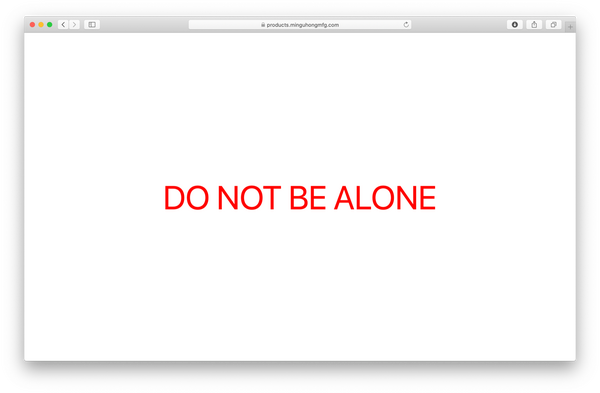
Min Guhong Manufacturing, Anything, Nothing, website, 2018. This website detects and prohibits almost every action a user can take in a browser, including moving the mouse cursor, clicking, touching, typing, resizing the browser, and waiting. Image courtesy of the artist. If you suddenly encounter an empty screen while viewing an exhibition, it may be worth using the browser’s built-in Web Inspector rather than assuming something has gone wrong. You might unexpectedly discover a message the maker has hidden.
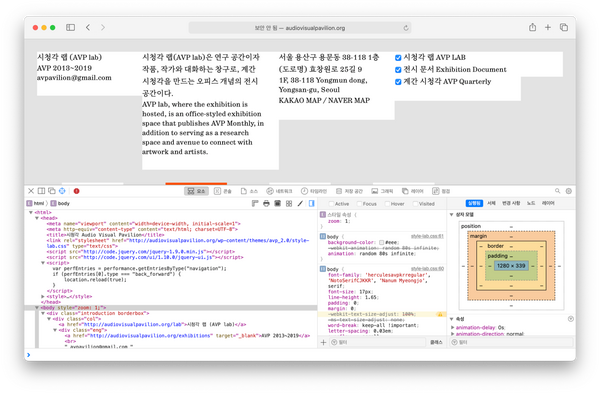
The Audiovisual Pavilion Lab website viewed through Web Inspector. Activating the inspector built into a web browser lets you examine the website’s structure and how it was made, and may even reveal messages the maker has hidden in the code. -
What distinguishes Choi Jeongho’s Hangul designs from earlier typefaces, or makes them an advance?
I don’t really know.
-
I am a student at the University of Seoul. Are there any minimum rules to observe when designing for the web?
There seem to be historical, economic, cognitive, and above all biological reasons why body text in a book is usually set at around ten points, or roughly 3.5 millimeters. That is a minimum rule, if you like.
The web is no different. Browsers set the default type size at sixteen pixels. Since that number comes from research by experts more capable than I am, I do not question it. Accordingly, I use sixteen pixels as one rem, the default unit, for all measurements. I make extensive use of divisors and multiples of sixteen everywhere. As some will know, this is not a methodology peculiar to me.
The other thing I keep in mind is that a website ‘runs.’ If a website is a space, tapping or clicking resembles moving between spaces. More taps and clicks mean a longer route. I try to keep that route as short as possible. As a result, I prefer to use a single page rather than create many pages, connecting its elements through scrolling. The page can naturally become very long, but that too is a natural characteristic of websites, and of the web.
-
So Ahn Graphics Lab is your host now! When I think about the web, I often forget how important the browser is. You have reminded me that web “publishing” also works within an existing framework. When you work on publishing, what freedoms and limitations do you encounter online and offline?
After more than a decade of editing printed books and websites, I find offline publishing resembles a game of ping-pong. The people making a publication broadly divide into editors and designers, passing the content back and forth like a ball until the work is complete. With online publishing—that is, websites—I oversee almost everything myself. Perhaps it is a game of ping-pong played alone. To me, this process is writing. It begins with coding, or writing, in a text editor and ends with troubleshooting, or revision. Along the way, I naturally consider the work’s structural, visual, and functional order. A website is not necessarily the only thing at the end of this writing. It would be nice if the process were as clear as products being assembled step by step on a factory conveyor belt, but in practice it is quite a mess. Like writing, or the web.
-
COVID-19 has begun to change even the traditional education system, which is rooted in physical spaces. Every week, you run New Order, described as ‘a liberal arts course for people today.’ As an in-person course, it seems almost antisocial at a time when social distancing is emphasized. Have you considered moving it online, like other higher education institutions?
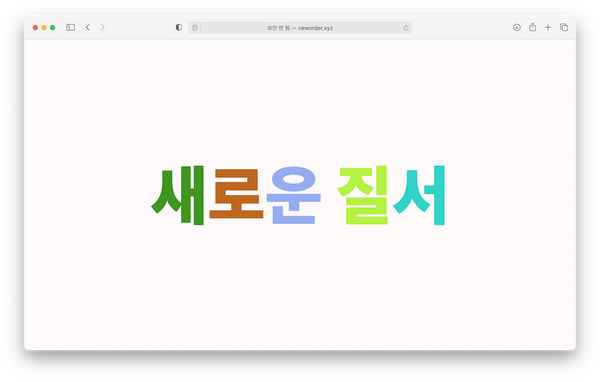
New Order is a course in giving information a new order and taking the lead as a medium transforms, using HTML (HyperText Markup Language), CSS (Cascading Style Sheets), and JavaScript (JS), the basic, foundational computer languages of the web. Together and individually, we try to answer this question: ‘How can the web contribute to our happiness?’ Most participants have felt something was missing from conventional school classes or online courses. I have experimented with online teaching for people whose circumstances prevent them from attending, but I think education works best when we face one another and make eye contact—even when the course is about the web. Of course, everyone must wear a mask, and we frequently clean our hands with hand sanitizer. Still, every class is followed by a period of self-reflection.

-
What is the concept of this event at COS?
Red letters that mean stop, prohibition, danger, or warning, but that might also give visitors an unexpected moment of delight, like the message in a fortune cookie.
-
What would it feel like to receive a website like this as a gift? I think I would look forward to my birthday every year. Are there any limits to making websites?
Seeing websites as an artistic medium is intriguing, but it also presents challenges. It creates tensions between technology and art, commerce and creativity, accessibility and experimentation. Yet these tensions make websites a richer, more varied medium.
-
Many of Min Guhong Manufacturing’s products are based on web technology. Unlike conventional sales, they are distributed on a donate-what-you-wish basis—effectively almost free. Does this come from the collaborative culture or open-source spirit familiar to developers? Or are there reasons involving the company’s “parasitic” operating model, publicity strategy, or technical limitations?
The web is one of several media Min Guhong Manufacturing uses to introduce itself. Perhaps that is why it is sometimes mistaken for a web design agency. We use the web mainly because it is easy to work with, has great reach, and, above all, is likely to be something people encounter just before falling asleep. Projects such as Beaker Browser have emerged to put decentralization into practice by focusing on the web’s philosophy of sharing. Still, the usual arrangement of renting space on a particular server fits the company’s principal survival strategy of parasitism. But as long as we achieve the original goal of introducing the company, the medium does not matter much. Given the opportunity, I would like to use traditional media such as newspapers, magazines, television, electronic billboards on buildings, painting, or sculpture. I am not averse to introducing the company in museums and galleries either.
-
Have you ever grown tired or bored of your current style?
Fortunately, not yet. As I have said before, I don’t think it will change much unless I suddenly become absorbed in hippies, naturalism, or traditional Korean dress. A few days ago, though, I had to wear a suit for a family gathering and went to a meeting at the National Museum of Modern and Contemporary Art in the same outfit. It occurred to me that living like this every day might not be so bad. People’s reactions were amusing, too. Even so, the default setting will remain unchanged. My mother, who dressed me exclusively in authentic Japanese-style Americana from childhood, is always displeased.
-
What do the ordinary web, Min Guhong Manufacturing’s web, and the pirates’ web have in common, and how do they differ?
Technically, there is no difference. Elon Musk got the Starlink project properly underway last year, but we still cannot properly access the internet without the undersea cables connecting continents. If a shark or sperm whale happens to bite and damage a cable, the internet goes dead. (Of course, that hardly ever happens.) The web is also a medium with clear constraints: it cannot even be viewed properly without the internet and a web browser. Yet it is also the last thing almost everyone encounters each night before falling asleep.
The differences must lie outside or beyond the technology. Technology is just that; what matters is how we define and use it. The pirates defined the web as “a region that belongs to no country’s territory under international law”—terra nullius. Inspired by that, I tried to use Beaker Browser. With this browser, a computer becomes both client and server. Users can exchange information without going through a central server. Combining websites and peer-to-peer networking, it attempts to decentralize the internet, but we did not manage to apply it to the actual project. There was not enough working time for various tests, and the browser was still in beta. It remains a regret.
-
To what extent should the difference between experiencing an artwork online and offline be overcome?
What if, from the outset, we allowed for a work to exist in two branches, online and offline? Or what if its original existed online, and the process of translating it into an offline form became an element of the offline work?
-
What kind of people do you like?
Intelligent people. Probably because I am not one myself. Intelligent people have a sense of humor, and a sense of humor makes someone attractive. That is, it makes you think of them from time to time. And people who can judge whether a sentence they have written is good or bad. Of course, only intelligent people can do that. Most such people also love themselves and, in my experience, are kindly disposed toward Min Guhong Manufacturing. And people with good manners. I would like the company’s clients to consist only of such people.
-
Could you describe the product-making process in a few words?
It is a process of solving problems—particularly the customer’s requirements—through editing. The term “manufacturing” gives some indication of how products are made. It originally means processing raw materials with human or mechanical power to produce goods, but in baseball it also refers to scoring through means other than hits, such as stolen bases, advancing runners, and sacrifice plays. Each product’s production process differs slightly, but the broad outline is similar: an order comes in, and we make and deliver the product. Of course, we also make products of our own accord.
-
What should we do to carry Choi Jeongho’s work forward?
Looking Choi Jeongho up on Wikipedia for today’s interview, I found the account very thin. Perhaps someone who wants to could start with something small like that. There is a book about him, but we could also make a website documenting his activities. For someone of his stature, establishing a type design award in his name would not be a bad idea. Turning typefaces that survive only as metal type or original drawings into digital fonts would give designers more choices. I see all these as different forms of documentation. In the process, Choi Jeongho would become a little better known than he is now, and perhaps others would benefit unexpectedly, as I did.
-
Virus Simulator, from 2020, is currently on view at DDDD. While your earlier products focused on introducing the company, this one takes the new infectious disease COVID-19 as its subject. Has Min Guhong Manufacturing changed since COVID-19?
At Min Guhong Manufacturing, the company is introduced in various ways: sometimes naturally, sometimes overtly, sometimes unexpectedly, and sometimes by relying on someone else’s reputation. This product also performs the task of introducing the company, even if all it does is place Min Guhong Mfg. among flowers, trees, stones, humans, and cherries in its world. Since COVID-19, we have received more inquiries about products and technical support, particularly from museums whose physical exhibitions were canceled. As a one-person company, we take a little time to respond, but we do so with sincerity, following the Min Guhong Manufacturing Email Response Guidelines. A Korean student intern who had been working remotely from Arnhem in the Netherlands also returned to Korea and spent a month at Workroom, the company’s host. The intern is now on a business trip to Jeju Island.
-
Thank you. Finally, is there anything you would like to say to the Yeonhui Literature Creation Village, which runs the webzine Biyu (비유)?
It is time for writers who use websites as their medium to take their rightful place in residence at the Yeonhui Literature Creation Village. Embracing websites as literature, in a manner worthy of literature, is another way for literature to link arms with “today.” That would be a path toward making something new, rather than a second or third Han Kang.