FAQ
- Anything to keep in mind?
-
Min Guhong Manufacturing hopes this FAQ will answer your questions about the company and the person who runs it. It brings together interviews, long and short, conducted since 2015, carefully compiled and then scattered into random order. Depending on when a question was asked, some facts may differ from those of today. Honorifics for people mentioned have also sometimes been omitted to suit the tone of the question. If you have read your way through the FAQ and still have questions, please tell us all about them at support@minguhongmfg.com. Min Guhong Manufacturing is ready to understand and acknowledge everything. Please look for a reply in the FAQ someday, though, rather than in your inbox.
-
Could Min Guhong Manufacturing ever leave its host and become independent?
No. Min Guhong Manufacturing is destined to close the moment it becomes independent. This is also why I have never registered it as a business, despite the many requests.
-
I heard you even had interns, as a proper company should. Could I apply too?
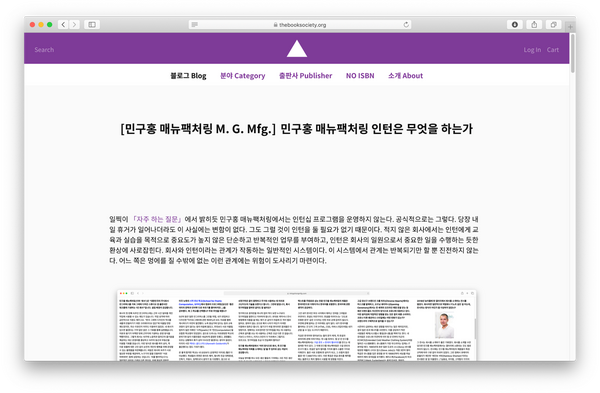
By then, a total of three people had passed through. The first intern, Song Yehwan, left after just one day. Time is not particularly important when the company and the intern both get what they want. Thanks to Yehwan, the company could demonstrate that it was sound enough to have an intern, and I gained a friend I can comfortably have tea with. For an account of internships at the time, please see this article.
For the current assignment and submission details, please see “Internships”.
-
I am thinking of writing a short paper about Min Guhong Manufacturing. Could you recommend any sources?

I recommend Rainbow Sherbet, Workroom Ghost and Archive Bomm, 2019. Here is the endorsement by the graphic design duo Sulki & Min on the back cover:
Rainbow Sherbet is a book that helps introduce Min Guhong Manufacturing. A few lines of introduction along these lines would be nice. It is a kind of trompe-l’œil, but since there is no separate preface inside the book, this seems a good place to use. Please limit it to around 160 characters, though.
-
Fashion brands have responded to COVID in their own ways: luxury accessories brand Chrome Hearts released masks, while Opening Ceremony closed all its physical stores worldwide. The people directly affected by these moves are ultimately consumers. How has your fashion or style changed since COVID? Could you name specific brands?
Following fashion as it shifts dramatically each season is fun, but it ultimately takes a lot of money and energy. People who find this difficult to sustain sometimes choose a system or a uniform. Quite apart from COVID, my clothing had already become somewhat systematized several years ago, rather like the U.S. military’s Extended Cold Weather Clothing System (ECWCS). IT is probably the industry where uniforms are most conspicuous. After visiting Sony’s Tokyo headquarters in the early 1980s and seeing some thirty thousand employees in matching uniforms, Apple’s Steve Jobs maintained his familiar outfit from 1998 until his death. Facebook’s Mark Zuckerberg favors a gray T-shirt, jeans, and Adidas slides.
When you think about it, everyone has a way of dressing. In my case, three main parts change according to the apparent temperature: top, bottom, and shoes. In midsummer, I wear a Printstar T-shirt, Gramicci or Gap shorts, and Rainbow Sandals flip-flops. On sunny days, I wear an Internet Archive cap, a gift from a friend when I was in New York. I intend to keep wearing it unless it falls apart. If it rains or is windy, I put on a K-Way windbreaker. From this base, as the apparent temperature drops, my top, bottom, and shoes change in that order. I add a gray Champion sweatshirt or hoodie over the T-shirt, replace shorts with Uniqlo chinos or Levi’s or A.P.C. jeans, and switch the flip-flops for New Balance sneakers. I once tried a pair of 992s I received as a gift, but the 530 or 996 seems to fit my feet better. Below 10 degrees Celsius, I wear an M-65 field jacket of unknown brand bought at a secondhand clothing shop in Busan; in winter, I add a Rab down jacket or Gloverall duffle coat. The T-shirts, which cost around 5,000 won each, are all replaced with the same ones after about a year. Everything else gets repaired when worn.
The strategy, in effect, is to establish specific but flexible rules—a kind of template—and treat each item as a module to combine and edit. The advantages are predictable spending and, as many people point out, being able to use the time spent choosing clothes for something else. Everything except winter outerwear can go through a washing machine’s normal cycle, so it is easy to care for too. Of course, for weddings and funerals, I wear a suit my uncle had made for me, with either Alden 9901s or Paraboot Chambords. But I avoid that outfit whenever possible.
This system emerged and settled naturally as I sought clothes I could wear comfortably for a long time without much thought. COVID merely added a mask. Unless I suddenly become absorbed in hippie culture, naturalism, or traditional Korean dress, I do not expect it to change much.
-
Min Guhong, who runs Min Guhong Manufacturing, has gone from being an editor (and designer and programmer) at Workroom to director of AG Lab. Will anything change at Min Guhong Manufacturing as a result?
No. And I hope nothing will.
-
Why did you later move to Ahn Graphics and begin running an ‘independent division of unknown identity’?
It was my fifth year at Workroom. I heard from Ahn Mano at Ahn Graphics: ‘Let’s work together.’ They were preparing for Ahn Graphics’ next stage, and I had hoped for an opportunity to contribute to the company that had brought me into design. That is how, with the title of ‘director,’ I came to take charge of an independent division of unknown identity called Ahn Graphics Lab, shortened and commonly referred to as AG Lab. In fact, my reason for deciding to move was trivial: the office was really close to my home. It is beside the park in Yeonnam-dong, Gyeongui Line Forest Park, a two-minute walk away. I have been running it for about a year now. I think AG Lab may be something like an add-on or plugin needed to upgrade the software called Ahn Graphics. Perhaps it would be right for it to fulfill its role quickly and disappear.
-
I graduated from Paju Typography Institute. How does combining typefaces differ between paper books and websites?
The concept is the same. The difference lies in the method. In CSS, the ‘font-family’ property, which controls typefaces, supports fallback. Put simply, you specify several typefaces, and if the first font does not support a glyph, the next font takes over. This allows basic, if not particularly refined, mixed-script typesetting. With the help of JavaScript, things become a little more complicated, but you can use regular expressions to automatically assign styles to the characters of each writing system—Hangul, the Roman alphabet, Chinese characters, kana, and so on—just as in InDesign. Multilingual JS, made by Won-Young So at MIT, a fellow SFPC alumnus, and E Roon Kang at The New School, is a representative JavaScript plugin for this. I used it to good effect on Typojanchi 2021: Turtle and Crane and the Busan Biennale 2022, among others. Although a full six years had passed since its last update, it worked without any trouble. I would like to take this opportunity to express my respect for them both. You can also go further and customize a font to make a complete multiscript font that requires none of the tricky settings I mentioned. Noto Sans, jointly developed by Google and Adobe, is a representative example.
-
Min Guhong Manufacturing says it ‘focuses on introducing the company—that is, Min Guhong Manufacturing itself—in various ways.’ Why are you so devoted to ‘introduction’?
At the root of every productive activity is a desire to introduce something, and ultimately oneself. In the face of this desire, Lee Ufan, Virgil Abloh, and an artist holding a first solo exhibition at Mapo Lifelong Learning Center are no different. Besides, introduction is a necessary step, something you have to do anyway. I believe a story can begin even if you concentrate on that alone. That is what makes introduction worth questioning. Min Guhong Manufacturing is the result of becoming a little more conscious of this desire and giving it a form. If ‘water drops’ were the subject Kim Tschang-yeul had to investigate, then for Min Guhong Manufacturing that subject is ‘introduction.’
-
What music did you listen to most this year?
I have never counted precisely, but I think the answer would be similar every year, not just this one: Apurimac, released in 1985 by the German band Cusco. ‘Can you travel through the ancient Inca civilization using nothing but synthesizers?’ This album gives a clear answer. None of its tracks have lyrics, so it makes good background music while working in the office. ‘Flute Battle’ and ‘Inca Dance’ in particular may be familiar to readers who enjoy documentaries. A piece I cannot rank above or below it is ‘Twin Peaks Theme,’ composed and performed by the American musician Angelo Badalamenti. It is the opening theme to Twin Peaks, the American drama that captivated the 1990s. Since learning that all seasons are available on Watcha, I have listened to it with childhood memories each time I watch. It is also a piece that makes me want to learn the piano again. For the record, the emotion doubles if you watch it with the opening sequence directed by David Lynch and edited by Duwayne Dunham.
-
How are Min Guhong Manufacturing’s technologies used at AG Lab?
Please take a look at the following. They need no further words.
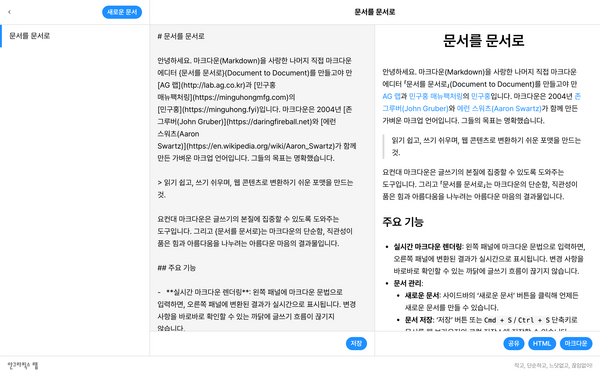
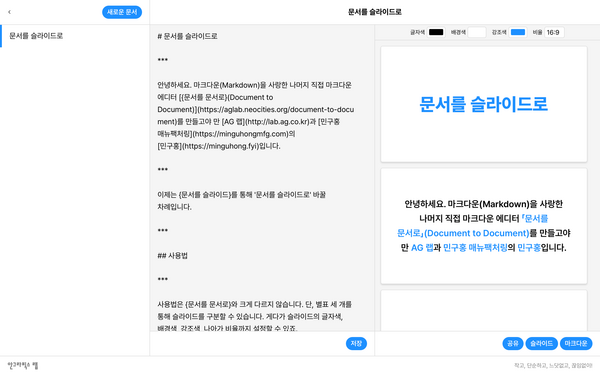
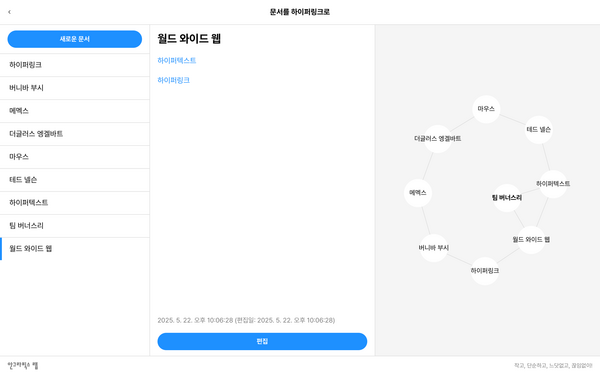
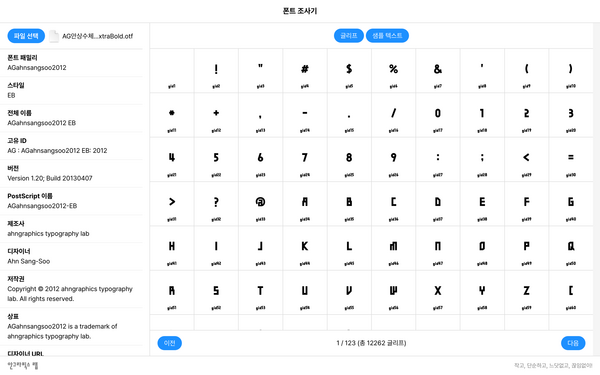
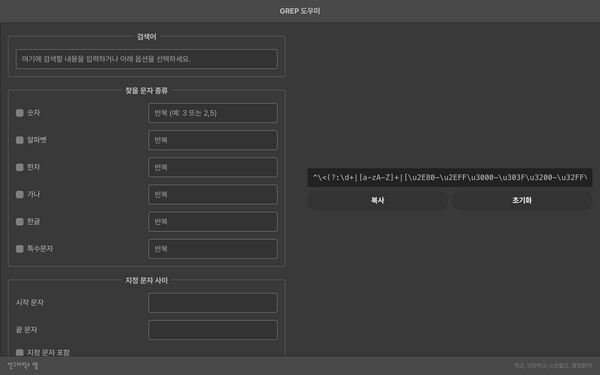
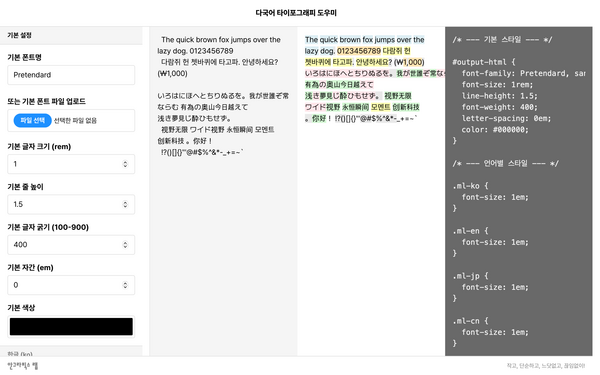
You might also visit the sprout, spore, or offshoot of AG Lab, itself a sprout, spore, or offshoot of AG and Ahn Graphics.
-
Where did you sit most often? At your studio desk, a favorite café, a park bench…
Probably my desk in the inner room at Nalgae.jip and Yri Café. When I left Nalgae.jip around seven, I would go to Yri Café with friends from the studio and talk over tea until late into the night. I also wandered aimlessly with my girlfriend, now my wife. I am not sure why, but we often went to Namsan. We frequently got lost, but it was not frightening because all we had to do was make our way down somehow.
At twenty-five, I lived without thinking much, and perhaps that openness of body and mind let me experience a great deal. In particular, I met many good people. That twenty-five-year-old is still inside me, and even sixteen years later, I still spend each day feeling, as I did then, that none of it is such a big deal. Incidentally, I am on a business trip in Japan right now, and the same goes for this hotel lobby, where I got up at dawn to write these answers. Days that are nothing special accumulate and eventually become a life that feels like mine. I want to say this to my twenty-five-year-old self, and to Hyunji, who is twenty-five now: it is okay not to plan. Things will not go according to plan anyway, just as I had no plan to wake at dawn today. Because that is being twenty-five. Because that is life.
-
I am a graduate of Paju Typography Institute. Do you have criteria for judging how well a website is finished?
The criteria will vary enormously depending on what a website talks about and how. As I mentioned earlier, shouldn’t it at least work properly in a web browser? Even that alone involves endless considerations. This may seem unrelated, but I would like to talk about a kind of writing. One principle of good writing I learned while studying literature is not to repeat yourself. Occam’s razor—the idea that, given two statements about the same thing, the simpler one is preferable—is a similar principle. I think it applies perfectly well to websites, including their code: combining duplicate elements or functions, for example. This requires repeated revision, just as writing does. It can be arduous, but it has to be done. Even a website consisting of a single sentence can turn out very differently depending on how much revision it has undergone.
-
An ordinary website organizes information so it can be understood at a glance. On websites by Min Guhong Manufacturing, by contrast, information is fragmented, hidden behind effects, or gradually revealed over time. Why do you use these forms? The interactive elements whose effects change with the mouse position are interesting too. Why present this kind of design?
A departure from convention can exist only because something familiar exists. It is less about my own desires than the feeling that this approach fits the content. These designs already existed in the web’s early days. To me, they look quite ordinary. When the technology of the web was still new, people made spaces of their own in all kinds of ways. With limited technology and no established visual rules, the results were all different. Websites that have passed through Min Guhong Manufacturing’s hands are closer to variations on, or reinterpretations of, a briefly forgotten ordinary web than to radical experiments.
At the suggestion of Choi Sung Min of Sulki & Min, I once translated Forget All the Rules You Ever Learned About Graphic Design. Including the Ones in This Book. by the legendary American graphic designer Bob Gill. There is a line in it: “Interesting words need boring graphics. Boring words need interesting graphics.” It means that words and graphics need balance to work together. I prefer the words to be interesting rather than the graphics, so I tend to spend my time thinking about how to handle them. The websites that pass through Min Guhong Manufacturing are, in fact, applications of basic, elementary techniques. Looking at the code, anyone could follow along. If they feel unconventional, it is probably because of the words rather than the graphics.
As I have said many times, Min Guhong Manufacturing is not a web design agency. I think of myself as writing and editing in the way I enjoy and do well, rather than designing websites. A website is one possible result. Somehow, it also happens to meet someone else’s desires. There are not many, but the clients who love this approach have allowed Min Guhong Manufacturing to scrape by until now.
-
Do you use a content management system such as WordPress when making websites?
Not unless I have no choice. They say a third of the world’s websites are made with WordPress, but I find it excessively heavy. It is like trying to take the KTX high-speed train to a park near your home. Besides, although WordPress plugins are varied and convenient, they are close to the worst possible option for maintenance. Because of this, even ‘Code is poetry,’ the phrase at the bottom of WordPress’s official website, feels excessively lyrical. Min Guhong Manufacturing uses Management, our own customization of open-source software that overcomes WordPress’s drawbacks, and we actively recommend it to clients. Why not experience the details firsthand as a client? Of course, sometimes hard coding—entering the content and code one stitch at a time—is the most time-saving method.
-
Speaking of which, in a recent interview with Naver Design, you said HTML and CSS were your strongest languages after Korean, English, and Japanese. How do they work in the process of making a website?
HTML gives content a conceptual structure and context and currently supports 113 tags. These tell the browser which parts are headings, paragraphs, images, or captions. As the common denominator of all web technology, HTML conceptually corresponds to typography in graphic design. CSS gives style to content whose structure and context have been established by HTML. Here, style includes macrotypography and animation as well as microtypography, and is created through the 129 properties CSS currently supports. Roughly speaking, an important part of making a website ultimately consists of combining and editing 113 HTML tags and 129 CSS properties. Even by a minimum calculation, the possible combinations approach infinity: 106,559,732,167,812,574,200. HTML and CSS may be the easiest languages to learn. They are not programming languages that perform complex calculations, but the more you explore them, the more they offer to consider about ‘coding as writing.’ For particular functions, you also need languages such as JavaScript (JS) on the front end and Java, PHP (PHP: Hypertext Preprocessor), or Python on the back end.
-
Do you have plans to promote products on television or radio, on subways or buses, or in office buildings and apartment elevators?
Whenever I promote a product, I recall the British singer George Michael’s maxim: “It’s better not to know a good friend’s careless whispers.” Still, depending on the product, there is no reason not to.
-
Metal chopsticks are said to require surprisingly advanced skills because they are heavy and blunt at the tips. But tell me: if you are good with chopsticks, are you good at handwriting too?
Picking up braised soybeans one at a time with chopsticks makes me feel that I am better with them than anyone. Yet I have rarely liked the way I write my name on a contract or in an exhibition guestbook. The strokes tend to head somewhere I did not intend and stop at an awkward point. If the writing implement happens to be a brush, the result is even worse. I am not entirely sure, but the muscles used for chopsticks seem a little different from those used for writing. Or perhaps I am simply more accustomed to a keyboard, mouse, or touchscreen. Should I practice with chopsticks a little more?
-
Hello. I would like to request a written interview with Min Guhong Manufacturing. I have listed the questions below in Times Blank, known as the company’s custom typeface. There are quite a few questions, and I would appreciate answers to all of them.
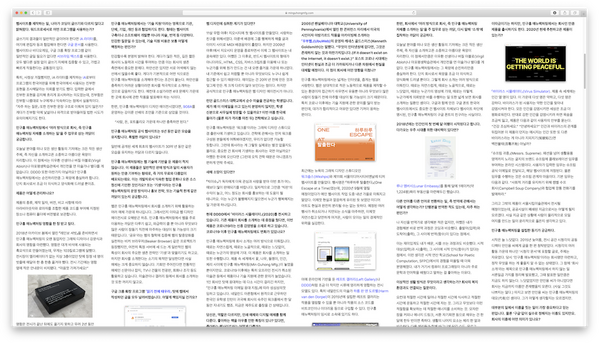
Pleased to hear from you. Looking through them one by one, most seem to concern matters already discussed in interviews. Why not first consult the FAQ on Min Guhong Manufacturing’s official website? If anything is still missing, please feel free to contact us again.
-
Since 2019, you have held New Order every Friday, describing it as ‘a general-interest course for modern people.’ What does the course cover, and how can people take part?
The final assignment at the School for Poetic Computation was to plan a school we wanted to create. I proposed the Ricotta Institute, a four-week school where you make ricotta, write about ricotta, make a website containing that writing, and finally learn how to market ricotta. At the time, I thought ricotta, writing, coding, and marketing were the essentials that kept contemporary industry running.
New Order is something like a prototype for the Ricotta Institute, which will open someday. It began with an unofficial workshop at Workroom on the day after Christmas in 2016. The curriculum was refined through classes at Paju Typography Institute and various special lectures and workshops. Since 2019, generous support from Studio PIE and Tastehouse, run by young artists such as Park Hyun-jung and Don Sunpil, has allowed it to grow into its current form.
New Order, held over six weeks at Studio PIE in Seongsan-dong, Mapo-gu, is not a web design course. Although it touches on design as a technique, it is closer to a writing course. We discuss coding from the perspective of ‘practical and conceptual writing.’ First, participants look at themselves and write about their interests. Then they use HTML, CSS, and JavaScript in turn to give the content a new order. Along the way, we discuss the history of the internet and the web, attitudes to maintain, net art, and computer languages themselves. By the end, you can at least make a website like this without much difficulty—provided you prepare and review thoroughly.
Some people who made memories together at New Order formed a loose collective called ‘After New Order…’ Recently, they achieved the distinction of being selected for Project Hashtag, organized by the National Museum of Modern and Contemporary Art and sponsored by Hyundai Motor. I hear that Hito Steyerl, who was on the jury, strongly recommended them. This November, we will be able to see the results of their thinking and enjoyment, won’t we? While running a workshop at the museum a few days ago, I had a glimpse of their work in progress. I hope the exhibition will become a lasting memory for them.
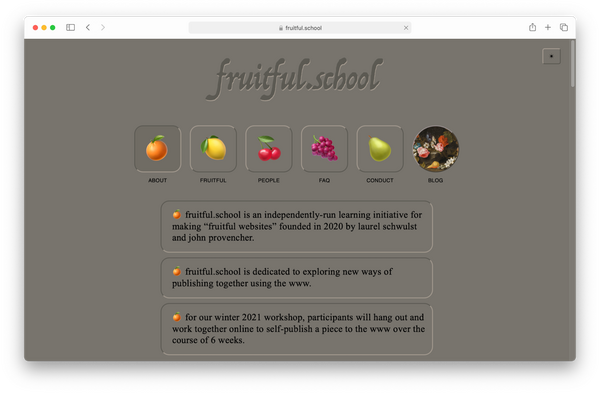
Recently, I also ran a four-week workshop for resident artists at SeMA Nanji Residency. For now, we have temporarily closed because social distancing has been raised to Level 4. I have had inquiries about private lessons, even online, but I decline them. Even when dealing with technology, I think time spent talking face to face matters. Our sister school is Fruitful School, run by the American graphic designers Laurel Schwulst and John Provencher.
-
Order and tidiness seem to be second nature to you. Is disorder an accident for Min Guhong? Could you give an example of a disorderly situation you have encountered and explain the sequence in which you devise a response—or sometimes choose not to?
What interests me is not order itself but the process and manner of giving something order. Of course, in some situations I obsess over order to a ridiculous degree, but not everything can be edited into a perfectly tidy state. The National Institute of Korean Language’s attempts to replace every foreign loanword with a Korean alternative demonstrate this. However faithfully you try to follow a set of principles, a situation beyond your control inevitably arises that undermines them, forcing you to add awkward supplementary rules. So my desk and its surroundings, not to mention my home, are far from orderly. As with the web, where all kinds of content and technology mingle—or, closer to home, our own lives—it is better for your mental health to accept that a complete mess is the natural state of things.