FAQ
- Anything to keep in mind?
-
Min Guhong Manufacturing hopes this FAQ will answer your questions about the company and the person who runs it. It brings together interviews, long and short, conducted since 2015, carefully compiled and then scattered into random order. Depending on when a question was asked, some facts may differ from those of today. Honorifics for people mentioned have also sometimes been omitted to suit the tone of the question. If you have read your way through the FAQ and still have questions, please tell us all about them at support@minguhongmfg.com. Min Guhong Manufacturing is ready to understand and acknowledge everything. Please look for a reply in the FAQ someday, though, rather than in your inbox.
-
How much further can technology for online exhibitions develop?
I am not sure. Think of early e-books, which used all kinds of technology to recreate turning pages. They were briefly amusing, and that was all. Technologies such as augmented reality (AR) and virtual reality (VR) have appeared, but even Google, a leader in web technology, proposed extreme magnification of artworks on its online exhibition website Google Arts & Culture.
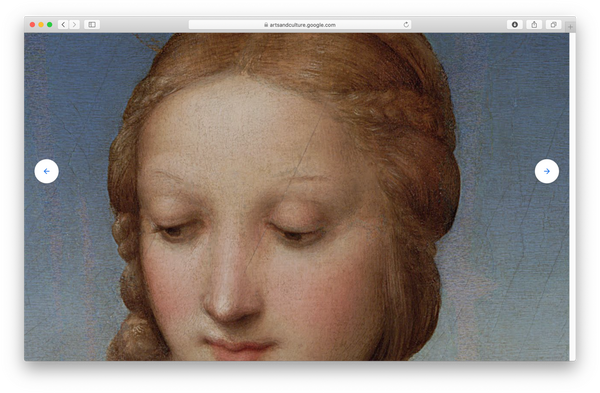
Google Arts & Culture. You can magnify works enormously and inspect even the brushstrokes, but… Websites made through Min Guhong Manufacturing are technically so simple that anyone could imitate them by looking at the source code. What matters is how technology is used. It may be a prejudice, but websites that flaunt technology or visual effects too much make me suspicious of their content. In my experience, this was a last resort when the content was too weak to salvage. It feels like indiscriminately dressing up in high fashion. If a handful of effects also slows down loading, that is the worst. Personally, I like websites that look plain but reveal a humorous or eccentric side the more closely you look. Of course, I do not insist on my personal taste when working, but taste tends to reveal itself naturally in the result.
-
Your attitude toward content, before design even enters the picture, is interesting. Do you have a favorite website?
I was asked the same question recently in special lectures at Fruitful School and Kaywon University of Art and Design. My answer is always the same.
It is the first publicly available website, made by Sir Tim Berners-Lee. The content of this website introducing the web is so elegant and practical that I want to translate it with care. Besides, it still works perfectly well some thirty years later. It uses default styles: a white background, black text, and underlined blue links. This website clearly embodies what Min Guhong Manufacturing pursues.
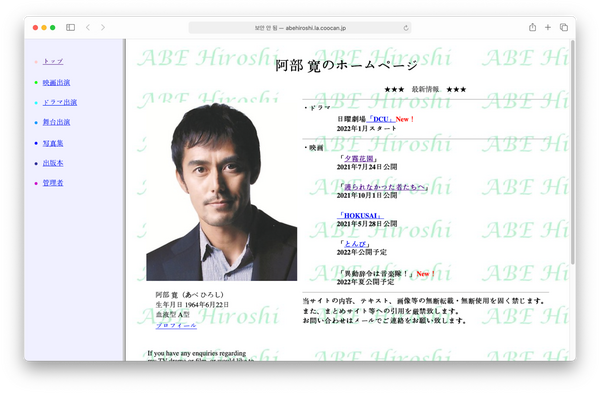
Though not quite as much as the first website, I also like the official website of the Japanese actor Hiroshi Abe. I once wrote about it in Littor, issue 24. Around 1996, the actor adopted a fan-made website as his official site, and it has retained its appearance ever since. At first glance, it looks as though someone who had just started learning web technologies made it, but its information is still kept up to date. It also contains things that are hard to find elsewhere, including old photographs of the actor and essays. Perhaps the tastes of an actor who still drives an old hatchback have something to do with a website maintaining the same style for around twenty-five years?
The two websites I mentioned have an aura that is hard to explain, thanks to the time accumulated in them. They are evidence of content taking command of design. The websites of Young-Hae Chang Heavy Industries and Haegue Yang are in a similar vein. If the content is beautiful, style may not matter very much. This cannot apply in every case, but in many cases you can edit the situation to make it possible.
-
After reading the yellow letters blinking against black for about an hour, almost as a meditation, it seems to me that both “you” and “this” refer to a “website.”
That is one possible reading. Information that once required searching libraries or seeking out experts now pours out when we type just a few characters into a search box. But look behind this for a moment and, as I continually experience myself, deep thought disappears, leaving only clicks and likes. We know more than yesterday, yet perhaps understand nothing. Meanwhile, our personal information is constantly collected and analyzed, sometimes even sold without our knowledge. As the futurist Nicholas Carr warned in The Shallows, our brains grow increasingly accustomed to processing fragments of information. Like Pavlov’s dogs, we respond reflexively to notification sounds. As we endlessly scroll through social media, what have we gained, and what have we lost?
-
I tend to believe that naming is the most important part of most things, though some names, like “Google,” arise by mistake. What does your company’s name mean?
“Manufacturing” generally refers to the mass production of goods by processing raw materials with human or mechanical power. In baseball, however, it also means scoring through means other than hits, such as stolen bases, advancing runners, and sacrifice plays. I wanted the company name to express a will to put the word’s functionalism and opportunism into practice.
-
Did these circumstances affect how the pirates’ voyage was designed and implemented?
Virtually not at all. Min Guhong Manufacturing’s attitude remains the same, regardless of COVID. In short, centering on the basic, fundamental technologies that make up the web—HTML, HyperText Markup Language, and CSS, Cascading Style Sheets—we try to use other computer languages within constraints and according to context, with an almost obsessive purity, and sometimes with an irregularity so complete it becomes pure. Of course, we introduce cutting-edge technologies when necessary, though that may take a great deal of time in some cases. This is related to the inexplicable faith in technology I mentioned earlier: not in the technology itself, but in how it is defined and used. It is the same reason graphic designers do not use every single feature of InDesign, or have no need to. I believe that if the content is beautiful, its vessel naturally acquires a certain aura without special decoration or devices—even if you leave it entirely untouched. In other words, if the outcome was meaningful or successful for the pirates, all the credit belongs to them.
-
What is included on the Welcome to Min Guhong Manufacturing ROM cartridge sold by BEM?
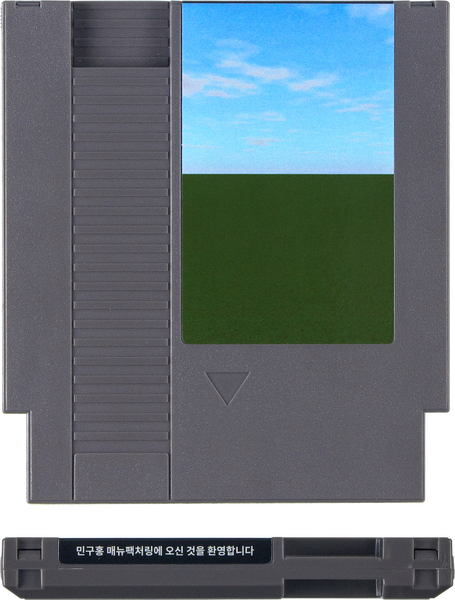
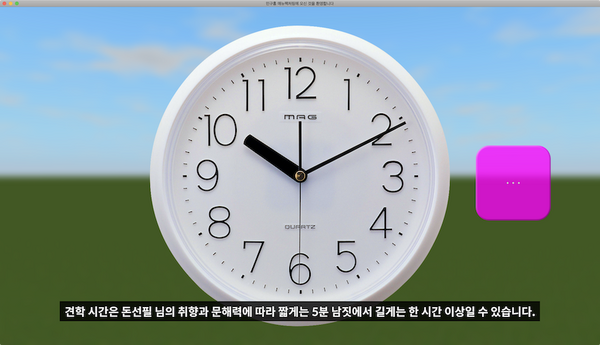
Along with the game, it includes annotated source code so you can take it apart and alter it to your heart’s content. Unfortunately, I am told it is now sold out.
-
Min Guhong Manufacturing has maintained that beneath every productive activity lies a precious and beautiful desire to introduce something and, further, the producer themselves. As we talk, everything seems to converge on “introduction.”
Exactly. Ultimately, it depends on how you introduce something—taste—and how much—ambition. And why would that apply only to online exhibitions?
-
What prompted you to establish Min Guhong Manufacturing?
Beginnings are always sudden. In late summer 2015, Ahn Inyong, co-director of the exhibition space Audiovisual Pavilion, commissioned a piece of writing from me. It was for Audiovisual Pavilion Documents, one of the space’s activities, and the subject was open. At the time, I had come up with the company name “Min Guhong Manufacturing” but had no idea what it should actually do. I took the opportunity to compile and publish thirty-seven things Min Guhong Manufacturing does not do under the title About the Company. To this day, I still do not do those things. It happened suddenly, but without Ahn Inyong, the company might still exist in name only. (That would not be bad, either.) In a sense, Ahn Inyong is Min Guhong Manufacturing’s godmother, though I do not know what she would make of that. In any case, I thank her whenever I can. I almost feel I ought to pay her a visit on every holiday.
-
At this point I am curious about Min Guhong, the person who loves websites so much. Do you remember the first website you made?
Of course. It was in 1995, nearly thirty years ago, when I was around eleven. The goal was simple but very clear. I just wanted to make someone I loved happy. Unfortunately, my first website disappeared when GeoCities closed. I had not backed up the files, so it now appears only in my dreams, which is a shame. In any case, that experience born of love allowed me to immerse myself seriously, from an early age, in computers, the web, and writing, including coding. The same held true when I studied literature and linguistics at university, met Ahn Sangsoo by chance and entered the art and design world, and then worked for some thirteen years at Ahn Graphics and Workroom as an editor, designer, programmer, and more. If you are curious about me, please refer to this website.
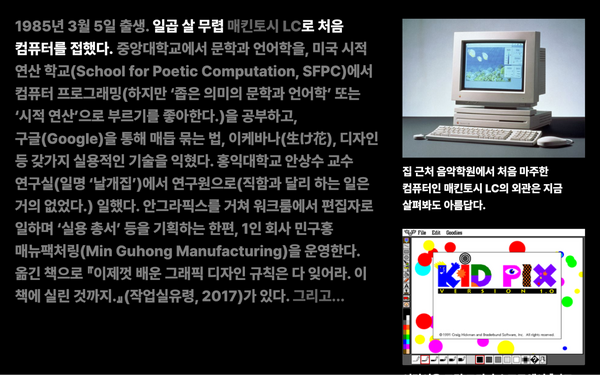
The following presentation, which gathers my thoughts on my writing—including coding—may also help a little. “Writing is the act of capturing and revealing thoughts and words that are about to disperse and disappear through a particular medium: not only written characters—letters, numbers, symbols, and so on—but also space.”

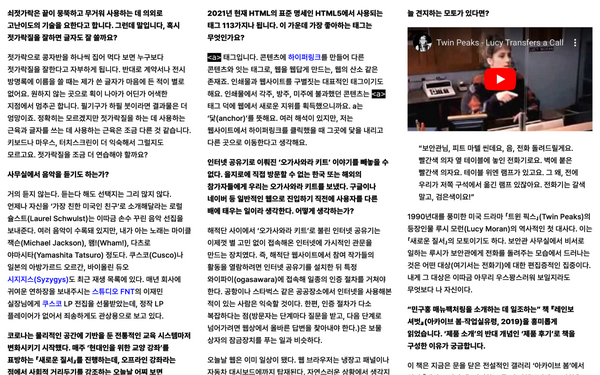
In 2015, I founded Min Guhong Manufacturing, believing solely in the power of the web and writing. It was a beautiful time, when studios carrying the prefix “small-scale” were appearing in the wake of Sulki & Min and Workroom. Short of capital and courage, I held to a policy of living parasitically at my workplace. As I accumulated memories with institutions, organizations, companies, and individuals, the company’s tenth anniversary somehow drew near. For more about Min Guhong Manufacturing, please refer to this website.
-
How do you think online and offline publications will develop, and what direction should their design take?
The familiar format of the paper book was completed with the invention of the codex over a thousand years ago. As content moved out of scrolls and into the codex, readers could consult information more easily and quickly. Today, materials and production methods have diversified, but the format of bound, trimmed sheets of paper remains unchanged. In Korea, the independent publishing boom of the early 2000s brought more producers into the world of paper books, leading to a phase of extreme experiments in content and form. At the same time, consumers’ tastes became more individual and sophisticated. When every area of a field reaches a uniformly higher standard, an interesting phenomenon often occurs. People feel a vague aversion to the present or turn their eyes back to the past. Once this phenomenon ends, new producers and consumers enter the field, and a new order emerges. Yet even new experiments in paper books cannot escape the codex’s field of influence. When it comes to the future of paper book design, I can only discuss personal, microscopic matters that interest a few producers and almost no consumers—for example, the proper vertical position of quotation marks. On websites, content leaves the codex and returns to the scroll. This will probably never happen, but if we were to limit websites to publications, might they go through a similar process to paper books?
-
I am thinking of writing a short paper about Min Guhong Manufacturing. Could you recommend any sources?

I recommend Rainbow Sherbet, Workroom Ghost and Archive Bomm, 2019. Here is the endorsement by the graphic design duo Sulki & Min on the back cover:
Rainbow Sherbet is a book that helps introduce Min Guhong Manufacturing. A few lines of introduction along these lines would be nice. It is a kind of trompe-l’œil, but since there is no separate preface inside the book, this seems a good place to use. Please limit it to around 160 characters, though.
-
What would Min Guhong Manufacturing like to try doing through the web in the future?
When I write, I often want to control the form of the writing and then even make letters suited to that form. It is a natural desire to command every element surrounding the writing. Making websites is enjoyable, of course, but I would like to help lay the foundations on which websites are made. I imagine making a browser or contributing to the next HTML and CSS standards. That would be for future colleagues as well as for Min Guhong Manufacturing.
-
Could Min Guhong Manufacturing ever leave its host and become independent?
No. Min Guhong Manufacturing is destined to close the moment it becomes independent. This is also why I have never registered it as a business, despite the many requests.
-
Does Min Guhong Manufacturing have any principles it always follows when making a website?
A good question. I try to follow the National Institute of Korean Language’s rules for Korean spelling and foreign-word transcription as closely as possible. In my experience with projects online and offline, focusing on the basics sometimes allows the result to emerge naturally. I also do not question the browser’s default font size of sixteen pixels. Everything else is just a detailed rule that changes from job to job.
-
Besides About the Company, published as the thirteenth Audiovisual Pavilion Document in 2015, another work that made Min Guhong Manufacturing memorable was the School for Poetic Computation exhibition website, School for Poetic Computation Presents Society for Power Control (2016). It served both as publicity and as an online exhibition. How was it made?
This website was itself an exhibited work, but its main purpose was to announce the school’s upcoming exhibition. As I recall, the available content consisted only of an exhibition outline—purpose, venue, dates—and the participants’ names and biographies. Even the work titles were not yet decided. Allowing time for publicity, I had only about a week to work. It needed editorial skill to weave these materials into a plausible story.
First, inspired by the school’s acronym, SFPC, I established a temporary organization called the Society for Power Control, also SFPC. Every work made with a computer was, after all, the result of controlling electrical power.
With little content, I limited the website to one page and arranged it to be browsed by scrolling. I divided the screen into two main sections, an index and details, and gave every hyperlink a randomly shaking animation. When visitors hovered over a link, it stopped shaking; clicking scrolled to the relevant content. The intention was to give visitors an experience of controlling power inside a browser. Meanwhile, all the content was centered, which I intended to insist reflected power concentrated in the center from every edge of the screen. (As you can see, concepts sometimes come afterward.) Times New Roman reflected my preference for a technically stable web-safe font over an unusual web font. I am proud of it as a result that joined concept and function using limited content in limited time.
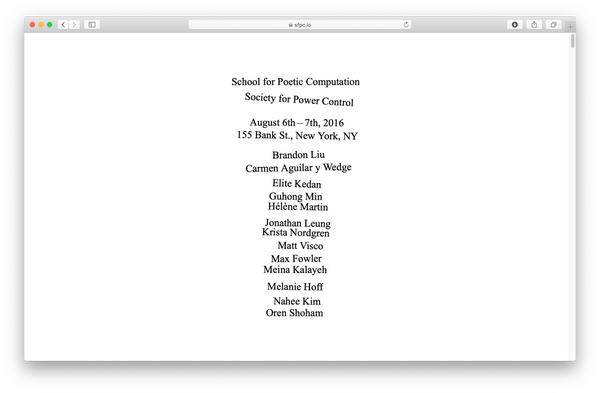
Min Guhong Manufacturing, School for Poetic Computation Presents Society for Power Control, 2016, website. Image courtesy of the artist All the participants liked it, but trouble arose somewhere unexpected. The school seems to have wanted something a little more “ordinary.” In particular, it apparently felt there was something mischievous about “SFPC Presents SFPC,” the exhibition title that had naturally followed from naming the organization. Suddenly having to persuade the school in my clumsy English, as the participants’ representative, was a little trying. But in the end, we kept the original intention. My English writing and speaking improved considerably in the process.
-
When you joined Ahn Graphics, did you expect to lead a life so close to design? How did you feel about taking a path different from your university major?
I naturally joined Ahn Graphics as a project I had been working on at Nalgaejip went on longer than expected. I was twenty-six, in my fourth year of university. If you call that chance, it was chance, and it was my first experience of working life. Since then, I have often been asked in interviews about my major and what I do now, or questions such as, ‘I didn’t major in design. Can I work as a designer?’ My answer is always the same. I am proud of my university and my major, but I do not worship them. In other words, I did not think they would determine my entire future. Perhaps because I studied literature, I had little desire, even so, to live as a poet or novelist. I simply wanted to write well and handle writing well. That naturally led me to typography, a technique concerned with the form of writing. Then I came to know Ahn Sangsoo. Typography is just one of several stepping stones, rather than the endpoint of that interest. Someday I might run a startup, release hip-hop music, or move to Japan—as long as it helps with what I consider my writing. In the end, I think literature taught me how to handle language and how to weave a world with it. Whether I am authoring, editing, translating, designing, or programming, I always feel that I am writing.
-
As the graphic design duo Sulki and Min’s introduction suggests, you have many titles—writer, translator, programmer, designer—but I hear you insist on ‘editor.’ How does your work relate to editing?
In publishing, ‘editing’ is often used narrowly to mean proofreading and copyediting, but I regard it as an activity that includes creation. I first became conscious of ‘editing’ in the early 1990s, when I encountered computers and was engrossed in games. Software commonly called ‘game editors’ let you manipulate a game’s database, changing not only a character’s statistics but the game itself. So my first experience of editing was ‘taking control of an established framework from within and without to influence the situation.’ My view has not changed much. I approach exhibiting work in museums and galleries, as well as making websites, with an editor’s mind. I also like the drabness of the word ‘editor.’ As the scope of my editing has broadened, though, the books I am responsible for have been delayed. I barely managed to complete the recently published All-In Fighting. I can only apologize to the authors and translators who understand me and wait without a word. I would like to take this opportunity to send them my regards.
-
Is it the thirty-odd years that have passed? It seems unrelated to design, yet has an aura of its own.
That is a welcome attitude. Design is not the only thing that gives something an aura. In the mid-1990s, a new community emerged on the web, and GeoCities in particular was its meeting place and playground. Fluorescent backgrounds, blinking GIFs, visitor counters, under-construction icons… They look somewhat comical now, but at the time they were as cutting-edge as ChatGPT is today. Just as early humans painted on cave walls, these people learned to express themselves in HTML. I was one of them.
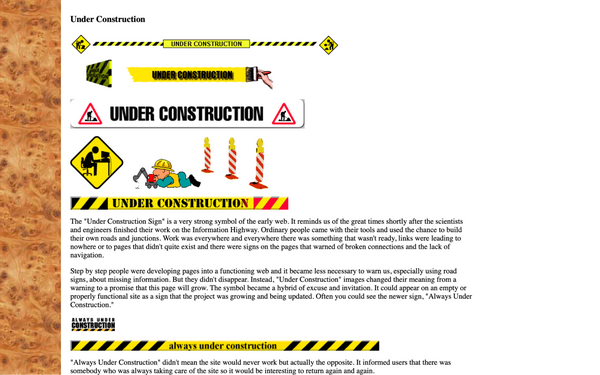
In particular, through Vernacular Web, Olia Lialina has continually explored the aesthetics of the early web, which today’s web designers would do well to reflect on. “The ‘under construction’ image changed from a simple warning into a promise that the web page would keep growing. It contains a mixture of apology and invitation.”
-
Min Guhong Manufacturing’s official website seems not to follow the usual formula for a design studio website.
I have been using cheap web hosting since 2015. It is too slow to display images for every product, so I am simply following its constraints. Besides, Min Guhong Manufacturing is not a design studio.
-
Since 2019, you have held New Order every Friday, describing it as ‘a general-interest course for modern people.’ What is this course that fills up every time it opens?
New Order began with a private web seminar at Workroom on the day after Christmas in 2016. I had just returned from New York after finishing the School for Poetic Computation. I thought that learning web technologies as ‘general knowledge for modern people’ would help Workroom’s members in their work, in one way or another. The curriculum was gradually refined through special lectures, workshops, and classes at Paju Typography Institute, until it reached its current form. So far, I have made memories with about two hundred ‘friends of New Order.’ Some were selected for the National Museum of Modern and Contemporary Art’s Project Hashtag, begun in 2020, and unexpectedly found themselves in the art world.
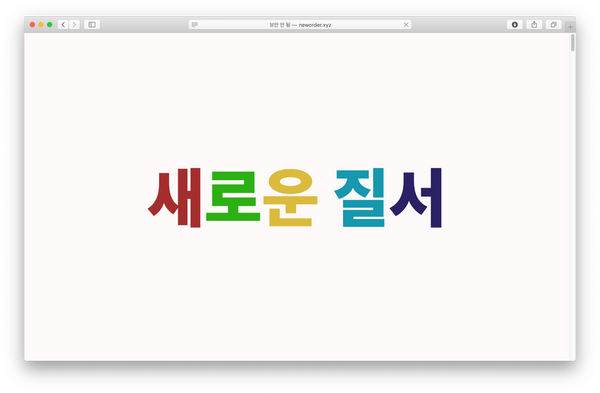
Min Guhong Manufacturing, New Order, website. Each individual letter in the website’s title, ‘New Order,’ is given a new order every second. Image courtesy of the artist.
Although New Order deals with design as a technique, it is not a web design course. It is closer to a course in ‘practical and conceptual writing.’ Friends of New Order produce their own content based on their interests—things they like, things they dislike—and learn computer languages such as HTML, CSS, and JavaScript to give that content a new order in stages. Working with technology, they become familiar with failure, recognize their limits, and consider ways around them to express their desires. The result of this writing is ultimately a website, but what is more valuable is the story that begins in the process.