FAQ
- Anything to keep in mind?
-
Min Guhong Manufacturing hopes this FAQ will answer your questions about the company and the person who runs it. It brings together interviews, long and short, conducted since 2015, carefully compiled and then scattered into random order. Depending on when a question was asked, some facts may differ from those of today. Honorifics for people mentioned have also sometimes been omitted to suit the tone of the question. If you have read your way through the FAQ and still have questions, please tell us all about them at support@minguhongmfg.com. Min Guhong Manufacturing is ready to understand and acknowledge everything. Please look for a reply in the FAQ someday, though, rather than in your inbox.
-
I am a graduate of Paju Typography Institute. Where do you find the motifs that drive your work?
For any project, I try to find a motif in what is essential to the anticipated result, especially its title. I look words up in a dictionary for a more precise sense of their meaning, or search my memory for related experiences. In the midst of that, something may suddenly occur to me while walking down the street and looking at a tree or stone. I believe that if the process is right, much will resolve itself naturally. For Typojanchi 2021: A Turtle and a Crane, for example, I focused on the animals’ characteristics. Turtles crawl slowly on the ground; cranes fly through the sky. From there, I proposed two reading environments on the website. The “turtle” environment used one column so visitors could browse at leisure; the “crane” environment used up to six columns so they could survey all the content at once. To say a little more about titles: in personal projects where I control the title, I often withhold a project if I am not happy with its name, even when everything else is finished. I fundamentally believe the title defines the project itself. I probably spend more than half the total working time on the title.
-
Hearing you mention self-reflexivity makes me all the more certain, as a curator, that you are an artist. I also agree that publishing no longer happens only on paper. Perhaps we should get used to a broader definition that includes any act of issuing information for public circulation. But unlike a printed book, much of what is published on the web can easily be changed, just as this interview remains open to revision and editing in Google Docs. Is that a good thing or a bad thing? Do we need shared rules, such as a requirement to indicate the edition?
“Self-reflexivity” could be a hashtag attached to Min Guhong Manufacturing. What drives it is “introduction.” Introducing something ultimately means making it widely known and connecting it with something else. This can lead to friends to spend time with (people), work to be proud of (a portfolio), and financial gains large and small (money). These three points rarely form an equilateral triangle, but is there anything as inescapable and sacred to Min Guhong Manufacturing as introducing itself?
In software terms, a website is a perpetual beta. If you want, it can be entirely different tomorrow from what it is today. The ability to revise content after publication may feel unfamiliar to someone accustomed to offline publishing. Conversely, someone used to online publishing may find the characteristics of offline publishing impractical. Rather than calling this good or bad, wouldn’t it be more practical to think about how to use this quality? Accurately recording when content was revised is important when running a website. But I also think we should treat websites as publications in our writing, just as we do printed books—including here, in this written interview on Google Docs. In Korean, this means enclosing a website’s title in double corner brackets (『』) or single corner brackets (「」), depending on its nature. It may feel a little awkward or cumbersome at first, but our attitude toward a publication as unexpectedly new as the website begins with small, seemingly trivial things.
-
What is the working environment at the company—that is, Min Guhong Manufacturing—like? I am especially curious about the working hours.
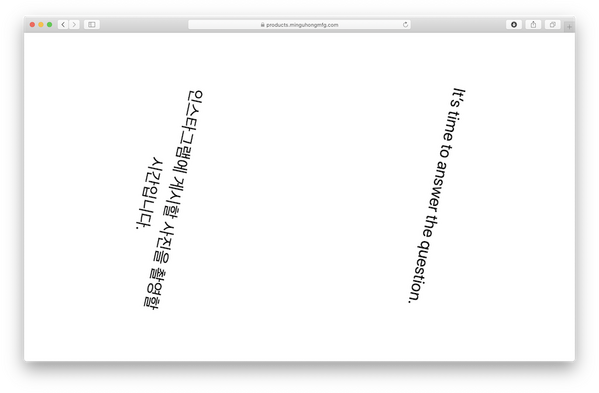
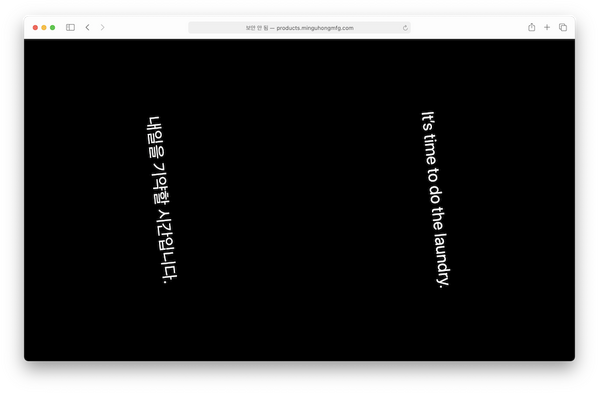
I work eight hours as an editor at Workroom on weekdays, between 10 a.m. and 7 p.m. During my fixed working hours, I work hard and happily as an employee. I tend to do Min Guhong Manufacturing’s work in spare moments or for about two hours afterward. This is why its products look simple and loose—or actually are. Of course, the boundary inevitably blurs from time to time.
To learn more about the company’s view of time, I recommend the piece on The Book Society’s website.
-
How did you become interested in web design?
I first encountered a computer in 1991, when I was about seven. It was a Macintosh LC, which still looks wonderful today. I think a kind of fascination with computers naturally began then. At around eleven, I made my first website on Yahoo! GeoCities, a free hosting service. It was for a friend I loved. Thinking about how to make my friend happy, I wrote, made images, and even tried making MIDI music. That seems to have given me a vague sense of the relationship between content and technology. But in 2009, as the dot-com bubble was deflating, Yahoo! abruptly shut down GeoCities. Now that website exists only in my dreams. Back then, I did not even know what a backup was. It is hard to contain this within the term ‘web design,’ but ever since, making something for someone with computer languages such as HTML, HyperText Markup Language, CSS, Cascading Style Sheets, and JavaScript has been a lasting pleasure. In the end, it is something I do for myself, too.
-
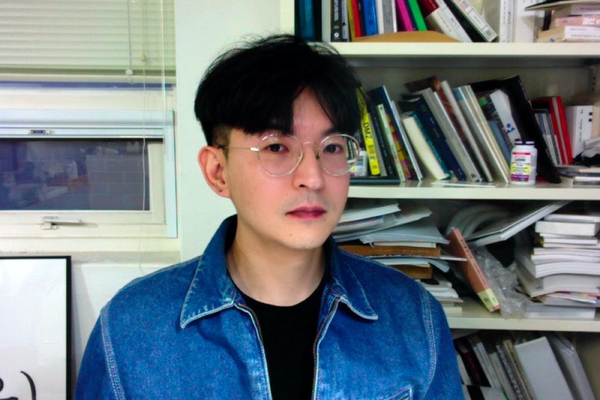
Is the operator, Min Guhong, a real person? Is “Min Guhong” his real name? What does he look like?
He is a real person, it is his real name (his mother’s work), and he looks like this…
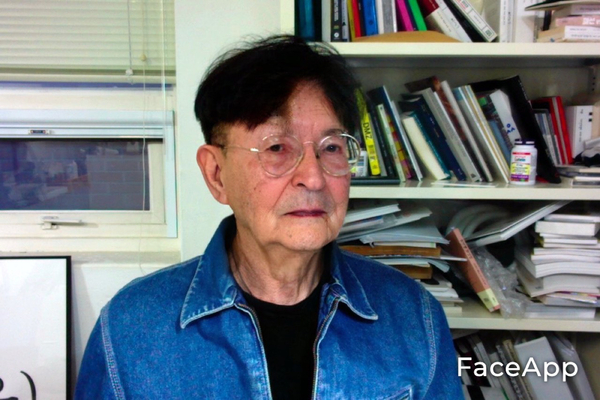
According to FaceApp, one day he is expected to look like this.
-
How might online and offline publications—websites and paper books—mix?
If I may, I would like to answer with another question. Do paper books and websites need to mix? Websites were originally invented so that scientists could share papers efficiently. Information that had been confined to footnotes, marginal notes, and endnotes became “real” information that could be opened with a single click or touch, thanks to blue, underlined hyperlinks. Websites grew out of paper books and made up for their shortcomings. In other words, they are paper books that have evolved. Trying to compare paper books and websites on the same plane will therefore only send the question around in circles.
For me, the valuable legacy of the paper book is less the paper itself than the way it presents content on paper—that is, on a limited flat surface. This method contains the accumulated successes and failures of countless specialists: scribes, editors, designers, printers, cognitive scientists, and more. Thanks to them, we can discuss an appropriate type size for the distance between the content and our eyes, an appropriate line length for that size, and an appropriate number of lines in turn. Seen this way, there is nothing strange about this method being reproduced or used not only on websites but in many other media. Paper books may disappear in the distant future, but perhaps this method will remain unchanged.
-
Which is your favorite of the 113 tags used in HTML5, the standard HTML specification as of 2020?
The
<a>tag. It creates hyperlinks, connecting one piece of content to another. The a stands for ‘anchor.’ So when we click a hyperlink on a website, we drop anchor there and move somewhere else. It is also one of the defining tags that distinguish a website from print. Content that had been merely a footnote, a marginal note, or an endnote in print acquired a new status on the web thanks to the<a>tag. It became something like oxygen for the web, making the web what it is.-
Do you have a wish for the new year?
I hope The Big Issue receives more interest and love from readers, and that this issue sells more copies than usual. First of all, that would increase the vendors’ earnings, and it would also help promote the company to some extent. It is one of those things that makes someone happy without making someone else unhappy.
-
I find One and Three Web Browsers, modeled on Joseph Kosuth’s famous One and Three Chairs, especially interesting. One and Three Chairs consists of an actual chair, a photograph of a chair, and a definition of a chair. But where is the actual browser in One and Three Web Browsers?
Um… What are you using to run that product, One and Three Web Browsers?
-
Alongside working as a book editor at Workroom, you have a strong interest in the web. What are the advantages and disadvantages of distinguishing the two media? As you move between them, what makes you choose one or the other?
The web is one of the media Min Guhong Manufacturing uses to introduce the company. But because it accounts for a considerable share of our work, we are sometimes mistaken for a web design agency. The company mainly uses the web because it is easy to handle, has a wider reach than print, and, above all, is likely to be something many people encounter just before falling asleep.
Since Sir Tim Berners-Lee invented the web so that scientists could share papers efficiently, the web historically began with print. In how it conveys information, the web incorporates the advantages of print by its very nature and continues to develop even at this moment. So rather than putting the two on the same starting line and comparing them one to one, it is more useful to regard print as the web’s ancestor and the web as a slightly more advanced form of print. The clear differences that immediately come to mind are that the web cannot offer the satisfaction of holding a book in your hands and that, unlike a book, it is forever a beta version.
-
I am a graduate of Paju Typography Institute. Are there characteristics specific to typography on websites?
Early in 2022, I was fortunate enough to visit Princeton University in the United States to give a talk. I showed a photograph of a grandmother, daughter, and granddaughter and said that a website is a book’s child: an evolved printed book. If the grandmother is a printed book and the daughter a website, the granddaughter is something else we might make in the future. As evolved printed books, websites face fewer spatial constraints than printed pages. Concepts such as format and page count, which affect production costs, become less distinct. In my experience, applying measurements for print typography directly to a website makes everything feel a little too small, narrow, and cramped. Ten-point type, a common body size in print, is roughly 13.5 pixels, and I see no reason to doubt browsers’ default body size of 16 pixels. Some people recommend 18, 20, or more. I also think line spacing should be a little more generous than in print. That probably explains why long texts often separate paragraphs with a blank line rather than an indent. It is also worth considering that websites appear on luminous screens, using RGB colors, so the contrast between black and white is greater than on a printed page.
-
Min Guhong Manufacturing collaborates with institutions, organizations, companies, and individuals under the name “technical support.” This takes many forms, from building websites and developing software to writing and translation. This may be a sensitive question, but how do you usually set your technical support fees?
The more sensitive it is, the more clearly it should be stated. Whether much or little, long or short, the company commits its labor and time, so this matters to its survival. There is a minimum, but beyond that, the more the better, as long as neither party feels awkward. There is also a basic condition: the client must introduce Min Guhong Manufacturing in some way. If meeting the minimum is difficult, active publicity for the company can sometimes substitute. A novelist, for example, would have to publish a work about the company in one of the four major literary journals.
If Min Guhong Manufacturing were a design agency, however, I would use the advice of E Roon Kang, who runs 908A, as my standard.
One of the three is enough: people, money, or portfolio.
-
You studied computer programming—though you prefer to call it ‘literature and linguistics in a narrow sense’—at the School for Poetic Computation, or SFPC, in New York. Why did you choose that school? What did you mainly learn?
Around the time I left Ahn Graphics after about five years, I happened upon it while posting a press release online for An Essay on Typography, which I had edited and designed. I liked that it was in central New York and that the course was short. Above all, its name was wonderful: ‘poetic’ and ‘computation,’ two words that seemed unlikely companions. Unlike the school’s outwardly freewheeling atmosphere, its name seemed carefully chosen. Without even knowing how competitive admission was, I thought it might make a nice holiday. I was also excited that the American poet Kenneth Goldsmith had taught there.
I was lucky enough to be accepted, and the school was much stranger—in a good way—than I had imagined. Students included a white-hat hacker, a graduate student in criminal justice, an architect, a dancer, and an electronic musician. My teacher in coding conventions, incidentally, was Hélène, who had worked as a baker in France. Conceptual and practical classes in art theory and computer theory ran from 9 a.m. to 6 p.m., sometimes later on days with lectures or workshops. (New York’s subway runs twenty-four hours a day.) I spent most weekends at school, too, absorbing in a short time what would take several semesters to learn and consider at an ordinary university. I was especially committed to the classes taught by Nick Montfort, the American poet and MIT professor of digital media.
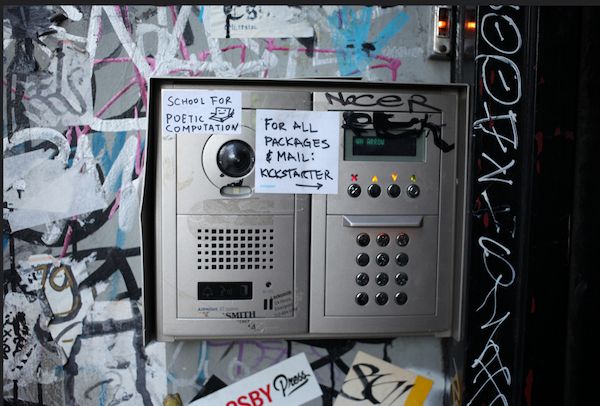
One point to emphasize is that this is not a school that kindly teaches you each technical skill from the beginning. To exaggerate a little, teachers functioned as ‘search-term suggestion engines,’ offering hints for solving the problems you faced. Students used those suggested terms as signposts, wandering the internet, recognizing their desires and technical limits, and devising ways around them. This approach is meaningful because what matters is not the technology itself but which technology you use and how.
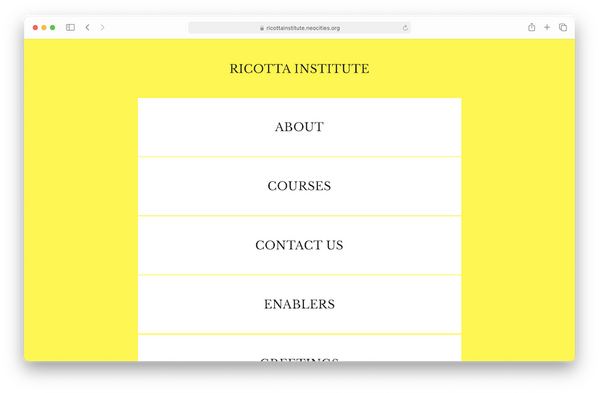
The final class was about making your own school: a chance for students to reverse roles and consider education from a teacher’s position. My proposal was the Ricotta Institute, where ricotta would be the focus for learning cooking, writing, coding, design, and marketing. New Order, which I run every Friday, is a prototype for the Ricotta Institute that will open someday. (You can experience the main concerns of this ‘liberal arts course for people today’ in New Order, presented at Art Sonje Center.)
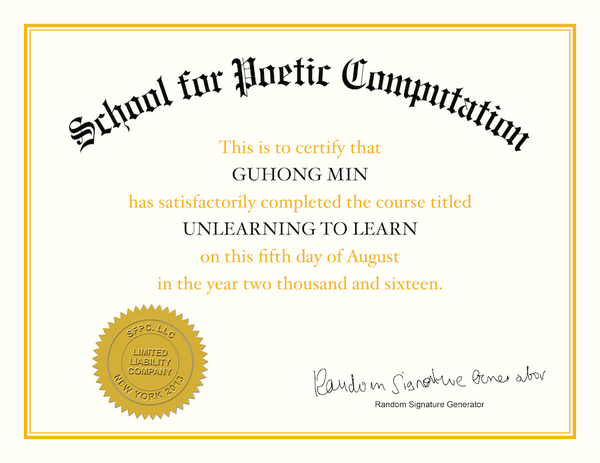
The school did not, however, have a proper diploma. What was the point of traveling across the Pacific to study if I had nothing to prove it? So, as my graduation project, I made a diploma generator and awarded diplomas to myself and my friends on the school’s behalf. In the place for the school’s official seal was each recipient’s own signature, randomly generated by Random Signature Generator.
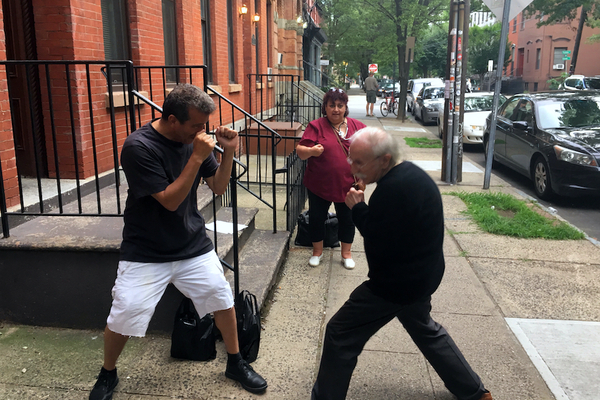
It was also a great stroke of luck to meet Louis (the man on the left in the photograph above) and Marilyn (the woman at the back), who said they wanted to adopt me, and Laurel Schwulst, another godmother of Min Guhong Manufacturing.
-
This may be a sensitive question, but could you tell us which work you made for the lowest fee?
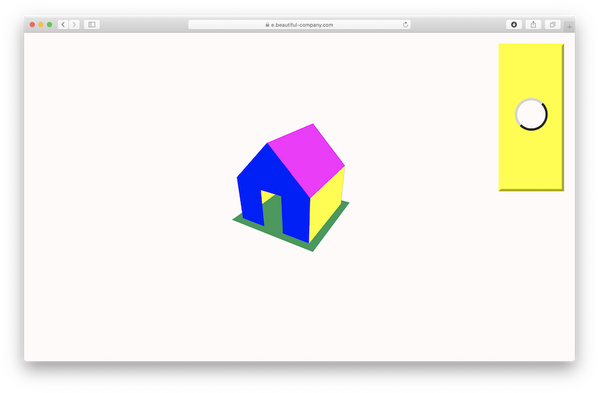
Bell House, introducing the eighth IRL Club. IRL Club describes itself as ‘anti-TED’ and is a gathering for discussing all kinds of computer culture. I hear it is currently on hiatus. I made the work with Beautiful Company, run by Laurel Schwulst. As the title suggests, it implements a ‘bell’ and a ‘house’ in a web browser. Bugs were deliberately inserted so that visitors would not confuse it with reality.
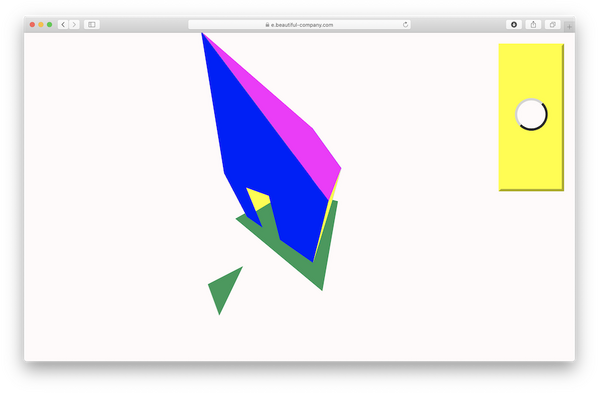
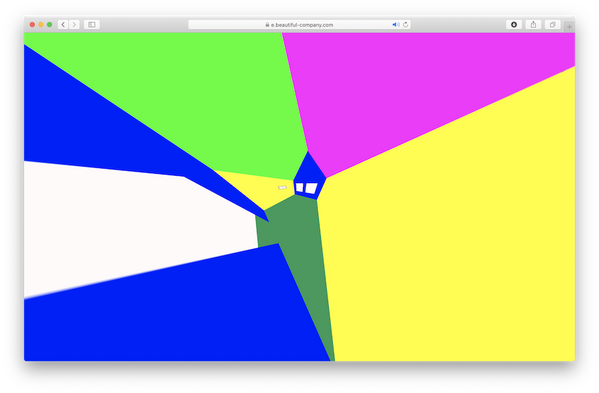
I was in New York at the time and had plenty of time. I no longer know why, but in place of a fee I accepted a delicious lunch and organic watermelon juice at Cong Ly, a Vietnamese restaurant run by Chinese owners in Chinatown.
-
As of 2021, HTML5, the current HTML specification, uses as many as 113 tags. Which is your favorite?
The
<a>tag. It creates a hyperlink in content to connect it to other content: something like the web’s oxygen, making the web what it is. It is also a defining distinction between print and websites. Content that was merely a footnote, marginal note, or endnote in print gained a new status on the web thanks to the<a>tag. The ‘a’ stands for ‘anchor.’ There are various interpretations, but I imagine that when you click a hyperlink on a website, you drop anchor there and move somewhere else.-
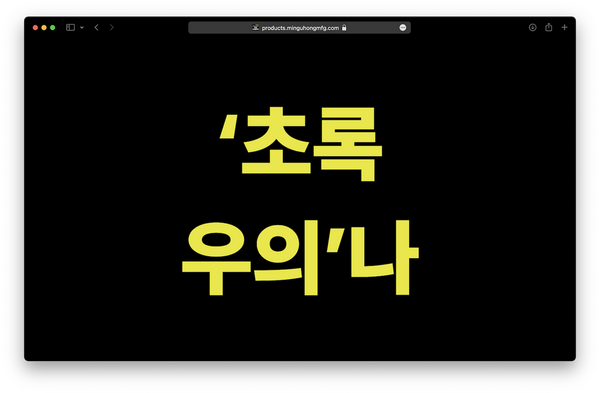
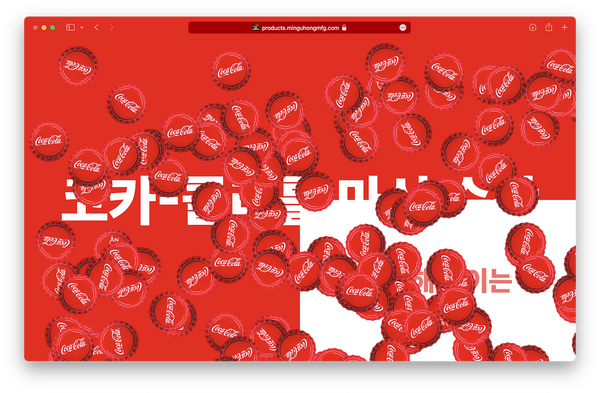
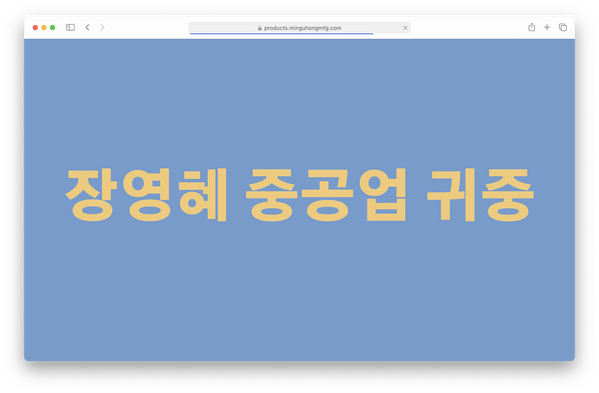
Min Guhong Manufacturing’s product Dear Messrs. Young-Hae Chang Heavy Industries looks to me like a lovely love letter. I am not sure whether I may call it that, but do you plan to develop a series of ‘love letters’?
Looking back, there were also To You and Dear Messrs. Coca-Cola Korea. Since I have yet to receive a reply to any of them, I will follow your suggestion and call them a ‘love letter series’ from now on.
-
We live in an age when social media alone can convey all the information we need—or, in Min Guhong Manufacturing’s terms, an ‘age of introductions.’ Is making a personal website still meaningful?
In terms of reach, nothing beats social media. But each platform has its own constraints, and those constraints limit users’ happiness. Twitter, for example, limits the length of posts, while Instagram requires an image or video even to post a single line of text. Hyperlinks in posts do not work, either. It is a strategy to keep users on Instagram forever.
The ‘like’ feature also places your life, your work, and ultimately yourself in a position to be judged by an unspecified public. Seeing the result as an adorable heart icon and a number of only a few hundred is not especially pleasant. Not everyone can have lots of likes, so someone may feel insignificant or come to reject their own work or life. Unless you use it on your own terms, you are bound to get swept along.
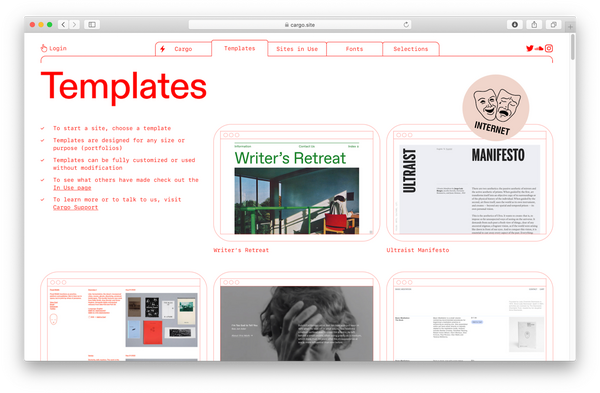
Meanwhile, services such as Cargo, used mainly in the design world, provide attractive templates for people unfamiliar with coding. They are certainly convenient, but the templates are detached from the content. You fit your content into a preexisting frame. In use, something inevitably feels not quite right, and changing one design element or another turns out to be difficult. The code gets messy, too. Making a website can come to be understood as simply modifying a template.
Learn a few computer languages, and you can control almost everything yourself. Building a website just for you from a blank slate is worth trying as ‘a liberal art for people today.’ Thinking about who you are, what you like and dislike, organizing those thoughts in writing, and considering how to give them a new order with computer languages is valuable. It also allows you to understand and use technology on your own terms.
Because of the pandemic, ‘death’ is a more familiar word than ever. Every morning we hear how many people died the day before. That makes us reflect on life all the more. Making a website for yourself may be no different from loving yourself profoundly. When you love yourself profoundly, you can love others profoundly, too. Love, and the happiness that follows it, spreads faster than an epidemic. Is there anything more important to do before we die?
-
After any sudden change, though, regret or lingering attachment can come rushing in. “If only I knew now what I knew then…”
Regret and lingering attachment are, ultimately, a curious wistfulness about a choice. Regret concerns what we chose; lingering attachment concerns what we did not. Either way, the more we dwell on them, the unhappier we become, and a fundamental question we had forgotten blooms again. Why was I born? To Korean parents, at that. So I try to keep my distance from regret and lingering attachment, but since daily life consists of choices large and small, I cannot be entirely free of them. If only I had confessed my feelings to that woman a little more boldly… If only I had not emailed that teacher… If only I had not taken that drug… If only I had stayed in New York longer… If only I had bought that apartment… If only I had voted for that person… If only I had turned down this commission to write…
-
The company’s first product, About the Company, lists thirty-seven things the company does not do, in English and Korean alphabetical order. Was that because the company’s main business was unclear at the time?
It still is. Also at work was a somewhat unfounded belief that, for a company, what it should not do matters more than what it does. Every item remains valid, including ‘Min Guhong Manufacturing does not collect donations in Bitcoin.’
-
Virus Simulator, from 2020, is currently on view at DDDD. While your earlier products focused on introducing the company, this one takes the new infectious disease COVID-19 as its subject. Has Min Guhong Manufacturing changed since COVID-19?
At Min Guhong Manufacturing, the company is introduced in various ways: sometimes naturally, sometimes overtly, sometimes unexpectedly, and sometimes by relying on someone else’s reputation. This product also performs the task of introducing the company, even if all it does is place Min Guhong Mfg. among flowers, trees, stones, humans, and cherries in its world. Since COVID-19, we have received more inquiries about products and technical support, particularly from museums whose physical exhibitions were canceled. As a one-person company, we take a little time to respond, but we do so with sincerity, following the Min Guhong Manufacturing Email Response Guidelines. A Korean student intern who had been working remotely from Arnhem in the Netherlands also returned to Korea and spent a month at Workroom, the company’s host. The intern is now on a business trip to Jeju Island.