FAQ
- Anything to keep in mind?
-
Min Guhong Manufacturing hopes this FAQ will answer your questions about the company and the person who runs it. It brings together interviews, long and short, conducted since 2015, carefully compiled and then scattered into random order. Depending on when a question was asked, some facts may differ from those of today. Honorifics for people mentioned have also sometimes been omitted to suit the tone of the question. If you have read your way through the FAQ and still have questions, please tell us all about them at support@minguhongmfg.com. Min Guhong Manufacturing is ready to understand and acknowledge everything. Please look for a reply in the FAQ someday, though, rather than in your inbox.
-
Were you familiar with COS before this event?
All I had done was happen to leaf through its free magazine a few times. But I am now considering using COS products as workwear.
-
Another language makes the impossible possible. Suddenly I want to explore the history of websites.
That is a natural response. As you peel back layers of pixels to uncover the history of websites, you feel like an archaeologist of the digital age, discovering the cultural artifacts hidden within.
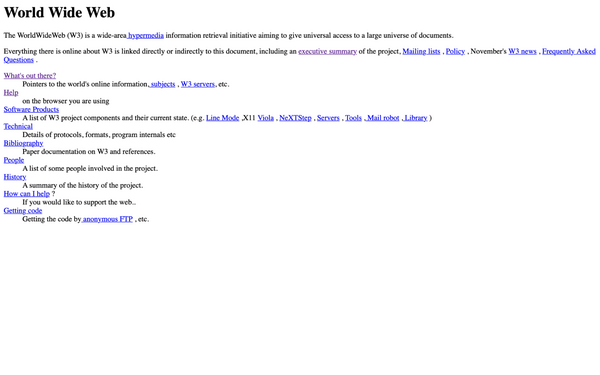
In 1991, the web’s creator, Tim Berners-Lee, made the first website to introduce the World Wide Web. It is my favorite website—indeed, the one I love most. It may look modest and simple by today’s standards, but it signaled the beginning of a digital revolution. Like Johannes Gutenberg’s invention of movable-type printing, it heralded the democratization of information. More than thirty years after its release, it still works with its original look and feel. Faced with this website, who could confidently claim that websites are less durable than printed books?
-
In your visual language, you often use centered alignment. Is there a particular reason?
I think it is the simplest and most effective way to emphasize content. Just giving something an expanse of white space that nothing else can encroach on makes it look magnificent.
-
I am a student at the University of Seoul. What did you make as a student? Which work do you remember most?
The computer I used as a student broke, so I do not remember the details well. But when studying literature, I wrote fiction that resembled poetry for fiction assignments and poems that resembled fiction for poetry assignments. For a criticism assignment, I wrote about a work that did not exist. The critic teaching the class asked me to bring in the work, and my lie was completely exposed. I always remember my novelist professor’s words: “Above all, you must be good at lying.” “Fact and fiction must coexist.”
For my graduation project, I wrote ten poems. I remember writing one poem, then continually editing it to complete the other nine. It was not very different at the School for Poetic Computation.
I think I always did what I wanted at school. Whenever I received an assignment, I tried to find an opening in which I could move happily, then kept widening it. Without straying too far from the school’s basic constraints, though.
-
I am a student at the University of Seoul. How has studying literature and linguistics influenced your design and programming?
Broadly, literature means playing with language to me, while linguistics means discovering its structures, rules, functions, and meanings. Design and coding both fall within those categories; the languages they use are just a little different.
Both ordinary writing and coding as writing presume communication. The first person you communicate with is presumably the writer—yourself. In coding, though, after communicating with yourself, you have to communicate with a computer. Unfortunately, computers are not as forgiving as humans. That is why coding requires accuracy, explicitness, and clarity.
-
When and how did you first encounter Choi Jeongho?
I do not remember clearly. At my previous company, I worked on a book about Choi Jeongho. Until then, I had known him only superficially, and I think that was when I came to know him a little better than most people. The first edition came out in 2014, so in any case it has been less than four years.
-
I am a student at the University of Seoul. I would like to hear about your experience at the School for Poetic Computation.
I stumbled on it around the time I was growing bored at Ahn Graphics. Names matter to me, and the school’s combination of “poetic” and “computation” was wonderful. I thought it neatly summed up my interests. That made me think the school would look right in the education section of my résumé.
My mother was stunned when I said I would suddenly leave a perfectly good job and go to the United States. I was already married, too. I later learned that admission was quite competitive, but I honestly do not know how I got in. It was a kind of alternative school, and although the course lasted three months, classes ran continuously from nine in the morning to six in the evening. Afterward, events such as guest lectures went on late into the night almost every day. Many classmates had come from other regions or countries, so with little else to do on weekends, most of us stayed at school then too.
Above all, it felt good to be a student again after so long. The greatest thing I gained was people. I made many friends. Along with Koreans active in New York’s art and design scene, including Taeyoon Choi, E Roon Kang, and Wonyoung So, I met Laurel Schwulst, whom I had previously known only through email. Through her, I made other friends, including David Reinfurt, John Provencher, and Mindy Seu. It is thanks to these friends that I was able to translate a recently published book and lecture at Princeton University. And, above all, having many friends in New York means having plenty of inexpensive places to sleep when I visit.
-
Online exhibitions are changing not only viewers’ roles but also how they view work. How can a viewer exist in an online exhibition?
Viewing an online exhibition on a website may feel different consciously, but it is not very different from browsing portals such as Naver or Daum or social media services such as Instagram. The website is placed in the context of an exhibition, but from the viewer’s perspective, only the template has changed. It may be a little troublesome, but viewers need to keep every possibility open and actively use the powers available to them—clicking, touching, scrolling—to explore the exhibition space provided on the website.
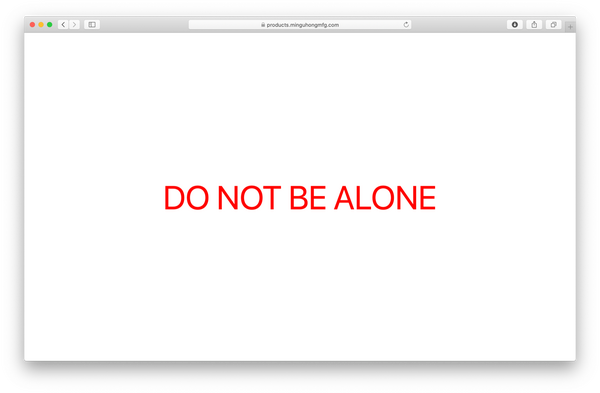
Min Guhong Manufacturing, Anything, Nothing, website, 2018. This website detects and prohibits almost every action a user can take in a browser, including moving the mouse cursor, clicking, touching, typing, resizing the browser, and waiting. Image courtesy of the artist. If you suddenly encounter an empty screen while viewing an exhibition, it may be worth using the browser’s built-in Web Inspector rather than assuming something has gone wrong. You might unexpectedly discover a message the maker has hidden.
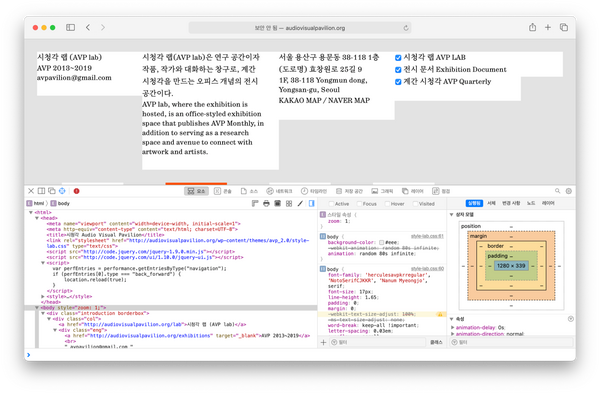
The Audiovisual Pavilion Lab website viewed through Web Inspector. Activating the inspector built into a web browser lets you examine the website’s structure and how it was made, and may even reveal messages the maker has hidden in the code. -
They say the first civilian journey to the moon will begin in 2018. Do you have any preparations for the coming space age?
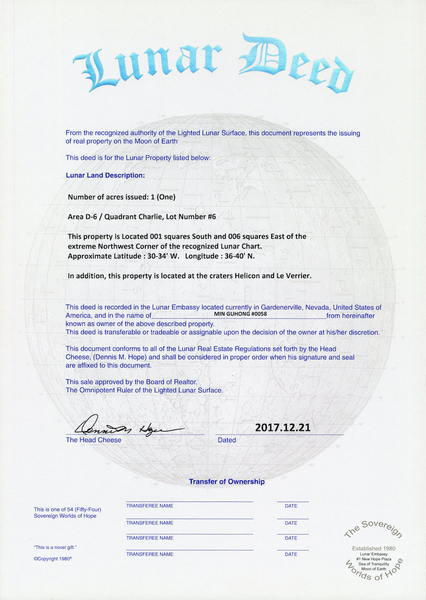
I have acquired one acre of lunar real estate, about 1,224 pyeong, through the Lunar Embassy. I also keep up with articles about Elon Musk from time to time. Recently, in April 2021, he said this:
Honestly, a lot of people may die in the beginning. It will be a glorious adventure and an amazing experience. This may sound uncomfortable and unpalatable, but you could die, too.
-
I tend to believe that naming is the most important part of most things, though some names, like “Google,” arise by mistake. What does your company’s name mean?
“Manufacturing” generally refers to the mass production of goods by processing raw materials with human or mechanical power. In baseball, however, it also means scoring through means other than hits, such as stolen bases, advancing runners, and sacrifice plays. I wanted the company name to express a will to put the word’s functionalism and opportunism into practice.
-
In publishing, ‘editing’ is often used in the rather narrow sense of proofreading or copyediting, but in various fields it has already expanded to mean something beyond creation. What kind of editorial judgment is needed when handling content on a website?
Fundamentally, this is not very different from print either. But you must consider that letters and images can do more than present content: they might perform a particular function as a button, for example. In other words, you need to consider and plan how the content can interact with the user.
-
What matters most to you when working across online and offline media?
Today, publishing does not happen only on paper. Making content public and introducing it online is also called publishing, so it no longer seems particularly odd to call paper books “offline publications” and websites “online publications.” If we group paper books and websites together as publications—if we believe that only the location of the content has changed—our concerns about the two media may be reframed, and some may resolve themselves.
Except when I am also the author, my role is limited by the medium and varies slightly. With paper books, I generally move between planning and editing; with websites, between planning, editing, designing, and programming. This process ranges from simply checking sentences for errors or smoothing them out to acts of creation that sometimes leave little room for the original creator. Even so, I try not to forget that most of this is secondary production, which cannot even begin without content. If publishing is speaking, one of my roles is to help the words reach their audience properly. In that case, isn’t the most important thing to understand what the original creator is trying to say?
-
If someone called you a ‘web designer,’ would you consider that accurate? If the term feels mismatched, why?
In a 2022 interview with The Floorplan, I said: ‘I would simply like to leave it to the other person to define what I am. It is interesting when a title I had not considered emerges and my attitude toward them changes accordingly. Depending on the person, I might become not just an editor but an artist, a teacher, or even a husband or lover.’ People call me by various titles, but above all I like the drabness of ‘editor.’ It comes from the uncertainty of the scope of ‘editing.’ It can be very broad or very narrow. I think design is part of editing, too. Anyone who has experienced both will know what I mean.
-
When you moved from editorial design to the web and code, what did you need to learn first? What paths do you think are open after school to someone who works with both editing and code?
I had been using computers since I was seven, so there was nothing I had to learn specifically for the transition. Only the medium I worked with changed, from paper to screen, and that medium was already familiar to me. It was quite a long time ago, so I don’t remember my student days very well, but I rarely thought about what would come after graduation. I had spent four years practicing how to read, write, and copy well—the basis of all work.
-
Have you always had such a flair?
Perhaps it is something you naturally pick up by spending time at Workroom.
-
Min Guhong Manufacturing’s products seem quite systematic. Could you explain a little more?
I consider it important to edit not only a product’s form but also the beauty of its content and the context and circumstances connecting form to content. This is as true of books, websites, games, browser extensions, and ricotta cheese as it is of writing.
-
We live in an age when social media alone can convey all the information we need—or, in Min Guhong Manufacturing’s terms, an ‘age of introductions.’ Is making a personal website still meaningful?
In terms of reach, nothing beats social media. But each platform has its own constraints, and those constraints limit users’ happiness. Twitter, for example, limits the length of posts, while Instagram requires an image or video even to post a single line of text. Hyperlinks in posts do not work, either. It is a strategy to keep users on Instagram forever.
The ‘like’ feature also places your life, your work, and ultimately yourself in a position to be judged by an unspecified public. Seeing the result as an adorable heart icon and a number of only a few hundred is not especially pleasant. Not everyone can have lots of likes, so someone may feel insignificant or come to reject their own work or life. Unless you use it on your own terms, you are bound to get swept along.
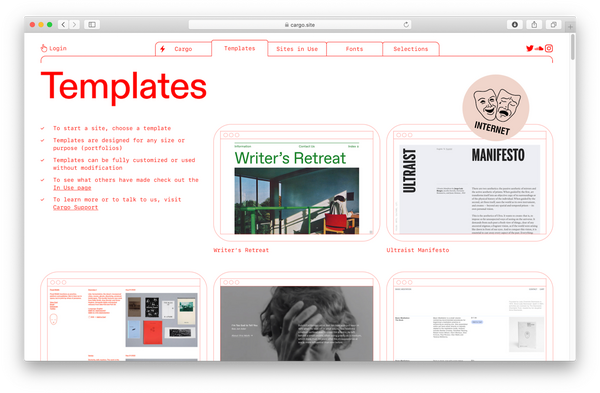
Meanwhile, services such as Cargo, used mainly in the design world, provide attractive templates for people unfamiliar with coding. They are certainly convenient, but the templates are detached from the content. You fit your content into a preexisting frame. In use, something inevitably feels not quite right, and changing one design element or another turns out to be difficult. The code gets messy, too. Making a website can come to be understood as simply modifying a template.
Learn a few computer languages, and you can control almost everything yourself. Building a website just for you from a blank slate is worth trying as ‘a liberal art for people today.’ Thinking about who you are, what you like and dislike, organizing those thoughts in writing, and considering how to give them a new order with computer languages is valuable. It also allows you to understand and use technology on your own terms.
Because of the pandemic, ‘death’ is a more familiar word than ever. Every morning we hear how many people died the day before. That makes us reflect on life all the more. Making a website for yourself may be no different from loving yourself profoundly. When you love yourself profoundly, you can love others profoundly, too. Love, and the happiness that follows it, spreads faster than an epidemic. Is there anything more important to do before we die?
-
Ahead of 2022, you sent a surprise letter with an update on your life. Some might find this curious, but what struck me was not only the beauty of its contents but also its address: ‘asdf.’
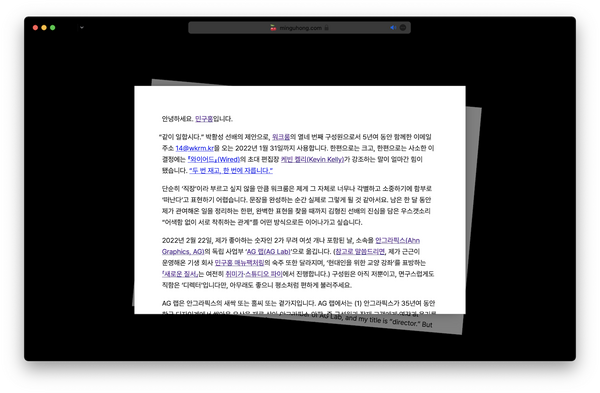
It was a small thing, but I wanted to share the news with people I had made memories with in and around Workroom over the past five years or so, and send New Year’s greetings at the same time. Explaining ‘asdf’ would take a long time. Until then, I suggest visiting asdf.com, run by asdf enthusiasts.
-
Min Guhong Manufacturing says it ‘focuses on introducing the company—that is, Min Guhong Manufacturing itself—in various ways.’ Why are you so devoted to ‘introduction’?
At the root of every productive activity is a desire to introduce something, and ultimately oneself. In the face of this desire, Lee Ufan, Virgil Abloh, and an artist holding a first solo exhibition at Mapo Lifelong Learning Center are no different. Besides, introduction is a necessary step, something you have to do anyway. I believe a story can begin even if you concentrate on that alone. That is what makes introduction worth questioning. Min Guhong Manufacturing is the result of becoming a little more conscious of this desire and giving it a form. If ‘water drops’ were the subject Kim Tschang-yeul had to investigate, then for Min Guhong Manufacturing that subject is ‘introduction.’
-
How did you first introduce your work to the world? I’m curious about what led you to establish your own distinctive voice or position.
I began with a text commissioned by the exhibition space Audiovisual Pavilion for its Audiovisual Pavilion Documents series. Under the title About the Company, I listed thirty-seven things Min Guhong Manufacturing does not do. I did no promotion of my own; I simply relied on Audiovisual Pavilion’s reputation. I think that more or less established my position.