FAQ
- Anything to keep in mind?
-
Min Guhong Manufacturing hopes this FAQ will answer your questions about the company and the person who runs it. It brings together interviews, long and short, conducted since 2015, carefully compiled and then scattered into random order. Depending on when a question was asked, some facts may differ from those of today. Honorifics for people mentioned have also sometimes been omitted to suit the tone of the question. If you have read your way through the FAQ and still have questions, please tell us all about them at support@minguhongmfg.com. Min Guhong Manufacturing is ready to understand and acknowledge everything. Please look for a reply in the FAQ someday, though, rather than in your inbox.
-
Which is your favorite of the 113 tags used in HTML5, the standard HTML specification as of 2020?
The
<a>tag. It creates hyperlinks, connecting one piece of content to another. The a stands for ‘anchor.’ So when we click a hyperlink on a website, we drop anchor there and move somewhere else. It is also one of the defining tags that distinguish a website from print. Content that had been merely a footnote, a marginal note, or an endnote in print acquired a new status on the web thanks to the<a>tag. It became something like oxygen for the web, making the web what it is.-
Which sneakers did you wear most often this year?
The New Balance 992s I received as a gift from Park In-wook, the head of thisisneverthat. Somehow they are half a size larger than the shoes I normally wear. But after slipping into them out of habit whenever I go out, my feet have surprisingly grown to fit them, and I feel a little taller, too. Could this be the astonishing power of the happiness a gift brings? Any readers considering limb-lengthening surgery for health or cosmetic reasons might wish to bear this in mind.
-
Above all, Min Guhong Manufacturing puts time and care into naming. Beyond ‘Manufacturing,’ I found it interesting that you describe the company as ‘parasitic’ on Ahn Graphics and now Workroom, and call its output ‘products’ rather than ‘artworks’ or ‘work.’ You have also discussed the negative market-economy connotations of ‘product.’ Could you elaborate?
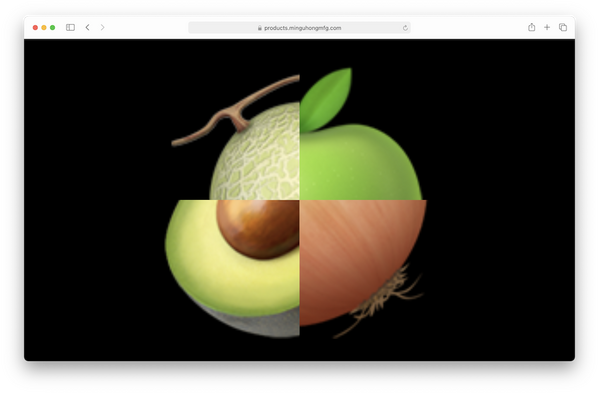
‘Is a tomato a fruit?’ Laurel Schwulst once asked this about the source code of an earlier product, Mysterious Fruit. I replied: ‘Some people think tomatoes are fruit, and others do not. But regardless of the truth, the moment I believe a tomato is a fruit, it becomes a fruit for me.’ The illusion that language transparently reflects its object has shattered. What matters is how the subject sees, defines, and ultimately edits the object. Words such as ‘artwork’ or ‘work’ not only fail to reflect the conditions in which things are consumed today; they add an illusion that obscures those conditions. Besides, since Min Guhong Manufacturing is a ‘company,’ ‘product’ seemed the natural word for what it produces. Or perhaps I called it a ‘company’ because I wanted to use the word ‘product.’
-
I am thinking of writing a short paper about Min Guhong Manufacturing. Could you recommend any sources?

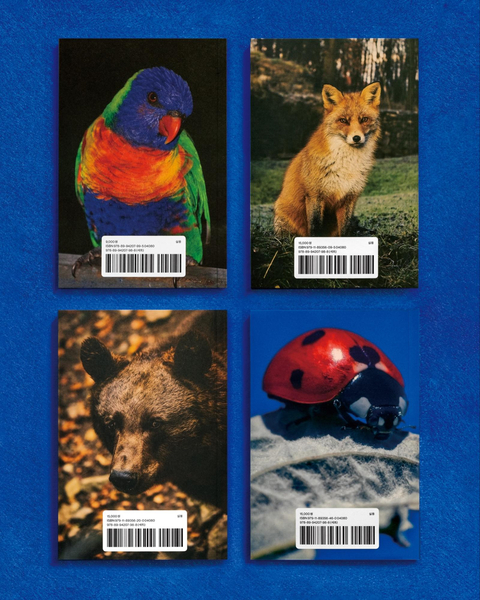
I recommend Rainbow Sherbet, Workroom Ghost and Archive Bomm, 2019. Here is the endorsement by the graphic design duo Sulki & Min on the back cover:
Rainbow Sherbet is a book that helps introduce Min Guhong Manufacturing. A few lines of introduction along these lines would be nice. It is a kind of trompe-l’œil, but since there is no separate preface inside the book, this seems a good place to use. Please limit it to around 160 characters, though.
-
What would you especially like to try next year?
Giving someone a name that meets the following conditions, in no particular order. It must not suggest a particular gender. It must be easy for anyone to pronounce. It must sound like a native Korean word yet be writable in Chinese characters. It must be no more than ten letters long in English. It must not be excessively unusual—in other words, leave no room for teasing, and thereby eliminate the possibility of its owner coming to hate me later. It must be timelessly elegant and sophisticated. It must contain at least one syllable. It must bring yin, yang, and the five elements into harmony. The surname must be Min.
-
How does it feel to live parasitically on a host? Is it a ‘modern’ and ‘healthy’ way to operate?
Above all, Min Guhong Manufacturing chose to live parasitically on its operator’s workplace rather than become independent because it lacked capital and courage. My complete ignorance of tax law and inability to work properly at home also played a part. In exchange for labor and a measure of amusement, the company covers its running costs with the operator’s salary and gains the use of the host’s movable and immovable property: workspace, computers, desks, Wi-Fi, coffee machines, and so on. This approach provides a platform for running a company as a hobby—that is, purely for personal happiness, without worrying about generating profit. My hope is for Min Guhong Manufacturing and its host to give each other what they need and grow together, or, to quote a colleague, ‘exploit each other without awkwardness.’ That is what sets it apart from parasitism in the usual sense of ‘sucking blood.’ The nourishment it needs would be our clients’ love and attention.
-
I am about to graduate from university. Do you plan to hire staff or interns in the first half of next year?
Neither in the first half nor the second. All the company can offer is a little space on the operator’s desk, a stool, an employee or intern ID card, business cards, and a work email address with the domain minguhongmfg.com.
There is no fixed recruitment schedule. For the current assignment and submission details, please see “Internships”.
-
Is there a motto you always keep in mind?
Sheriff, it’s Pete Martell. Um, I’ll transfer him. To the phone on the table by the red chair. The red chair against the wall. There’s a lamp on the table. You know, the lamp we moved from that corner before. Not the brown phone—the black one!
These are the historic first lines of Lucy Moran, a character in Twin Peaks, the American TV series that captivated the 1990s. They are also the motto of New Order. What we see when Lucy, a secretary at the sheriff’s office, transfers a call to the sheriff is an obsessive focus on an object—in this case, a telephone. For me, however ridiculous it may sometimes seem, that object is above all myself.
-
What is the coolest place of 2021 that you can confidently recommend?
Hongdae Climbing Center, an indoor climbing gym near my home, at 02-332-5015. It has been run for nearly twenty years by Yoon Gil-su, one of Korea’s first-generation sport climbers, known in the field as a ‘rock climber.’ In its calm, serious atmosphere, I can concentrate on meditation using my whole body. Unfortunately, in 2021, as in 2020, I had to spend most of my time at home or in the office. Had I not made time to come here each week, I think I would have struggled to find much energy in daily life. Besides, simply looking at the colorful holds of all sizes on the wall makes both my body and my mind feel healthier. After a weekend workout, I go up to the summit of Seongmisan. On the way home, I stop at FOE, run by Moonba, to browse its outlandish new products, then satisfy my hunger and top up my lutein with a variety of fresh green and yellow vegetables at the Yeonnam branch of Nokwon Ssambap, at 02-332-9483. There is no better way to round off the week.
-
I think I am beginning to understand what a website is. But I want to ask again, even if I get the same answer. What on earth is a website?
Well. In any case, we called that place a ‘website.’ But what the dictionary definition covers now seems a little narrow. The website’s tomorrow lies where technology and humans meet. Websites will continue to be places where information and art, technology and the humanities come together. Might we make new cultures here, develop new ways of thinking, and explore new ways of existing? As T. S. Eliot said, ‘We arrive where we started and know the place for the first time.’ The experiences we encounter through websites are no different. And as we wander through endless digital space, what we come to know in the end will be ourselves—first me, and then us.
-
What principle matters most when introducing the company or planning and making products?
The only principle that is not revised to suit the circumstances—requiring detailed rules or appendices—or discarded immediately after being put into practice is “following the Korean spelling rules and rules for writing foreign words in Korean set by the National Institute of Korean Language.”
-
I like the idea of treating online documents issued for publication as publications, just like printed books. EPUB offers various interface features and ways of using links; similarly, readers could trace revisions if they wished, or we could use one symbol for an open document and another for a closed one. Have you thought about developing this kind of web publication?
I find the idea of “open documents” and “closed documents” interesting. In that sense, perhaps we should devise symbols suited to marking website titles. As long as at least one of the three points I mentioned earlier is satisfied.
-
What matters most to you when working across online and offline media?
Today, publishing does not happen only on paper. Making content public and introducing it online is also called publishing, so it no longer seems particularly odd to call paper books “offline publications” and websites “online publications.” If we group paper books and websites together as publications—if we believe that only the location of the content has changed—our concerns about the two media may be reframed, and some may resolve themselves.
Except when I am also the author, my role is limited by the medium and varies slightly. With paper books, I generally move between planning and editing; with websites, between planning, editing, designing, and programming. This process ranges from simply checking sentences for errors or smoothing them out to acts of creation that sometimes leave little room for the original creator. Even so, I try not to forget that most of this is secondary production, which cannot even begin without content. If publishing is speaking, one of my roles is to help the words reach their audience properly. In that case, isn’t the most important thing to understand what the original creator is trying to say?
-
Which trend or cultural phenomenon of 2021 did you find hardest to understand?
In my experience, falling in love with something you cannot understand is worth attempting now and then. You simply let your body and mind go with the flow, even if you sense that everything will become a mess. Among the trends of 2021, the metaverse and NFTs, or non-fungible tokens, remain especially difficult to understand. To be honest, I have little desire to understand them. But judging by the atmosphere, one thing is certain: people will be talking about them for a while. Min Guhong Manufacturing is also watching for an opportunity to dip a toe in.
-
Do you also provide branding services, such as naming?
So far, only for Dongshinsa, run by graphic designer and writer Kim Dongshin. It was around the time we were each imagining the businesses we would go on to run. I think my first suggestion was ‘Kim Dongshin Manufacturing.’
-
Now that we are in the “age of living to a hundred,” I am handing our three-generation restaurant business over to my son and his wife and starting a second life as a graphic designer. I have begun by redesigning our menu. Could you recommend a book?
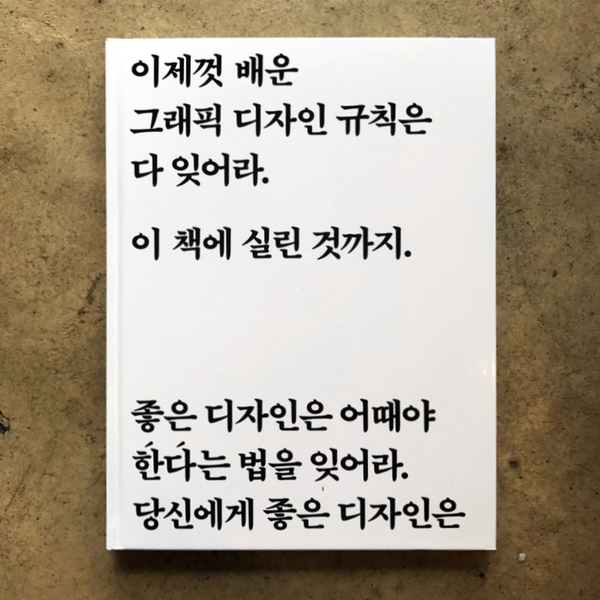
First, you will need to learn the rules of graphic design, won’t you? Then please read Forget All the Rules You Ever Learned About Graphic Design. Including the Ones in This Book. Keep reading until you can forget the rules in it. You might refer to the introduction on Achimdal's blog.
In this book, he argues for the importance of “defining (and redefining) the problem” in design. First, ask whether a problem poses the right question; if it does not, redefining and reframing it is far more important than finding an answer. He then introduces various works of his own that follow or break this principle. Is defining (and redefining) the problem important only in design? No. It matters in many parts of life, especially in any field of art. It means first recognizing the recipient—the other person—of one’s art, while also reconsidering one’s own perspective. It is an essential process for keeping one’s wit fresh.
-
Pisces are easily swept up in emotion. You love yourself more than anyone I know. Have any creators caught your interest or stood out to you recently?
I am not sure.
-
Are there websites you refer to while working? Any you would recommend?
For reasons of time, I do not think I can share my nearly one thousand bookmarks. I do refer to well-made websites. But if a result is too attractive, I find myself unconsciously copying it, regardless of the content. Instead of looking only at the visible result, I consider how the content was approached and handled, and imagine the working process from the beginning. Websites made purely for their creators’ own happiness catch my eye. In particular, I often visit Neocities and FC2 Web. Such websites can be visually rough, but they are not bound by formulas and sometimes gleefully defy them. Their content and the way they handle it recall something I had briefly forgotten, while making me forget newer technologies such as CMSs and JavaScript. They even make me want to become friends with the people who made them.
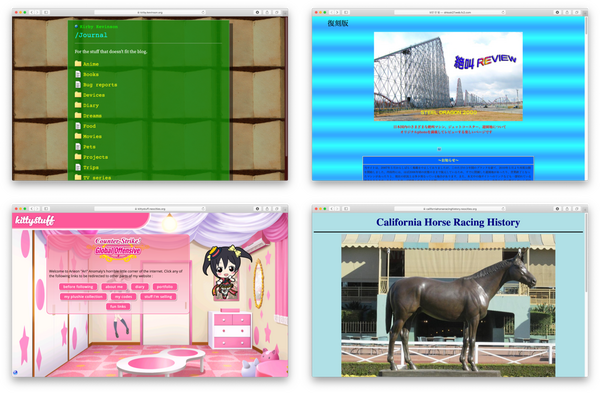
Looking at websites made purely for their creators’ own happiness recalls something briefly forgotten. For the latest web technologies, meanwhile, there is nowhere quite like MDN Web Docs, run by the Mozilla Foundation.
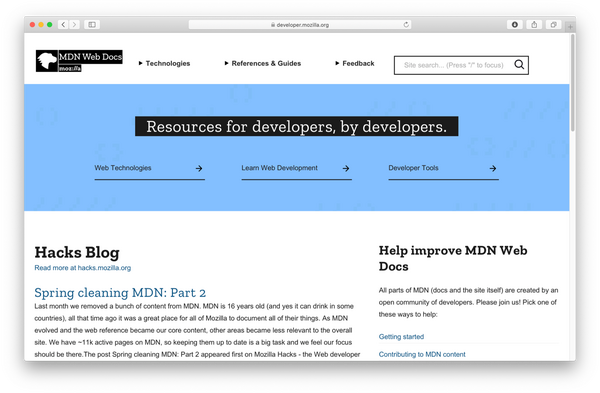
MDN Web Docs -
Min Guhong Manufacturing says it ‘focuses on introducing the company—that is, Min Guhong Manufacturing itself—in various ways.’ Why are you so devoted to ‘introduction’?
At the root of every productive activity is a desire to introduce something, and ultimately oneself. In the face of this desire, Lee Ufan, Virgil Abloh, and an artist holding a first solo exhibition at Mapo Lifelong Learning Center are no different. Besides, introduction is a necessary step, something you have to do anyway. I believe a story can begin even if you concentrate on that alone. That is what makes introduction worth questioning. Min Guhong Manufacturing is the result of becoming a little more conscious of this desire and giving it a form. If ‘water drops’ were the subject Kim Tschang-yeul had to investigate, then for Min Guhong Manufacturing that subject is ‘introduction.’
-
You have released a great many works both online and offline. Which have you found most satisfying?
During my time at Ahn Graphics and then Workroom, I have made quite a few books, from slender sixteen-page volumes to books nearly a thousand pages thick. Unlike websites, no book can be revised at all until it is reprinted, so they all leave me somewhat dissatisfied.
Simple Sabotage Field Manual was the first book I planned after returning from the United States and moving to Workroom. It is based on a secret document distributed during World War II to agents operating in enemy territory by the Office of Strategic Services, the predecessor of the CIA. The book introduces methods of sabotage anyone can practice in daily life, such as holding unnecessary meetings frequently or leaving the lights on when going home. I asked military expert Hong Hee-beom to translate it. Simple Sabotage Field Manual is also the first book in the Practical Books series, which has since published Heavy Duty, How to Make Hit Songs, and Practical Fighting. For reference, the series’ motto is: ‘We uncover material that was once practical but no longer functions on practicality alone, and material that was once impractical but functions practically today. We consider ourselves a general-interest series for modern readers that invites them to reconsider practicality. We welcome readers to the beautiful world of the practical.’

I also remember thisisneverthisisneverthat, a book documenting ten years of the fashion brand thisisneverthat. This is the nearly thousand-page book I mentioned earlier. Much of it consists of a catalog of some three thousand products, and a website proved a useful tool for organizing a list containing diverse kinds of entries. It is a good example of a website leading a project from the front. The content of Typojanchi 2021: Turtle and Crane was also first organized on a website. Both are good examples of a website leading the project and becoming another finished outcome alongside the paper book.
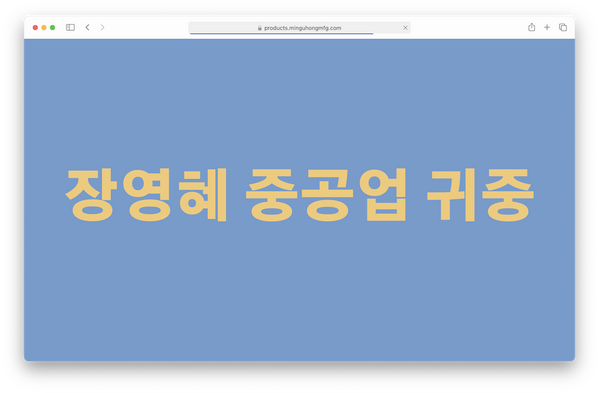
If we limit the question to websites, I would choose Dear Messrs. Young-Hae Chang Heavy Industries, released around Christmas 2020. The work takes the form of a letter expressing Min Guhong Manufacturing’s respect and love for Young-Hae Chang Heavy Industries, along with one request. Since Adobe Flash, the technology they mainly used, had been discontinued, I wondered how it felt to have no choice but to use Vimeo, and took the opportunity to ask. Although I sent it to their official email address, I have yet to receive a reply. At first I was disappointed and a little hurt, but now I have found the courage to send another letter.