FAQ
- Anything to keep in mind?
-
Min Guhong Manufacturing hopes this FAQ will answer your questions about the company and the person who runs it. It brings together interviews, long and short, conducted since 2015, carefully compiled and then scattered into random order. Depending on when a question was asked, some facts may differ from those of today. Honorifics for people mentioned have also sometimes been omitted to suit the tone of the question. If you have read your way through the FAQ and still have questions, please tell us all about them at support@minguhongmfg.com. Min Guhong Manufacturing is ready to understand and acknowledge everything. Please look for a reply in the FAQ someday, though, rather than in your inbox.
-
I like the idea of treating online documents issued for publication as publications, just like printed books. EPUB offers various interface features and ways of using links; similarly, readers could trace revisions if they wished, or we could use one symbol for an open document and another for a closed one. Have you thought about developing this kind of web publication?
I find the idea of “open documents” and “closed documents” interesting. In that sense, perhaps we should devise symbols suited to marking website titles. As long as at least one of the three points I mentioned earlier is satisfied.
-
Does Min Guhong Manufacturing have any particular principles it follows when making websites?
Good question. Above all, I try to follow the Korean spelling rules and rules for writing foreign words in Korean set by the National Institute of Korean Language. When you remain faithful to the basics, the result sometimes emerges naturally.
-
How does it feel to live parasitically on a host? Is it a ‘modern’ and ‘healthy’ way to operate?
Above all, Min Guhong Manufacturing chose to live parasitically on its operator’s workplace rather than become independent because it lacked capital and courage. My complete ignorance of tax law and inability to work properly at home also played a part. In exchange for labor and a measure of amusement, the company covers its running costs with the operator’s salary and gains the use of the host’s movable and immovable property: workspace, computers, desks, Wi-Fi, coffee machines, and so on. This approach provides a platform for running a company as a hobby—that is, purely for personal happiness, without worrying about generating profit. My hope is for Min Guhong Manufacturing and its host to give each other what they need and grow together, or, to quote a colleague, ‘exploit each other without awkwardness.’ That is what sets it apart from parasitism in the usual sense of ‘sucking blood.’ The nourishment it needs would be our clients’ love and attention.
-
I have recently noticed the activities of a group called ‘After New Order…’ You seem to have influenced each other in various ways. What is its relationship to New Order?
They are ‘friends of New Order’ who made memories in the only edition of the course held without masks: a loose collective of specialists in fields including literature, art, and design.
-
I am a student at the University of Seoul. Why did you create New Order?
‘When you like something and eventually come to love it, you naturally want to share that beautiful feeling with those around you.’ The final class at the School for Poetic Computation, where I studied, was about making a school of our own. I believe a teacher’s role is to make more teachers, not unquestioning students. So from the very first class, we settle on calling each other simply by name. The moment you call someone ‘teacher,’ a hierarchy forms, and I do not think such hierarchies help us teach or learn—that is, share.
As consumers, we are very familiar with websites, but as producers, they are usually a new medium. Because everything must be done one character at a time instead of through sophisticated toolbars, you have no choice but to examine your own working process. There is a saying that every designer should make a book from scratch. I think this is because the situations encountered in making a book include many of the variables one faces in design. A website takes you a step further into another kind of experience.
-
I am a graduate of Paju Typography Institute. Are there characteristics specific to typography on websites?
Early in 2022, I was fortunate enough to visit Princeton University in the United States to give a talk. I showed a photograph of a grandmother, daughter, and granddaughter and said that a website is a book’s child: an evolved printed book. If the grandmother is a printed book and the daughter a website, the granddaughter is something else we might make in the future. As evolved printed books, websites face fewer spatial constraints than printed pages. Concepts such as format and page count, which affect production costs, become less distinct. In my experience, applying measurements for print typography directly to a website makes everything feel a little too small, narrow, and cramped. Ten-point type, a common body size in print, is roughly 13.5 pixels, and I see no reason to doubt browsers’ default body size of 16 pixels. Some people recommend 18, 20, or more. I also think line spacing should be a little more generous than in print. That probably explains why long texts often separate paragraphs with a blank line rather than an indent. It is also worth considering that websites appear on luminous screens, using RGB colors, so the contrast between black and white is greater than on a printed page.
-
In late summer 2018, you held an exhibition introducing the company at a gallery. Companies generally hold trade shows or keynotes. Wasn’t an exhibition a somewhat strange approach?

It was a good opportunity to introduce the company. As long as it can introduce itself, Min Guhong Manufacturing does not particularly mind being summoned to a gallery. In the exhibition, its products were mixed together without distinction according to certain rules. In that sense, Rainbow Sherbet, the title proposed by curator Yoon Juli, suited it very well. (“It is extremely difficult to sum up in a single phrase the fitting arrangement in which practicality, elegance, and mischief spray from their respective nozzles.”) I learned later that “rainbow sherbet” is also slang for a drug made by mixing different kinds of marijuana.
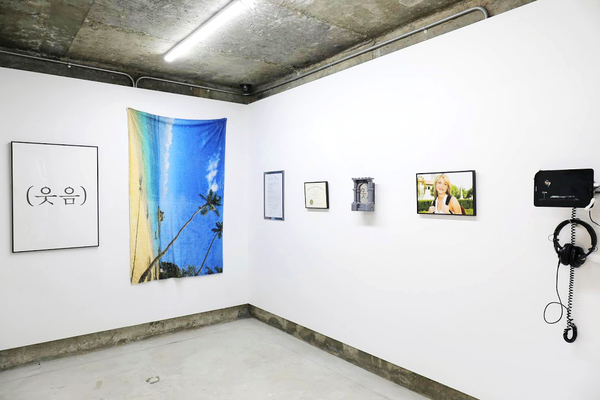
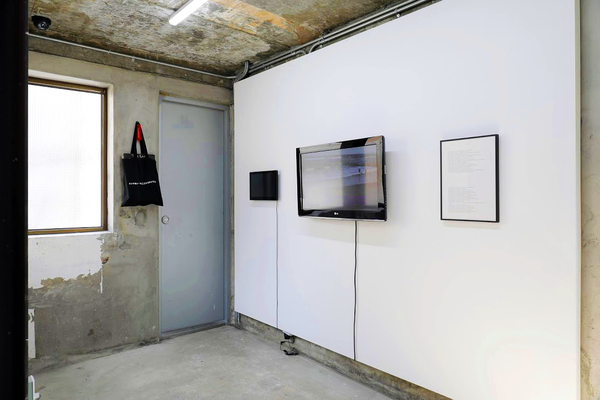
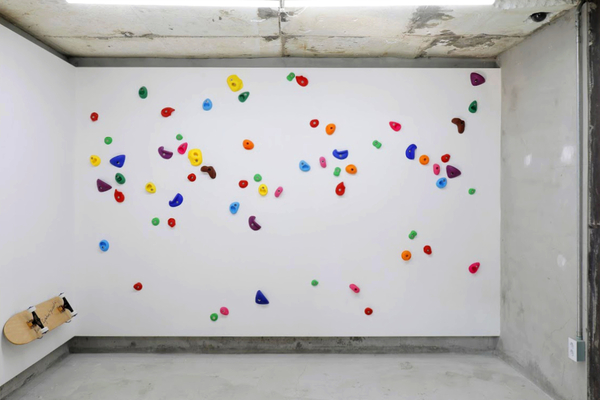
Some products were made with collaborators. Collaboration is an important mode of production at Min Guhong Manufacturing, above all for making better products. Doing everything alone, and doing it skillfully, is not easy today—and, more importantly, is not very good for your health. Here, Min Guhong Manufacturing functioned a little more like a company. It selected collaborators through meetings and sent them purchase orders; they made and delivered the products accordingly. Business cards, a company introduction video, and a short story by Kim Nuiyeon about Min Guhong Manufacturing thus found places in the company’s memories.
Another achievement was bringing “Pinkie” out of the computer.
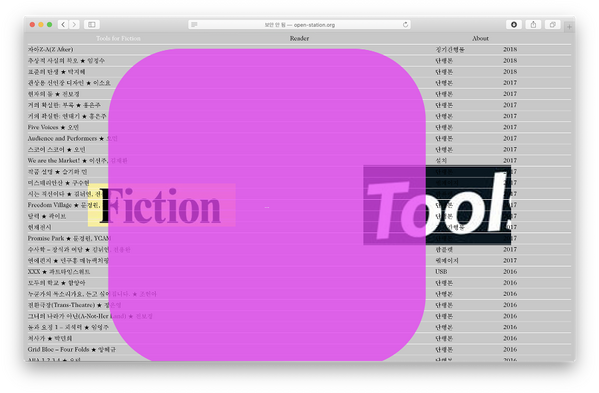
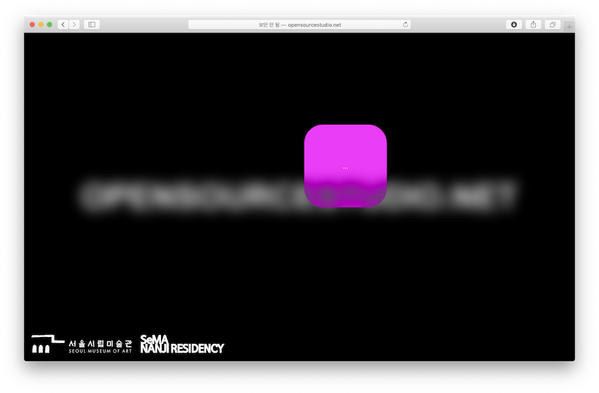
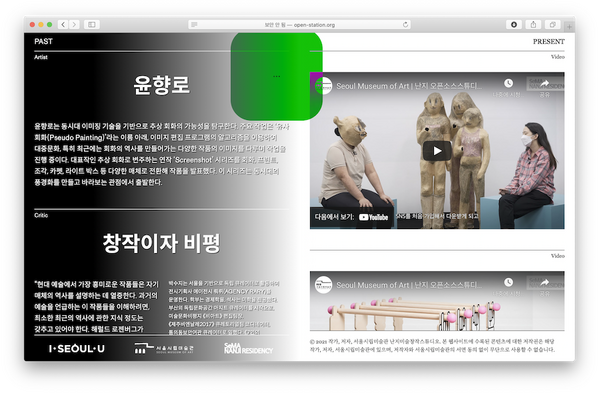
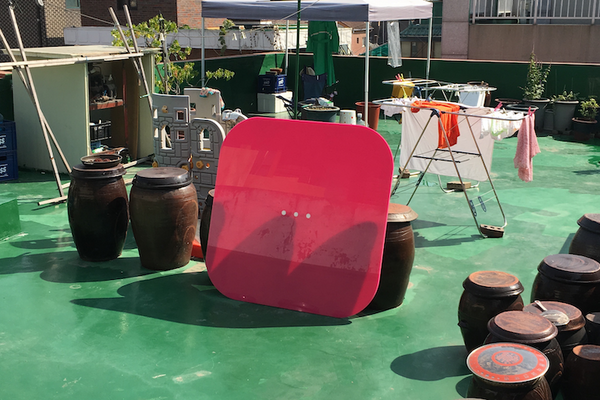
“Pinkie” is the nickname people gave it; its real name is Fuchsine, after the dye that makes a magenta color. A kind of mascot for Min Guhong Manufacturing, Fuchsine was born on a website long, long ago. With help from HTML, CSS, and JavaScript, it took up residence in the website’s head (
<head>), grew larger once a day, and talked to itself when a user clicked it. It loves Pyongyang naengmyeon and dreams of wearing Balenciaga Triple S shoes, but unfortunately it has no legs or feet yet.At the exhibition opening, meanwhile, we played Versatile Opening DJ Set, made with DJ and producer Maalib. Cho Taesang of Byul.org, in particular, called it a useful product for any kind of event in an age when rappers and DJs are busily summoned to all kinds of openings. The rental fee is 150,000 won per hour, equal to the average hourly performance fee of a DJ working in Seoul. The Asia Culture Center once rented it for an entire day.
-
I would like to ask a somewhat sentimental question. As you leave Workroom, what is—or was—Workroom to Min Guhong Manufacturing?
Workroom itself is so special and precious to me that I would not want to call it simply a ‘workplace,’ and I find it difficult to casually say I am ‘leaving.’ I feel as though it would really happen the moment I finished the sentence. During the remaining month, I will wrap up the work I have been involved in. Until I find the perfect expression, I also want to continue, in some form, what my senior colleague Kim Hyung-jin jokingly but sincerely called ‘a relationship in which we exploit each other without awkwardness.’
-
What are Min Guhong Manufacturing’s future plans?
I intend to continue not doing the thirty-seven things listed in About the Company, published when I founded the company in 2015.
-
Is there an attitude we should maintain when making websites?
In Why I Write, published in 1946, the British novelist Eric Arthur Blair, widely known by his pen name George Orwell, identified four motives for his own writing and, more broadly, for writers’ work. This was in 1946, two years before the publication of Nineteen Eighty-Four in 1949.
- Sheer egoism. The desire to seem clever, to be talked about, to be remembered after death, and to get revenge on those who ignored you in childhood.
- Aesthetic enthusiasm. The desire to convey the beauty of the external world, or the beauty of words properly arranged.
- Historical impulse. The desire to pass on to future generations the truth discovered in things and events.
- Political purpose. The desire to change other people’s thinking and push the world in a particular direction.
These four motives apply not only to writing but to every kind of production. At certain stages, someone making a website naturally has to become a designer or a marketer. But before that, they must become a writer and, above all, an editor with sheer egoism. This means recognizing and controlling constraints before expressing one’s desires. No matter how original a novelist’s ideas, communicating with readers is difficult without proper sentences—that is, without following conventions. A website will not work if you break even a small rule. As you find openings within constraints and keep widening them, the constraints become further possibilities. Reading English well also matters, since the latest information on web technologies is primarily provided in English.
Earlier, I said that making a website means adding a dish to the menu of the restaurant called the internet. Not every dish needs to be as elaborate as a full Korean banquet. A whipped-cream cake with a cherry on top or rainbow sherbet will do. What matters is the experience of finishing something from beginning to end, however simple it may be. That experience becomes a reference point for completing other things, and the more often you finish, the higher the reference point rises. The questions and choices you encounter in this process will certainly connect with your other work.
-
Online exhibitions suddenly increased because of the epidemic. How is designing an exhibition website different? And what efforts do you think are needed to overcome the limitations of online exhibitions?
Unless the works are digital and made for the online environment, an online exhibition cannot surpass an offline one. I think that will remain true no matter how far technologies such as VR or AR advance. If a journey begins with packing and heading to the airport, an online version inevitably removes the invisible experiences of being there. I do not believe that online can perfectly reproduce offline, especially in an exhibition. Think of early e-books, which deployed all kinds of technology to imitate turning a page. They were briefly amusing, and that was all. When content is placed on the web, it matters to connect it with the web’s particular qualities as a technology. That is not easy, of course. The possibilities are endless.
If a website merely performs the role of traditional printed media—a poster, leaflet, or catalog—in other words, if it only gathers everything together at the final stage, it gives up many of the web’s possibilities. To make the fullest use of the web in an exhibition, start the project there and make it the platform that guides the whole process. All activity happens and accumulates inside the website; unexpected bugs appear; audiences observe or participate in these situations in real time; a result emerges naturally from the process itself, producing an experience. This comes from the web’s inherent qualities, to which the logic of print does not apply.
An epidemic nobody expected has made online exhibitions unavoidable, but I hope they are more than a passing phenomenon. I would like to think we have discovered a new territory of web design, rather than a brief fashion that fades after the pandemic. I hope it becomes a field we can explore and cultivate further. It would be even better if these websites came to be accepted naturally as works in their own right. In any case, that gives us one more thing to experience.
-
How much further can technology for online exhibitions develop?
I am not sure. Think of early e-books, which used all kinds of technology to recreate turning pages. They were briefly amusing, and that was all. Technologies such as augmented reality (AR) and virtual reality (VR) have appeared, but even Google, a leader in web technology, proposed extreme magnification of artworks on its online exhibition website Google Arts & Culture.
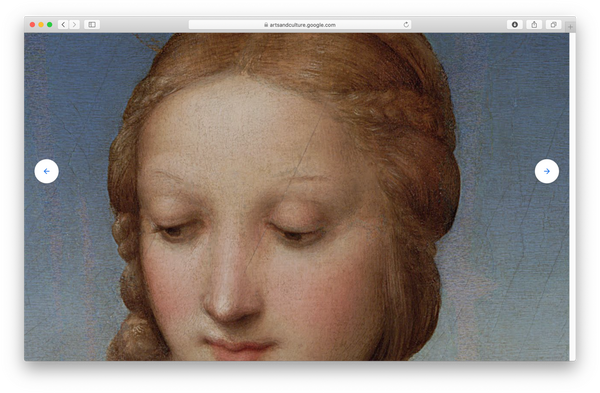
Google Arts & Culture. You can magnify works enormously and inspect even the brushstrokes, but… Websites made through Min Guhong Manufacturing are technically so simple that anyone could imitate them by looking at the source code. What matters is how technology is used. It may be a prejudice, but websites that flaunt technology or visual effects too much make me suspicious of their content. In my experience, this was a last resort when the content was too weak to salvage. It feels like indiscriminately dressing up in high fashion. If a handful of effects also slows down loading, that is the worst. Personally, I like websites that look plain but reveal a humorous or eccentric side the more closely you look. Of course, I do not insist on my personal taste when working, but taste tends to reveal itself naturally in the result.
-
Min Guhong Manufacturing’s official website seems considerably faster.
That is correct. We have used the American company DreamHost for hosting since 2015. We moved from its data center in Oregon, on the west coast of the United States, to Singapore, which is closer to Korea, and also started using Cloudflare’s nameservers. It was not easy, but as a result, our ping time dropped from nearly two hundred milliseconds to under one hundred.
-
At times your company’s ego trip borders on repulsive.
Rather than hating someone, why not find a pretext to make use of them for your own purposes? If you cannot contain your anger and make your hatred public, that too is likely to end up introducing Min Guhong Manufacturing.
-
Do you listen to music in the office?
Almost never. Even when I do, the choices are limited. Laurel Schwulst, who always asks me to introduce her as my ‘best American friend,’ sometimes sends me compilations she has made herself. They contain all sorts of music, but the only artists I recognize are Michael Jackson, Wham!, and Tatsuro Yamashita. Cusco and Syzygys, the Japanese avant-garde organ and violin duo, have also been on my recent playlists. Lee Jaemin of Studio FNT, who sends the company a lovely New Year’s card every year, gave me the complete Cusco LP collection. Unfortunately, I do not have a record player, so, with apologies, I admire it as a decorative object.
-
What is the relationship between Min Guhong Manufacturing’s products, including About the Company, and the ‘editing’ you perform as an employee of your host?
Today, editing is everywhere, just like products. Open the iPhone’s default Mail app and you can immediately see editing’s standing.

I studied literature and linguistics at university. In a fiction-writing class, my teacher explained why he wrote fiction: ‘I just wanted to be good at lying.’ He added, ‘To do that, you have to let fact and fiction coexist.’ Looking back, I think I was a student who took my teacher’s words literally.
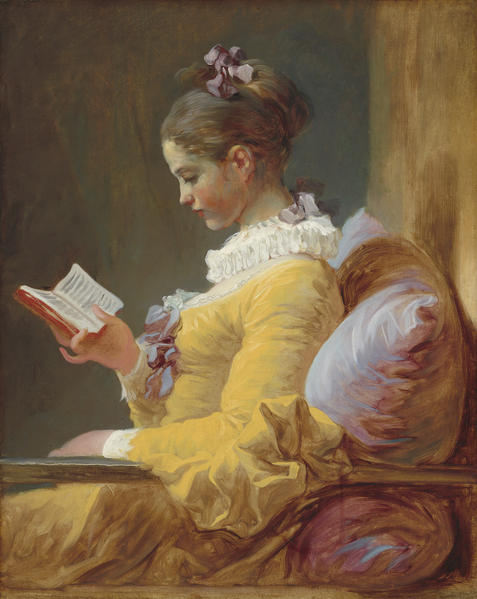
Lately, I have developed an ambition to sum up information about each Min Guhong Manufacturing product in a single line. For now, I have decided to call this product ‘Standard Press Release Format.’ I am studying the bibliography citation rules in The Chicago Manual of Style. It is beautiful: a pure form that is practical and brings content and form into harmony. I do not know when I will finalize it, but the press release format looks something like this:
Product name, “quotation/quoted phrase,” type or types separated by middle dots [·], collaborator or collaborators separated by middle dots [·], year of production/release.
I make use of conventions—or good customs—this way because I have little talent for creating formal beauty. Besides, a convention is beautiful because it has already been completed once, and above all, it is convenient to use. The web may have democratized education, but some things cannot be helped. That is also why I enjoy spending time with designer and artist friends who have abilities I lack.
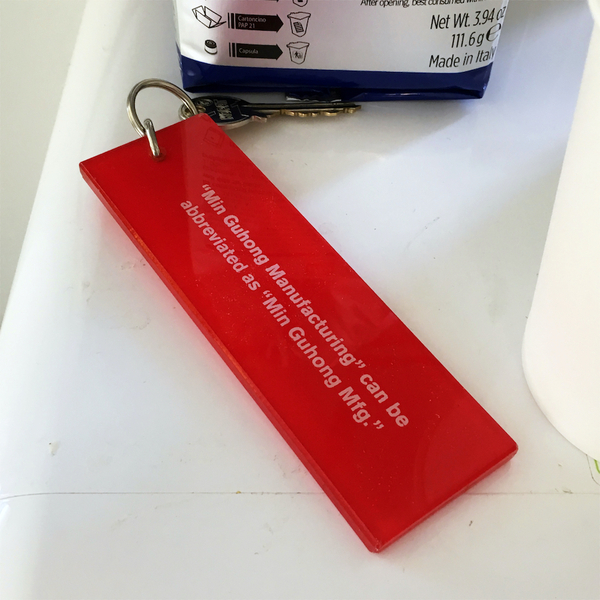
For example, put keys on a key ring and it fulfills its original role. Put your ring finger through it and it becomes a rather strange-looking ring. What if it were printed with the sentence ‘“Min Guhong Manufacturing” can be abbreviated as “Min Guhong Mfg.”’ in a sans-serif typeface? What if it were titled ‘Min Guhong Manufacturing Style Guide, English Edition’? And what if a company promoted it as a ‘product’ that introduced the company?
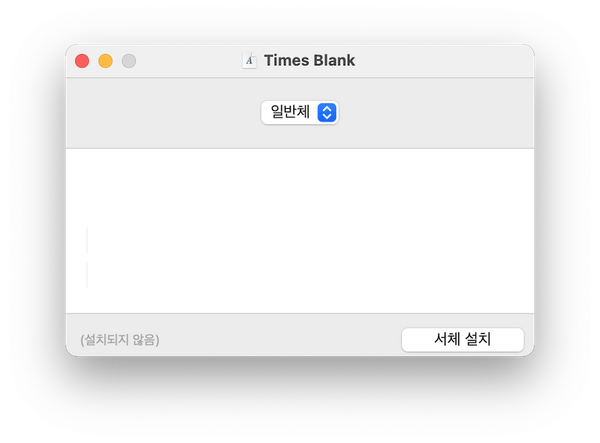
Typographic conventions and grammar are also among Min Guhong Manufacturing’s interests. As you know, looking as though you are doing nothing takes more effort than you might expect. This is not very different from what I actually do as an editor at my host. Times Blank, in which all the letters in Times New Roman have been erased, is in this vein. Times Blank is Min Guhong Manufacturing’s custom typeface. A good one to use while listening to John Cage’s 4′33″… You might even reproduce 4′33″ in text.
-
Hearing this, Min Guhong Manufacturing seems like the result of editing yourself purely for your own happiness—or a set of editorial guidelines for doing so.
I can only be grateful if you see it that way.
-
How did you become interested in web design?
I first encountered a computer in 1991, when I was about seven. It was a Macintosh LC, which still looks wonderful today. I think a kind of fascination with computers naturally began then. At around eleven, I made my first website on Yahoo! GeoCities, a free hosting service. It was for a friend I loved. Thinking about how to make my friend happy, I wrote, made images, and even tried making MIDI music. That seems to have given me a vague sense of the relationship between content and technology. But in 2009, as the dot-com bubble was deflating, Yahoo! abruptly shut down GeoCities. Now that website exists only in my dreams. Back then, I did not even know what a backup was. It is hard to contain this within the term ‘web design,’ but ever since, making something for someone with computer languages such as HTML, HyperText Markup Language, CSS, Cascading Style Sheets, and JavaScript has been a lasting pleasure. In the end, it is something I do for myself, too.
-
There is an urban legend that goes roughly as follows. “One day, a real estate agent took charge of a building. While inspecting its floor plan, the agent noticed something strange. At the center of the building, where the plan showed a room, there was only a wall. With the owner’s permission, the agent eventually tore it down. Inside was a room neatly laid with tatami. A Chinese-style dining table stood on it, and on the table was a bowl of rice, still steaming. The agent searched everywhere, but there was no entrance or exit other than the demolished wall.” Rumor has it that Min Guhong Manufacturing is connected with the building in this story. Is that true?
That is not true.
-
Order and tidiness seem to be second nature to you. Is disorder an accident for Min Guhong? Could you give an example of a disorderly situation you have encountered and explain the sequence in which you devise a response—or sometimes choose not to?
What interests me is not order itself but the process and manner of giving something order. Of course, in some situations I obsess over order to a ridiculous degree, but not everything can be edited into a perfectly tidy state. The National Institute of Korean Language’s attempts to replace every foreign loanword with a Korean alternative demonstrate this. However faithfully you try to follow a set of principles, a situation beyond your control inevitably arises that undermines them, forcing you to add awkward supplementary rules. So my desk and its surroundings, not to mention my home, are far from orderly. As with the web, where all kinds of content and technology mingle—or, closer to home, our own lives—it is better for your mental health to accept that a complete mess is the natural state of things.