FAQ
- Anything to keep in mind?
-
Min Guhong Manufacturing hopes this FAQ will answer your questions about the company and the person who runs it. It brings together interviews, long and short, conducted since 2015, carefully compiled and then scattered into random order. Depending on when a question was asked, some facts may differ from those of today. Honorifics for people mentioned have also sometimes been omitted to suit the tone of the question. If you have read your way through the FAQ and still have questions, please tell us all about them at support@minguhongmfg.com. Min Guhong Manufacturing is ready to understand and acknowledge everything. Please look for a reply in the FAQ someday, though, rather than in your inbox.
-
Was Workroom your first workplace? Were you aware of it before joining? Did starting work at this publisher and design studio have a major influence on how you now run Min Guhong Manufacturing? What was the most important thing you learned there?
Around the time I was accepted to SFPC, I heard from Park Hwal-sung at Workroom: ‘Let’s work together.’ I first met him, along with Kim Hyung-jin and Lee Kyung-soo, while planning 16:00 at Ahn Graphics. They became senior colleagues I liked and respected, and naturally I had imagined working with them. So after finishing school and returning to Korea, I naturally joined Workroom. In fact, without Workroom’s offer, I would probably still be in the United States, working as an artist or teaching, like my classmates. My role at Workroom was editor, but the first things I did were translate Bob Gill’s Forget all the rules about graphic design. Including the ones in this book. into Korean and redesign the Workroom website and the Workroom Press website. This was possible because Workroom did not strictly define its members’ roles. After that, I planned various books, including the Practical Books series, and made websites large and small within and beyond art and design, learning how to work and deal with people. In the process, I was able to introduce Min Guhong Manufacturing more widely. Thanks to Workroom, I spent my early and mid-thirties very happily indeed.
-
I had no idea this world existed. I need to edit my bookmarks again. What, then, makes net art net art?
Ways of seeing and practices that approach websites as new literary and artistic media, as net art does, are closely tied to the concept of ‘hypertext.’ First proposed by Ted Nelson in 1965, it began to realize its potential only with the arrival of the web some twenty-five years later. Put simply, hypertext is text that departs from a linear structure. Instead of reading in an order prescribed by the writer, readers move freely between texts through hyperlinks. The infinitely branching narrative structure of Borges’s The Garden of Forking Paths (El jardín de senderos que se bifurcan) has become a reality. One distinctive difference is that users face not two paths, but more.
-
Hello. I would like to request a written interview with Min Guhong Manufacturing. I have listed the questions below in Times Blank, known as the company’s custom typeface. There are quite a few questions, and I would appreciate answers to all of them.
Pleased to hear from you. Looking through them one by one, most seem to concern matters already discussed in interviews. Why not first consult the FAQ on Min Guhong Manufacturing’s official website? If anything is still missing, please feel free to contact us again.
-
It is appealing that the result of writing can be executed as well as read. Computer languages act as tools that change reality on a different level from natural language.
Creating through code can propose new forms of literature, such as ‘code poetry,’ which uses the grammar and structure of programming languages to write poems. Below is an excerpt from a poem Daniel Holden wrote in C. It may look mechanical at first, but it expresses the beautiful resolve to love you forever. And it can be executed.
for (;love;) {
    while(true) {
        me.love(you);
    }
}
Code can thus become more than a functional tool: a new language for expressing feelings and ideas. Making a website is therefore not merely technical work but a highly creative act in a binary world made solely of zeros and ones. T. S. Eliot said: ‘A skilled writer does not steal language but conquers it.’ The same is true of website makers. They conquer the language of code and use it to create new worlds.
At this point, I would like to suggest a modest lens through which to see websites: as more than stores of information or functional tools—as language systems, works written in those languages, media that move and inspire us, and meeting points between technology and art. Like the Library of Babel imagined by Jorge Luis Borges, perhaps we are already making a world of infinite possibilities through code.
-
You have also participated in exhibitions with websites as artworks, notably Fuchsine. What do you think about web design being presented as art in arts institutions? As graphic design has entered museums, how do you view web design becoming part of the art system?
If you fill an empty building with something convincing and call it a ‘museum’ or ‘gallery,’ people regard it as one. In the same way, what matters is what you call something and how you define it. With a sound enough rationale, anyone can accept it without discomfort. Min Guhong Manufacturing is willing to exhibit the company or its products in museums and galleries, provided it can introduce the company.
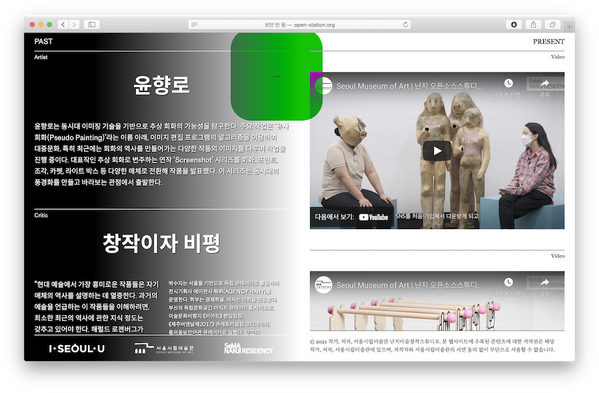
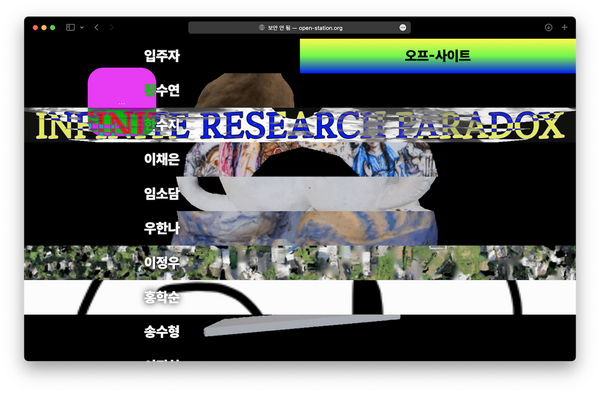
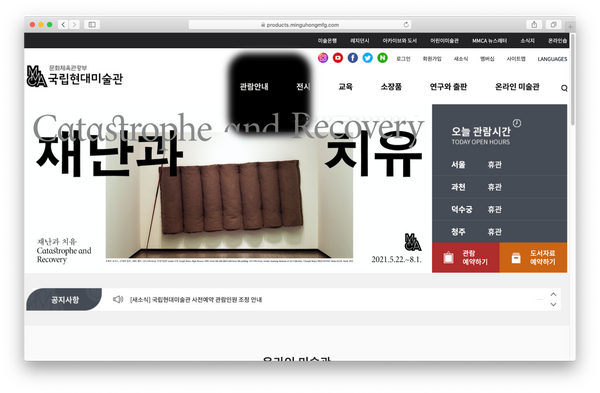
Fuchsine, often nicknamed ‘Pinky,’ was first conceived for Fiction Tool, an exhibition organized by art critic Lee Hanbum. It wanders around the event website, mumbling something to visitors whenever they touch or click it—as a visitor, a docent, or an artist. During the exhibition, it grew once a day until it took over the entire website. It has since appeared on the websites of various art projects. These days it is especially adored by the people at Nanji Art Studio.
-
First, please introduce the company.
Min Guhong Manufacturing (in Korean, “민구홍 매뉴팩처링,” which may also be written without the space as “민구홍매뉴팩처링”) is a one-person parasitic company. “Parasitic” means that it lodges with another company: my workplace. This is one of Min Guhong Manufacturing’s operating methods. It is currently parasitic on Workroom, a graphic design studio and publisher. Its previous host was the South Korean company Ahn Graphics. When I founded it in 2015, I first introduced the company through a list of thirty-seven items. The piece, About the Company, was published as the thirteenth Audiovisual Pavilion Document and was the company’s first product. This was because its main business was unclear then, as it still is to some degree. A somewhat groundless belief also played a part: for any self-respecting company, what it should not do matters more than what it should. Each item remains valid, including “Min Guhong Manufacturing does not collect donations in Bitcoin.”
During a visit to New York a few days ago, I decided to add some items while riding the train back to JFK Airport. Some existing items also needed revision. In doing so, I settled on one principal business that had been unclear until then and put it into a sentence.
Above all, Min Guhong Manufacturing concentrates on introducing the company.
Then I thought I should add a few phrases to make it more specific and avoid confusion.
Above all, Min Guhong Manufacturing concentrates on introducing the company, that is, Min Guhong Manufacturing itself, in various ways.
-
I like the idea of treating online documents issued for publication as publications, just like printed books. EPUB offers various interface features and ways of using links; similarly, readers could trace revisions if they wished, or we could use one symbol for an open document and another for a closed one. Have you thought about developing this kind of web publication?
I find the idea of “open documents” and “closed documents” interesting. In that sense, perhaps we should devise symbols suited to marking website titles. As long as at least one of the three points I mentioned earlier is satisfied.
-
What is the concept of this event at COS?
Red letters that mean stop, prohibition, danger, or warning, but that might also give visitors an unexpected moment of delight, like the message in a fortune cookie.
-
You have made websites large and small, including HOMEWORK at Art Sonje Center (2020), Project Hashtag at the National Museum of Modern and Contemporary Art (2020–), SeMA Coral, Seoul Museum of Art’s shared research platform (2021), Typojanchi 2021 (2021), and the Ob/Scene Festival. Someone even exaggerated a little and called Min Guhong Manufacturing a “website factory.” Your description of websites as the results of writing is particularly striking.
Counting those not open to the public, there must have been around a hundred over roughly two years. When I first settled on the name “Min Guhong Manufacturing”—when I decided to add “Manufacturing” after my name—I vaguely imagined a company mass-producing various “products” through writing and editing. But I never imagined the business would expand this way. I have always thought about not only the content of writing but also its forms and methods. Looking back, perhaps this is the way of writing that suits me. I think of myself as writing and editing in a way I enjoy and do well, rather than designing websites. A website is one result, and it somehow happens to fit someone’s desires today. As I have said many times, Min Guhong Manufacturing is neither a web design agency nor a graphic design studio.
-
As a company, Min Guhong Manufacturing does release products, if only occasionally. Are there any you would recommend as of 2020?
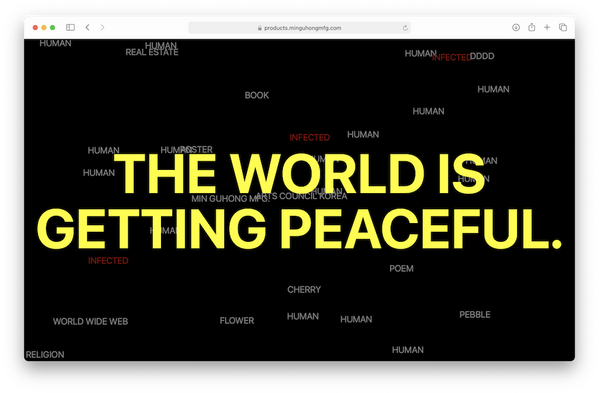
Virus Simulator. Ten humans inhabit the product’s world: five weak and five strong. The user becomes a virus and must find and infect the weak humans. Once all the humans are infected, the world becomes a little more peaceful. Try to infect a strong human instead and you gradually lose lives, while the product inquires after your well-being: ‘Take care of your health.’ ‘How are you?’ Reversing the relationship between humans and viruses, perhaps the product’s message is not that humans are another virus, but ‘Know your enemy and yourself, and you need not fear a hundred battles.’
Dear Messrs. Supreme is an online system that assigns collaboration missions to Supreme, the prominent brand extending its reach beyond fashion into everyday goods. Missions entered by users are sent to Supreme’s official email address and saved on the website. Whether to carry them out is, of course, up to Supreme’s staff. The default mission is: ‘To maintain social distance, collaborate with the Campbell Soup Company to release a tin-can telephone.’
Other products were due to be exhibited at the Seoul Museum of Art, but with public facilities now closed, I do not know what will happen. In fact, I am considering whether creating an opportunity for people to gather physically is ethically right in circumstances like these.
-
We left out the most important items. What brands are your underwear and socks?
Usually Uniqlo. It is not that I insist on a brand from a particular country; there is simply a store ten minutes’ walk from home. As the most important items, they must be easy to replenish as soon as they show any wear. But whatever happens, I do not wear no-show socks or ankle socks.
-
After reading the yellow letters blinking against black for about an hour, almost as a meditation, it seems to me that both “you” and “this” refer to a “website.”
That is one possible reading. Information that once required searching libraries or seeking out experts now pours out when we type just a few characters into a search box. But look behind this for a moment and, as I continually experience myself, deep thought disappears, leaving only clicks and likes. We know more than yesterday, yet perhaps understand nothing. Meanwhile, our personal information is constantly collected and analyzed, sometimes even sold without our knowledge. As the futurist Nicholas Carr warned in The Shallows, our brains grow increasingly accustomed to processing fragments of information. Like Pavlov’s dogs, we respond reflexively to notification sounds. As we endlessly scroll through social media, what have we gained, and what have we lost?
-
If you were to pose a question to VISLA readers based on a memorable event in art, fashion, music, or another area of culture, what would it be?
It is now 2022. What’s more, you may go bankrupt or die before 2023 arrives. At this point, don’t you feel like making some memories with Min Guhong Manufacturing, one way or another, before that happens?
-
What kind of people do you like?
Intelligent people. Probably because I am not one myself. Intelligent people have a sense of humor, and a sense of humor makes someone attractive. That is, it makes you think of them from time to time. And people who can judge whether a sentence they have written is good or bad. Of course, only intelligent people can do that. Most such people also love themselves and, in my experience, are kindly disposed toward Min Guhong Manufacturing. And people with good manners. I would like the company’s clients to consist only of such people.
-
What does a day at Min Guhong Manufacturing look like?
Min Guhong Manufacturing is a parasitic company. Its current host is Workroom, a graphic design studio and publisher. During my contracted working hours, I work hard and as happily as possible as an employee of the host. In spare moments, I do Min Guhong Manufacturing’s work. (This is why most products are simple.) Of course, the two sometimes blur. After work, I used to meet friends, watch television, or read. These days I play a little PlayStation, then fall asleep thinking about Min Guhong Manufacturing’s tomorrow.
-
If we go further and draw on the power of websites, it seems quite possible to bring the Library of Babel into reality. Shall I give it a try?
Unfortunately, you are already too late. It seems we are not the only ones to have entertained that desire. The following website, made by Jonathan Basile, effortlessly realizes Borges’s Library of Babel on the web.
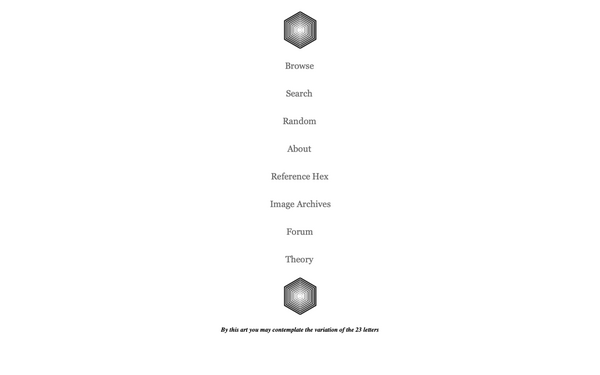
Jonathan Basile appoints himself the library’s librarian. One day, lying in bed, he had the idea of an online Library of Babel and realized it would require far more storage than he could imagine. To get around this limit, he designed an algorithm that simulates the Library of Babel.
-
As of 2021, HTML5, the current HTML specification, uses as many as 113 tags. Which is your favorite?
The
<a>tag. It creates a hyperlink in content to connect it to other content: something like the web’s oxygen, making the web what it is. It is also a defining distinction between print and websites. Content that was merely a footnote, marginal note, or endnote in print gained a new status on the web thanks to the<a>tag. The ‘a’ stands for ‘anchor.’ There are various interpretations, but I imagine that when you click a hyperlink on a website, you drop anchor there and move somewhere else.-
I am a student at the University of Seoul. Could you tell us about your career, from your first job to the present?
I entered design thanks to Ahn Sangsoo. I happened to meet him in my third year at university. After completing military service, I began working as a researcher at his office, Nalgae-jip, in the first semester of my fourth year. I submitted an employment notice to the university and went to Nalgae-jip every day, on the condition that I properly complete my graduation project.
Nalgae-jip was a design studio and another school for me. I did not actually do very much: I joined meetings, added a few words, and watched how the researchers began and finished their designs. Kim Byungjo, Kim Dongshin, and Park Chanshin, whom I met there, were also my InDesign teachers.
While participating in a project connected with Ahn Graphics, I naturally moved there in the second semester of my fourth year. At the time, Ahn Graphics had over one hundred staff. I worked there for about six years, then went to the School for Poetic Computation, moved to Workroom and worked there for about seven years, and returned to Ahn Graphics. I have been director of Ahn Graphics Lab since February 22, 2022.
When I think about it, I have never really taken a break since university. Around the time I completed military service, quite a few people in my unit were preparing to apply to the National Intelligence Service. If I had not met Ahn Sangsoo, I might be serving the country as an intelligence agent myself.
-
Min Guhong Manufacturing’s official website seems not to follow the usual formula for a design studio website.
I have been using cheap web hosting since 2015. It is too slow to display images for every product, so I am simply following its constraints. Besides, Min Guhong Manufacturing is not a design studio.
-
Why does the company make ‘introducing the company—that is, Min Guhong Manufacturing itself—in various ways’ its main business? In other words, why the obsession with ‘introduction’?
Today, regardless of the field, at the root of all productive activity lies a precious, beautiful desire, large or small, to introduce the producer—that is, oneself. In this respect, Lee Ufan, Virgil Abloh, and an artist who has held a solo exhibition at Mapo Lifelong Learning Center are much the same. Min Guhong Manufacturing tries to remain almost naively faithful to that desire. As a company, it simply makes the desire a little more conscious and gives it a form. The company is introduced in various ways: sometimes naturally, sometimes overtly, sometimes unexpectedly, sometimes by relying on someone else’s reputation, and sometimes like this. In a broad sense, carrying out someone else’s commission is also part of introducing the company. Even with the Google Fonts Korean website, which we made with Google, E Roon Kang, Won-Young So, and Yangjang, what matters more than the website itself is the fact stated at the bottom: Min Guhong Manufacturing is a friend of Google Fonts.
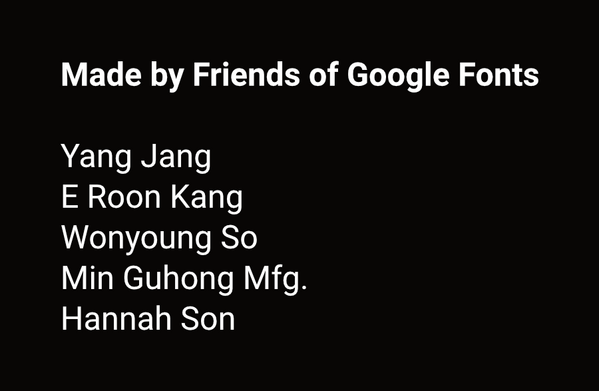
Being friends with a search engine that accounts for about 92 percent of the global search market is certainly something to boast about to older relatives during the holidays.