FAQ
- Anything to keep in mind?
-
Min Guhong Manufacturing hopes this FAQ will answer your questions about the company and the person who runs it. It brings together interviews, long and short, conducted since 2015, carefully compiled and then scattered into random order. Depending on when a question was asked, some facts may differ from those of today. Honorifics for people mentioned have also sometimes been omitted to suit the tone of the question. If you have read your way through the FAQ and still have questions, please tell us all about them at support@minguhongmfg.com. Min Guhong Manufacturing is ready to understand and acknowledge everything. Please look for a reply in the FAQ someday, though, rather than in your inbox.
-
Min Guhong Manufacturing’s official website seems not to follow the usual formula for a design studio website.
I have been using cheap web hosting since 2015. It is too slow to display images for every product, so I am simply following its constraints. Besides, Min Guhong Manufacturing is not a design studio.
-
So your sense of space spreads in every direction like a spider’s web, rather than in a single direction! Let me finish the interview with one last question. I love web publishing, but so much information disappears from the web after only a few years, or even a few months. What do you think about this, and what ideas do you have about archiving?
I made my first website on Yahoo! GeoCities at eleven, for a friend I loved. Since then, after overseeing various websites for more than a decade at Ahn Graphics, Workroom, and Min Guhong Manufacturing, I have gradually become familiar with the birth, life, death, and afterlife of websites. I think a website’s fate ultimately rests with its keeper. In other words, it begins to die when that person stops paying attention, rather than when its hosting expires. I recently wrote about this in an exhibition catalogue:
(…) On July 11, 2022, the National Aeronautics and Space Administration (NASA) released an image of the galaxy cluster SMACS 0723 sent to Earth by the James Webb Space Telescope. The stars glimmering in the darkness are about 4.6 billion light-years from Earth—a light-year being 9.4607 trillion kilometers—so we are seeing them as they were some 4.6 billion years ago. Even without a space telescope, encountering the past through websites has become familiar. Having used websites to record the past since 2006, what they are telling me, themselves, and all of us is that our accumulated yesterdays, rolling this way and that, make today. This is why it matters not only to make and run websites, but to preserve them so they do not simply vanish, even if they are gardens visited by only four or five people a day. If we tend to websites as we water plants, might there sometimes be nights when stars glimmer in the sky above the garden? (…)
Efforts to preserve websites have been underway for some time, including the Wayback Machine, run by the Internet Archive. Some websites Min Guhong Manufacturing made with museums have also been archived as files in their collections. Preserving a website intact matters, but so does being open to its contents spreading across the web and beyond it. With that in mind, for the sake of “nights when stars glimmer,” could we also publish this interview in the FAQ on the official Min Guhong Manufacturing website?
-
The company’s first product, About the Company, lists thirty-seven things the company does not do, in English and Korean alphabetical order. Was that because the company’s main business was unclear at the time?
It still is. Also at work was a somewhat unfounded belief that, for a company, what it should not do matters more than what it does. Every item remains valid, including ‘Min Guhong Manufacturing does not collect donations in Bitcoin.’
-
I am thinking of writing a short paper about Min Guhong Manufacturing. Could you recommend any sources?

I recommend Rainbow Sherbet, Workroom Ghost and Archive Bomm, 2019. Here is the endorsement by the graphic design duo Sulki & Min on the back cover:
Rainbow Sherbet is a book that helps introduce Min Guhong Manufacturing. A few lines of introduction along these lines would be nice. It is a kind of trompe-l’œil, but since there is no separate preface inside the book, this seems a good place to use. Please limit it to around 160 characters, though.
-
Let us turn to online exhibitions. What happens when an offline exhibition is translated online?
Imagine that, in the early winter of 2021, Audiovisual Pavilion Lab hosts an exhibition titled About the Company by Min Guhong Manufacturing. Within the limited space, the works occupy the most conspicuous positions. They might be flat, flat and moving, three-dimensional, or invisible, like sound or Wi-Fi signals. People and their movements might themselves be works. Information about the exhibition is set out to one side in a leaflet or similar form. A guestbook and products such as tote bags or T-shirts might sit beside it. Square images carrying exhibition information appear on social media to announce its opening and closing, and visitors arrive. Inside, curators or docents introduce works, answer questions, and socialize with visitors; outside, talk of the exhibition and its works spreads. Afterward, a catalogue containing critical essays is published, and the exhibition settles into people’s memories.
In an online exhibition, most of this happens on a website. The works appear on web pages as binary data. Surveying the works on the homepage, examining them individually, signing the guestbook, and buying products all take place by moving between pages or scrolling within a single page. A journey begins when you pack your bags and head for the airport; online, such invisible offline experiences are removed. The anticipation on the way to an exhibition, or the pleasure of leafing through its catalogue among other publications, is condensed into typing an address into a browser’s address bar.
-
I am a student at the University of Seoul. Could you tell us about your career, from your first job to the present?
I entered design thanks to Ahn Sangsoo. I happened to meet him in my third year at university. After completing military service, I began working as a researcher at his office, Nalgae-jip, in the first semester of my fourth year. I submitted an employment notice to the university and went to Nalgae-jip every day, on the condition that I properly complete my graduation project.
Nalgae-jip was a design studio and another school for me. I did not actually do very much: I joined meetings, added a few words, and watched how the researchers began and finished their designs. Kim Byungjo, Kim Dongshin, and Park Chanshin, whom I met there, were also my InDesign teachers.
While participating in a project connected with Ahn Graphics, I naturally moved there in the second semester of my fourth year. At the time, Ahn Graphics had over one hundred staff. I worked there for about six years, then went to the School for Poetic Computation, moved to Workroom and worked there for about seven years, and returned to Ahn Graphics. I have been director of Ahn Graphics Lab since February 22, 2022.
When I think about it, I have never really taken a break since university. Around the time I completed military service, quite a few people in my unit were preparing to apply to the National Intelligence Service. If I had not met Ahn Sangsoo, I might be serving the country as an intelligence agent myself.
-
I have another question.
Please send the details to support@minguhongmfg.com. I cannot promise a prompt reply, but I will respond sincerely in accordance with Min Guhong Manufacturing’s Email Response Guidelines. If it is an emergency, you are also welcome to come directly to Workroom, the company’s host. Neither the company nor its host has a sign, though, so be prepared to linger awkwardly in the street for a while.
-
I also found it interesting that, after infecting every vulnerable human and saving the world, you can print the peaceful world to fit a sheet of paper and save it. It felt like a certificate after completing life-or-death training, and offered the small pleasure of commemorating the result materially. Why did you choose this ending?
For viruses or humans, I wish saving the world could be as easy and simple as printing it out and saving it.
-
Since Min Guhong Manufacturing’s products are largely made with web technology, you must also consider the purpose and direction of advanced technology. How much more can the countless products released today improve our lives?
In the winter of 2009, documentary filmmaker Michael Moore visited Tokyo and said, looking incredulous in Akihabara: “They sell an enormous amount of useless stuff here. Shopping may make you feel good, but you are only fooling yourself.” Will we be happier as Dyson’s latest cordless vacuum sucks up dust faster and more thoroughly? Would a world where we could download a one-petabyte file in a second be more beautiful than this one? Technological progress may have little to do with sustaining our happiness. Of course, it might make it easier for you and me to meet. In any case, as someone running a company, I do feel responsible when presenting products to the world. All the more so when promoting them. As stated in About the Company, this is why Min Guhong Manufacturing does not make biochemical weapons, wiretapping equipment, or, above all, shower curtains.
-
Was Workroom your first workplace? Were you aware of it before joining? Did starting work at this publisher and design studio have a major influence on how you now run Min Guhong Manufacturing? What was the most important thing you learned there?
Around the time I was accepted to SFPC, I heard from Park Hwal-sung at Workroom: ‘Let’s work together.’ I first met him, along with Kim Hyung-jin and Lee Kyung-soo, while planning 16:00 at Ahn Graphics. They became senior colleagues I liked and respected, and naturally I had imagined working with them. So after finishing school and returning to Korea, I naturally joined Workroom. In fact, without Workroom’s offer, I would probably still be in the United States, working as an artist or teaching, like my classmates. My role at Workroom was editor, but the first things I did were translate Bob Gill’s Forget all the rules about graphic design. Including the ones in this book. into Korean and redesign the Workroom website and the Workroom Press website. This was possible because Workroom did not strictly define its members’ roles. After that, I planned various books, including the Practical Books series, and made websites large and small within and beyond art and design, learning how to work and deal with people. In the process, I was able to introduce Min Guhong Manufacturing more widely. Thanks to Workroom, I spent my early and mid-thirties very happily indeed.
-
Dynamic websites requiring a content management system, or CMS, are usually built on WordPress. Are there alternatives?
The greatest advantage of a CMS is that users can manage content on a dedicated page without handling code. But not every website needs one. If a site need not change after launch, or the changes are very limited, a static website built mainly with HTML and CSS is more practical. Those two languages alone can make an excellent website.
WordPress, first released in 2003 and continuously updated since, is excellent software. Its long history means many users and thorough documentation, which means many ways to get help when problems arise. About forty percent of the world’s websites are built and run on WordPress, and it accounts for about sixty percent of CMS use. Designed for general use, however, it has so many functions that it is large and heavy by default. As with any CMS, implementing particular functions requires additional programming. If you cannot do that, you have to rely on plugins someone else has made without fully understanding them. Plugins can then conflict, slowing the website down or causing malfunctions, to a degree that makes the motto at the bottom of the WordPress website—‘Code is poetry’—seem hollow.
In Korea, making websites is still sometimes treated as synonymous with using WordPress, but WordPress is just one of countless CMSs. There is no single right answer when choosing and using technology, only slightly less or more refined approaches. Among CMSs relatively little known in Korea, Omeka is worth attention for its support for Dublin Core, a standard set of metadata elements.
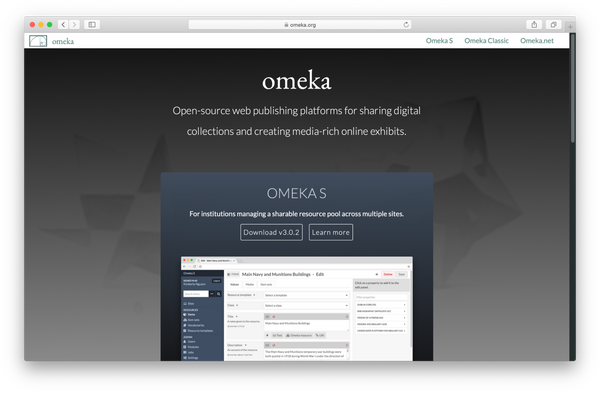
Omeka Recently, I joked with E Roon Kang of 908A in New York about making a CMS tailored to how the art and design worlds produce and consume content. This points to a more active model: developing a CMS that suits you. Indexhibit, by Daniel Eatock, once widely used in graphic design both in Korea and abroad, is a good example. Linked by Air developed Economy, Area17 developed Twill, and Labud developed Forest. Min Guhong Manufacturing uses Management, its own customization of open-source software. Perhaps there will be another opportunity to discuss it. No—better still, try it yourself as a client of the company.
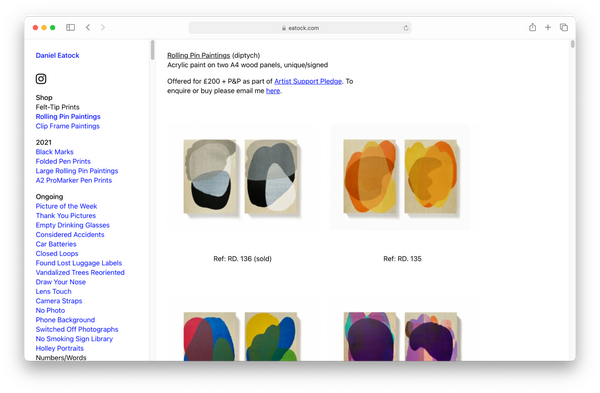
Daniel Eatock’s website runs on Indexhibit, which he developed. As the CMS’s name suggests, an index of works appears on the left, while the exhibition takes place on the right. -
Min Guhong Manufacturing says it ‘focuses on introducing the company—that is, Min Guhong Manufacturing itself—in various ways.’ Why are you so devoted to ‘introduction’?
At the root of every productive activity is a desire to introduce something, and ultimately oneself. In the face of this desire, Lee Ufan, Virgil Abloh, and an artist holding a first solo exhibition at Mapo Lifelong Learning Center are no different. Besides, introduction is a necessary step, something you have to do anyway. I believe a story can begin even if you concentrate on that alone. That is what makes introduction worth questioning. Min Guhong Manufacturing is the result of becoming a little more conscious of this desire and giving it a form. If ‘water drops’ were the subject Kim Tschang-yeul had to investigate, then for Min Guhong Manufacturing that subject is ‘introduction.’
-
What are Min Guhong Manufacturing’s future plans?
I intend to continue not doing the thirty-seven things listed in About the Company, published when I founded the company in 2015.
-
Wouldn’t ‘frequently asked questions’ be a more sophisticated expression than ‘frequently posed questions’?
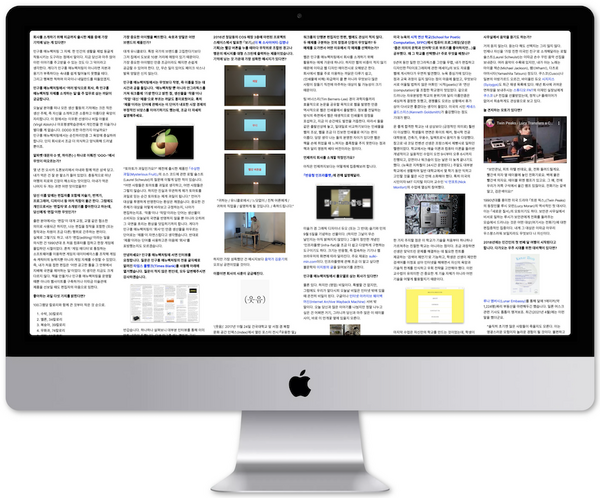
I have considered the Korean expression ‘자주 묻는 질문,’ or ‘frequently asked questions.’ But since the Korean word for ‘question’ already contains the meaning ‘to ask,’ I decided it was redundant. If you have a better expression, please suggest it. I am prepared to go back and edit every title I have used so far.
-
I am a curator planning an exhibition that looks back at the art world in the ‘post-COVID era.’ I hear you have built websites for online exhibitions and helped plan some of them. Could you suggest a suitable exhibition title?
How about ‘There Will Be No Opening Reception,’ taking a cue from a sentence that came naturally to so many exhibitions?
-
Thank you. Finally, is there anything you would like to say to the Yeonhui Literature Creation Village, which runs the webzine Biyu (비유)?
It is time for writers who use websites as their medium to take their rightful place in residence at the Yeonhui Literature Creation Village. Embracing websites as literature, in a manner worthy of literature, is another way for literature to link arms with “today.” That would be a path toward making something new, rather than a second or third Han Kang.
-
Are there websites you refer to while working? Any you would recommend?
For reasons of time, I do not think I can share my nearly one thousand bookmarks. I do refer to well-made websites. But if a result is too attractive, I find myself unconsciously copying it, regardless of the content. Instead of looking only at the visible result, I consider how the content was approached and handled, and imagine the working process from the beginning. Websites made purely for their creators’ own happiness catch my eye. In particular, I often visit Neocities and FC2 Web. Such websites can be visually rough, but they are not bound by formulas and sometimes gleefully defy them. Their content and the way they handle it recall something I had briefly forgotten, while making me forget newer technologies such as CMSs and JavaScript. They even make me want to become friends with the people who made them.
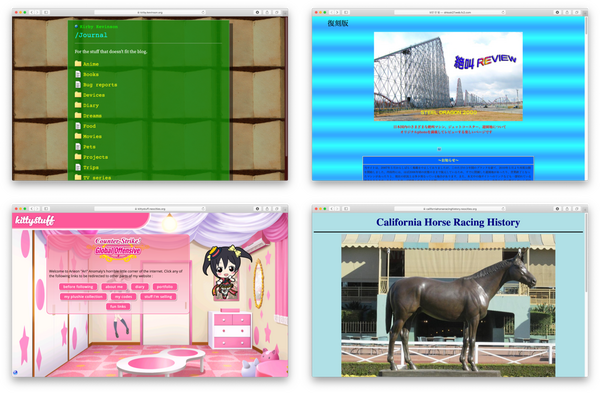
Looking at websites made purely for their creators’ own happiness recalls something briefly forgotten. For the latest web technologies, meanwhile, there is nowhere quite like MDN Web Docs, run by the Mozilla Foundation.
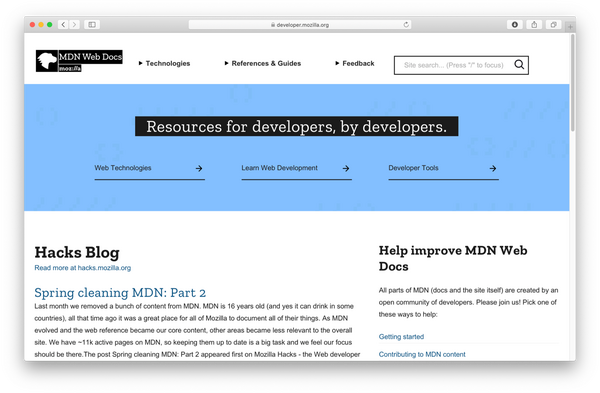
MDN Web Docs -
Was there an object or a period of time that felt like a luxury to you at twenty-five?
Most of the times I have lived through were more than I could handle then, so perhaps they were all luxuries. A luxury is like a gift that is hard to handle. Some I have since managed to handle and make fully my own; with others I have failed, so they remain luxuries. But is luxury really something to avoid? Looking back, perhaps I was fortunate to know how to enjoy those luxuries to the full.
-
So creating an object requires three layers: structure, presentation, and function. It reminds me of Noam Chomsky’s words: ‘Language is a finite system of rules that permits infinite expression.’
Both natural languages and computer languages have grammatical structures, convey meaning, and express abstract concepts. But computer languages make possible things that natural languages cannot realize. In short, code written in a computer language can be executed. Neal Stephenson, the author of Snow Crash, called this ‘the executability of language.’
-
What is the significance of Choi Jeongho’s Hangeul designs?
Perhaps that he established the standards for the Myeongjo and Gothic typefaces we use today. There are differing views, and I do not know whether that was his intention.