FAQ
- Anything to keep in mind?
-
Min Guhong Manufacturing hopes this FAQ will answer your questions about the company and the person who runs it. It brings together interviews, long and short, conducted since 2015, carefully compiled and then scattered into random order. Depending on when a question was asked, some facts may differ from those of today. Honorifics for people mentioned have also sometimes been omitted to suit the tone of the question. If you have read your way through the FAQ and still have questions, please tell us all about them at support@minguhongmfg.com. Min Guhong Manufacturing is ready to understand and acknowledge everything. Please look for a reply in the FAQ someday, though, rather than in your inbox.
-
I am a graduate of Paju Typography Institute. Are there characteristics specific to typography on websites?
Early in 2022, I was fortunate enough to visit Princeton University in the United States to give a talk. I showed a photograph of a grandmother, daughter, and granddaughter and said that a website is a book’s child: an evolved printed book. If the grandmother is a printed book and the daughter a website, the granddaughter is something else we might make in the future. As evolved printed books, websites face fewer spatial constraints than printed pages. Concepts such as format and page count, which affect production costs, become less distinct. In my experience, applying measurements for print typography directly to a website makes everything feel a little too small, narrow, and cramped. Ten-point type, a common body size in print, is roughly 13.5 pixels, and I see no reason to doubt browsers’ default body size of 16 pixels. Some people recommend 18, 20, or more. I also think line spacing should be a little more generous than in print. That probably explains why long texts often separate paragraphs with a blank line rather than an indent. It is also worth considering that websites appear on luminous screens, using RGB colors, so the contrast between black and white is greater than on a printed page.
-
Min Guhong Manufacturing’s official website seems considerably faster.
That is correct. We have used the American company DreamHost for hosting since 2015. We moved from its data center in Oregon, on the west coast of the United States, to Singapore, which is closer to Korea, and also started using Cloudflare’s nameservers. It was not easy, but as a result, our ping time dropped from nearly two hundred milliseconds to under one hundred.
-
Many titles precede your name: editor, author, translator, programmer, designer. Yet you say that, as an individual, you prefer to be introduced as an ‘editor.’ What does ‘editing’ mean to you?
In publishing, ‘editing’ is usually used in a narrow sense, such as proofreading or copyediting. I tend to regard editing as an activity that includes creation—or exists on a somewhat different plane from creation. That is also how it works in practice. I became conscious of editing in the early 1990s, when I first encountered computers and was deeply absorbed in games. Software commonly called ‘game editors’ let me manipulate a game’s database, changing not only a character’s attributes but the game itself. So the first kind of editing I encountered was ‘taking command of an established framework, from within and without, to control the situation.’ My thinking has not changed much since. I approach things with an editor’s mindset not only when making books or running Min Guhong Manufacturing, but also when building websites or occasionally showing products in art museums.
-
Do you have a favorite website?
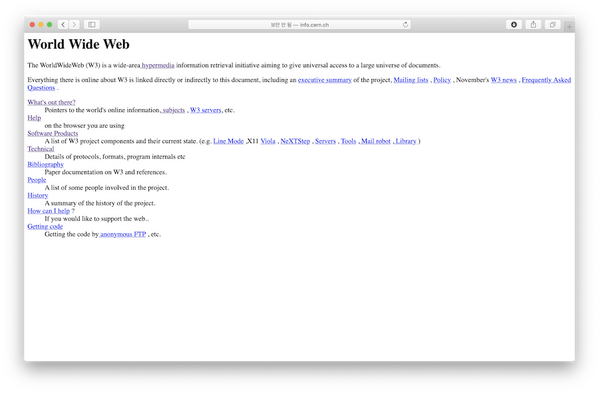
The world’s first website, surely made by Tim Berners-Lee. It clearly embodies what Min Guhong Manufacturing pursues. The content is elegant and practical; the technology is old, yet still works without trouble more than thirty years later. As of 2020, there are said to be around 1.7 billion websites on the web. That means there are more than 1.7 billion ways to make a website. But we do not know everything, nor do we need to learn it all. We have many other things to do, such as living.
-
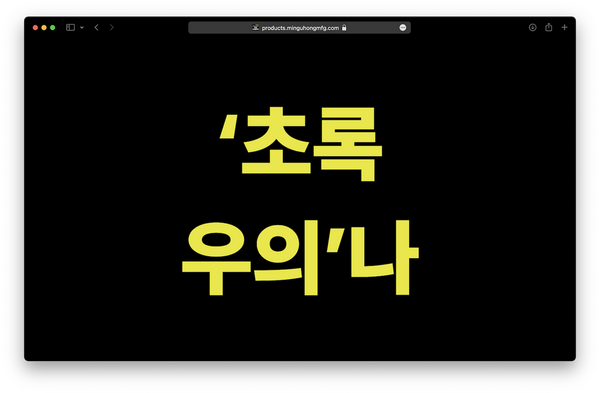
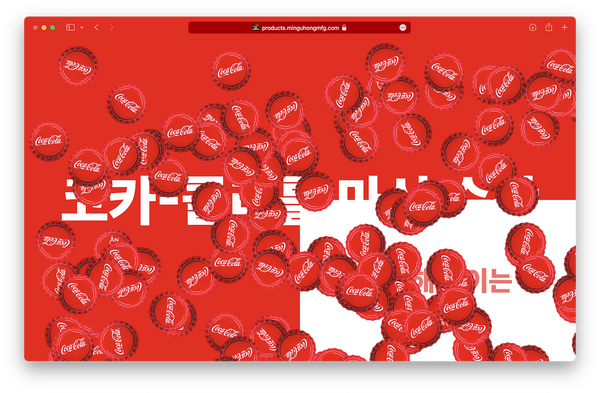
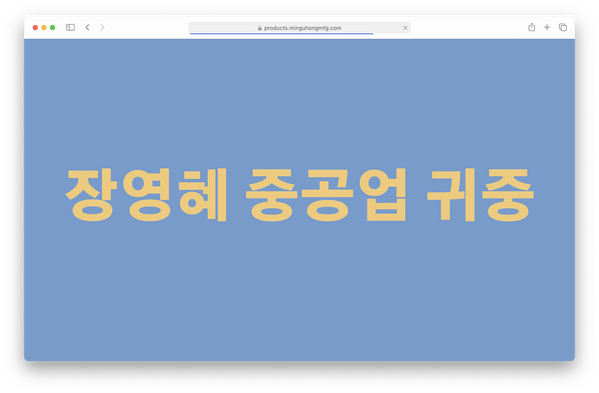
Min Guhong Manufacturing’s product Dear Messrs. Young-Hae Chang Heavy Industries looks to me like a lovely love letter. I am not sure whether I may call it that, but do you plan to develop a series of ‘love letters’?
Looking back, there were also To You and Dear Messrs. Coca-Cola Korea. Since I have yet to receive a reply to any of them, I will follow your suggestion and call them a ‘love letter series’ from now on.
-
I am a curator planning an exhibition that looks back at the art world in the ‘post-COVID era.’ I hear you have built websites for online exhibitions and helped plan some of them. Could you suggest a suitable exhibition title?
How about ‘There Will Be No Opening Reception,’ taking a cue from a sentence that came naturally to so many exhibitions?
-
More than thirty years have passed since Sir Tim Berners-Lee, the British computer scientist working at CERN, the European Organization for Nuclear Research, opened the web to the public. Its history is shorter than one might think. How has the web developed in that time?
The web is divided into versions according to how content is produced and consumed. Web 1.0 refers to the early period from 1994 to 2004. In Web 1.0, content flows in one direction, from producer to consumer; consumers can view it but cannot control it. Web 2.0 followed, and users moved to blogs and social media services rather than making personal websites. Producing and consuming content became much easier, and the boundary between producer and consumer blurred. At the same time, however, the culture of making personal websites cooled far too quickly, especially in Korea. The present, still difficult to define, is the age of Web 3.0; experts have also identified artificial intelligence as one of its main features. A new version shifts the dominant current, but the previous version is not discarded entirely. Today’s web is a jumble of all these versions, sometimes blended within a single website. Among Web 2.0’s representative technologies, trackbacks—which let websites or blogs refer to one another—are interesting, but sadly are now rarely used.
-
Have any of your personal plans changed or been canceled?
With even overseas travel out of the question, my wish to emigrate after turning forty, some five years from now, has become an indefinitely deferred dream. Every night before bed, I console myself by looking at the immigration websites of countries I want to move to and travel accounts other people have posted on their blogs.
-
Some people name books as their ‘mental food.’ Do you agree?
It would depend on the person. If mental food means something that benefits the mind, it is hard for me to agree as someone who makes books. Reading, looking at, and touching books all fall within the category of work for me. After wrestling with all kinds of books from ten in the morning until seven in the evening, I generally don’t want to deal with any more books after work. Making books is enjoyable, but you can’t drink nothing but corn silk tea all the time. After eight hours of making books, my mind has tilted to one side. I straighten it out with PlayStation games, thriller films, or Min Guhong Manufacturing.
-
What did a crisis look like to you at twenty-five? When did you feel you were in crisis?
I was twenty-five in 2009, sixteen years ago. I entered military service in the summer of 2007, so that would have been just after my discharge and return to university. A chance encounter with Ahn Sangsoo of Hongik University led me to work as a researcher at his studio, Nalgae.jip. To recognize a crisis, you generally need to take some “right answer” as a standard, measure your present against it, and sense anxiety in the gap. But I think I lived without thinking much about it. (To put a flattering spin on it, I was always suspicious of any supposedly right answer.) With little thought, there was no crisis, and I was not even anxious about not thinking much. It is the same now. A crisis seems to seep into us unawares when we step into a framework of language someone else has made—into the depths of language.
-
I would like to return to my first question. When introducing Min Guhong Manufacturing, you use the word “parasitic” to describe its relationship with Workroom. Since Workroom is a publisher, this also sounds like your own way of understanding the relationship between the web or online world and the physical or offline world. How do you think this understanding appears not only in your relationships with Workroom and your clients, but also in your “products,” to use your term for your work?
“Product” is simply the word I arrived at while looking for a suitable term for the things made using the skills of Min Guhong Manufacturing, which calls itself a company. Of the media the company has worked with through its various products, it particularly loves websites. By their nature, websites are reproduced and consumed in large quantities. I felt this chimed with the original meaning of “manufacturing”—mass-producing new products by applying physical or chemical processes to materials or components—which sits proudly in the company’s name.
As a one-person company, Min Guhong Manufacturing inevitably has to rely on something to keep running smoothly. The word “parasitic” lays this fate bare. This also relates to the nature of websites. Almost everything on the web converges on the web browser. A website cannot reach its users without one. In short, websites are inherently dependent on web browsers as their hosts. This fragility and incompleteness make the website a medium worth continuing to explore.
On February 22, 2022, Min Guhong Manufacturing moved from its host Workroom to Ahn Graphics Lab (AG Lab), an independent division of Ahn Graphics whose identity remains a mystery. To return to an earlier answer, I acquired another title: director. The host has changed, but whenever Min Guhong Manufacturing is needed, it continues to work with Workroom, as it did on Busan Biennale 2022 and An Exhibition with Little Information. The company’s way of being a parasite is evolving toward symbiosis, something I had in mind from the time I decided to use the word “parasitic.”
-
I am a graduate of Paju Typography Institute. How do you consider a website’s visitors?
Even if a website contains wonderful content or its code is perfect, you cannot even view it without a web browser. The browser is the destination of all web technology. Ultimately, what matters most to users is how the site works in their browser. In that respect, I place the greatest importance on loading speed. Statistics apparently show that many people give up on viewing a site if it takes more than three seconds to load. For image-heavy websites, I pay close attention to image file sizes. I think they should be as small as possible without degrading image quality. I use every available means to achieve this, even removing unnecessary image metadata. Alternative text for images and contrast between text and background colors are also important for blind and partially sighted people. Semantic HTML markup that avoids a disorderly proliferation of
<div>tags is, of course, a basic requirement.-
The recently launched website for Alternative Space LOOP is impressive.
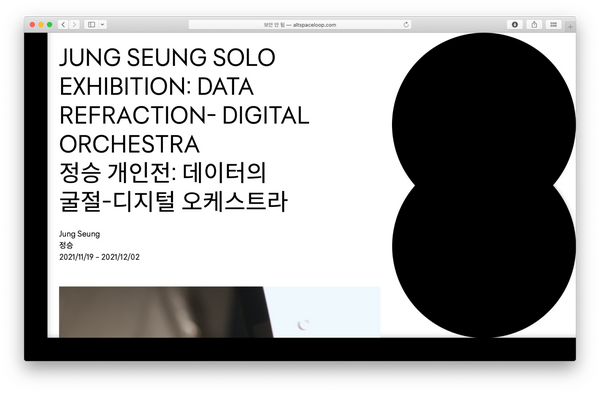
In general, a gallery website inevitably takes the form of a meta-exhibition because of its content and structure. Alternative Space LOOP’s website is no exception. Its elements suggest the English name ‘Loop’ while also serving as navigation between pages. The second ‘O,’ which changes randomly each time you visit, links to a past exhibition. I wanted not only visitors but also the members of LOOP to revisit the time accumulated there. Min Guhong Manufacturing also supported LOOP by donating the website’s production. It was my way of supporting the activities of a pioneer of alternative art spaces in Korea.
-
What do you think about converting one language into another—that is, translation? You have also translated books. Is it something you do often?
I have never thought of myself as a translator, but in my experience, the process of translation resembled coding: there is a source language, or input; a target language, or output; and between them, translation, or a function.
Interestingly, this also resembled the process of writing poetry as I had learned it: there is a poetic subject, or input; a poem, or output; and between them, poetic perception, or a function. This thought became clearer when I recalled my experience at the School for Poetic Computation, or SFPC. That is why I like to say that I mainly learned literature and linguistics there, rather than computer programming.
-
Since this is a special issue on graphic design education, I would like to ask about the School for Poetic Computation, where you studied. Why did you decide to go? What did you expect from the school, what kind of student were you, and was there a gap between expectation and reality?
It was my fifth year at Ahn Graphics. Even before graduating from university, I had happened to work as a researcher in Ahn Sangsoo’s studio at Hongik University, known as Nalgaejip, and then naturally joined Ahn Graphics. I had never really taken a break. I think I needed some rest. Work was beginning to bore me, too. Around then, I happened to hear that the School for Poetic Computation, or SFPC, in New York was recruiting students for its summer term. What caught my interest was purely the name. The combination of ‘poetic’ and ‘computation,’ two words that seemed unlikely to go together, was wonderful. The name also overlapped somewhat with my own life: I had studied literature, particularly poetry, at university and loved computers since childhood. Browsing the school’s website, I thought it was a little strange. ‘Our motto is: More poetry, less demo.’ I tilted my head and grew curious at the same time. I also liked that Kenneth Goldsmith, an American poet I admired and the operator of UbuWeb, had taught there. I hoped to meet him. When I actually arrived, the school was much stranger than I had imagined. SFPC is an alternative art school founded in New York in 2013. A small group of students and faculty work closely together to explore the intersections of code, design, hardware, and theory, with art at the center. It was not a ‘kind’ school that explained everything one step at a time from the beginning. It guided us toward solving problems ourselves, and classes ran from morning until evening all week long. Compared with a conventional university, the course probably amounted to about two years of study. I did not meet Kenneth Goldsmith. As of 2023, SFPC’s classes are held online.
-
What is the relationship between Min Guhong Manufacturing’s products, including About the Company, and the ‘editing’ you perform as an employee of your host?
Today, editing is everywhere, just like products. Open the iPhone’s default Mail app and you can immediately see editing’s standing.
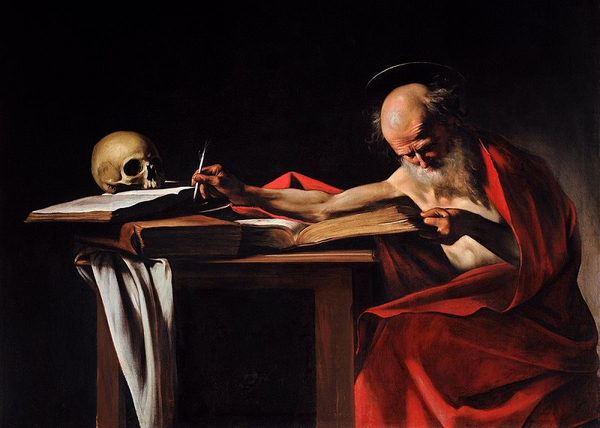
I studied literature and linguistics at university. In a fiction-writing class, my teacher explained why he wrote fiction: ‘I just wanted to be good at lying.’ He added, ‘To do that, you have to let fact and fiction coexist.’ Looking back, I think I was a student who took my teacher’s words literally.
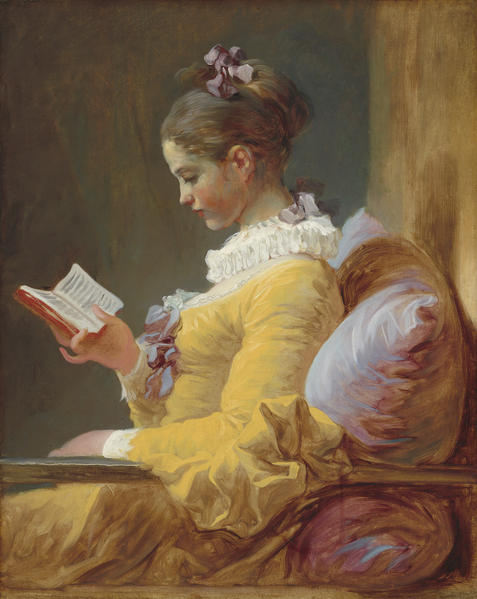
Lately, I have developed an ambition to sum up information about each Min Guhong Manufacturing product in a single line. For now, I have decided to call this product ‘Standard Press Release Format.’ I am studying the bibliography citation rules in The Chicago Manual of Style. It is beautiful: a pure form that is practical and brings content and form into harmony. I do not know when I will finalize it, but the press release format looks something like this:
Product name, “quotation/quoted phrase,” type or types separated by middle dots [·], collaborator or collaborators separated by middle dots [·], year of production/release.
I make use of conventions—or good customs—this way because I have little talent for creating formal beauty. Besides, a convention is beautiful because it has already been completed once, and above all, it is convenient to use. The web may have democratized education, but some things cannot be helped. That is also why I enjoy spending time with designer and artist friends who have abilities I lack.
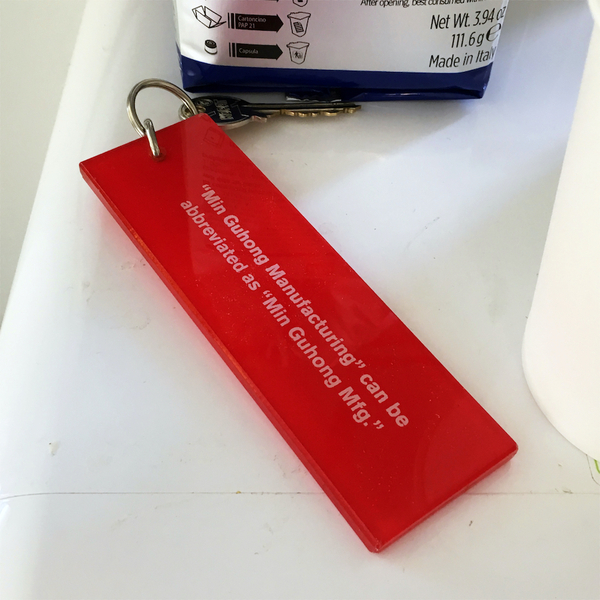
For example, put keys on a key ring and it fulfills its original role. Put your ring finger through it and it becomes a rather strange-looking ring. What if it were printed with the sentence ‘“Min Guhong Manufacturing” can be abbreviated as “Min Guhong Mfg.”’ in a sans-serif typeface? What if it were titled ‘Min Guhong Manufacturing Style Guide, English Edition’? And what if a company promoted it as a ‘product’ that introduced the company?
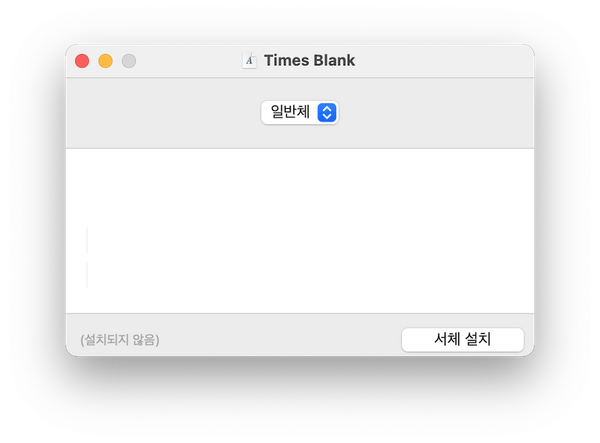
Typographic conventions and grammar are also among Min Guhong Manufacturing’s interests. As you know, looking as though you are doing nothing takes more effort than you might expect. This is not very different from what I actually do as an editor at my host. Times Blank, in which all the letters in Times New Roman have been erased, is in this vein. Times Blank is Min Guhong Manufacturing’s custom typeface. A good one to use while listening to John Cage’s 4′33″… You might even reproduce 4′33″ in text.
-
You redesigned the Min Guhong Manufacturing website after ten years. Is this also one of the company’s “products”? And what did you focus on this time?
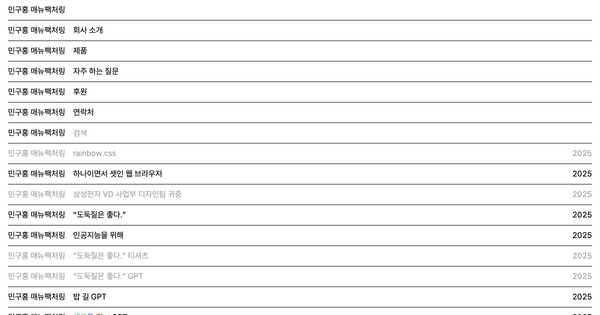
It is closer to an interim review than a redesign. At Min Guhong Manufacturing, things that look like products are products, but so are things that do not: a character, a phrase, a sentence, a paragraph, a piece of writing, an unrealized plan, even a basketball abandoned by the roadside and the stone beside it. As long as we call them “products.” For this project, meanwhile, I adopted the following motto: “If we cannot return to the past, we have no choice but to edit it.”
-
It is still hard to tell exactly what Min Guhong Manufacturing does, but it has been involved in many things, large and small. What matters most to you when beginning a job?
I do not present myself as a fixer. In meetings, I sometimes feel as though I am supposed to solve every problem effortlessly. There is a certain expectation of that, too. If I give in to the temptation—in other words, fasten the first button wrong—unmanageable suffering begins to swell at some point. Above all, it is important to share the company’s limits and particular strengths with the client and reach a mutual understanding, so that the client can make good use of Min Guhong Manufacturing.
-
You work with both print and digital media, though in different roles. Do your favorite books share any characteristics? If so, how do these differ from your favorite websites?
They look peaceful and innocent at first, but the closer you look, the more unsettling something becomes. (Or the reverse.) They preserve their initial logic and principles to the end while breaking them at the same time. They are light.
As a consumer, I only need the content to be useful to me. That is inevitably relative and changeable. When making a pie for a snack, for instance, Carl Sagan’s Cosmos does not guarantee that my ‘cosmic’ pie will taste good.
I have a little more to say about form. The more perfect the microtypography, the better, but I am less sure about macrotypography. Sometimes a single pretty photograph of a flower on the front cover is enough. What matters is whether it is a daffodil or a poppy.
I also teach the web, broadly, and interactive design, more narrowly, at design schools. I often tell students that a website is a book with no fixed format, volume, or weight, and a book is a website with volume and weight but no hyperlinks or scrollbar. As you know, the web began as a way for scientists to collaborate by sharing papers, so websites owe much of their form to books. At some point their forms parted at a fork in the road, but their destination is the same. (Their paths seem to lie inside a tesseract.) Of course, books are at a considerable disadvantage when moving house. Websites, on the other hand, can be changed at any time even after they are ‘published.’ Without restraint and decisiveness, that raises your chances of carpal tunnel syndrome, so take care.
-
The previous example seems useful when planning an online exhibition around content and technology. Could you introduce other projects that made active use of a website?
A website’s beauty doubles when it serves a practical purpose: when it leads a project from the outset, for example. thisisneverthisisneverthat (2020), which Workroom made with the fashion brand thisisneverthat, was not initially planned at all. The website was a tool for organizing information on some 3,000 items to be included in a book. Using Excel or Google Sheets to organize images, product names, product codes, types, colors, materials, and other information made reworking the data inconvenient. At first, it resembled a headless CMS that managed only a database, with no frontend. As the database grew, it naturally expanded into a full website. If a website performs only the traditional role of print, it gives up many of its possibilities.
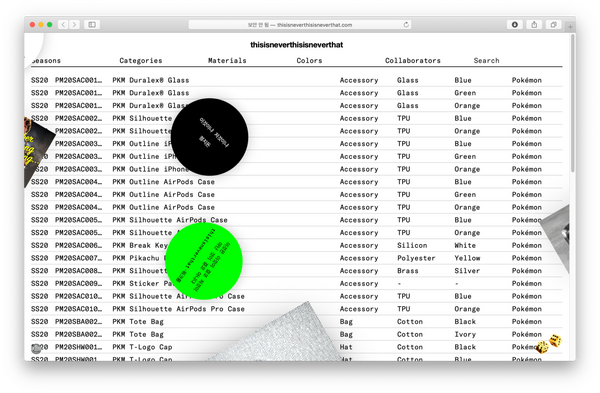
Min Guhong Manufacturing, thisisneverthisisneverthat, 2020, website. Image courtesy of the artist The recent Typojanchi 2021 project was not so different. Content for the catalog was also edited on a website initially built as a working tool.
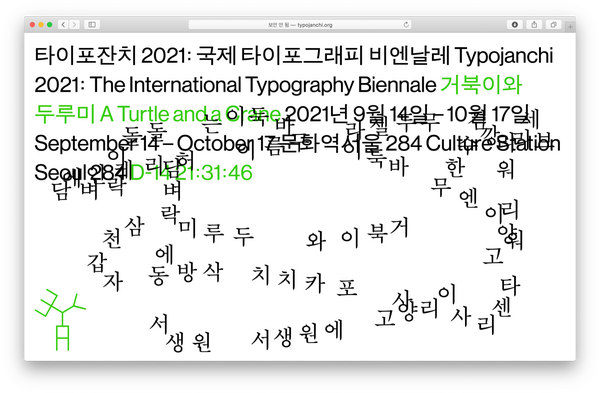
Min Guhong Manufacturing, Typojanchi 2021 Preview, 2021, website. Image courtesy of the artist 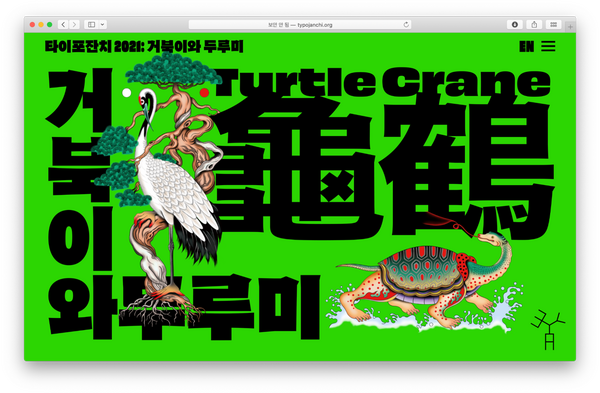
Min Guhong Manufacturing, Workroom, Typojanchi 2021, 2021, website. Image courtesy of the artist For We Came from the Sea (2021), organized by Kim Ikhyun, Park Gahee, and Lee Miji, we used a Wi-Fi router called the “Ogasawara Kit.” First, we made a recruitment website that collected and analyzed participants’ names, places of residence, phone numbers, email addresses, and so on. Applicants in Korea received a particular link; those overseas received an Ogasawara Kit. Inspired by the experience of connecting to the internet at an airport or Starbucks, the main website could be accessed only through the kit. Through this, we tried to address the act of connecting to the internet itself, before reaching a website.
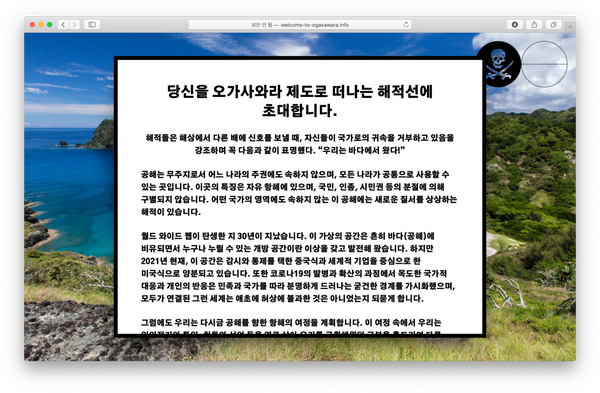
Min Guhong Manufacturing, We Came from the Sea, 2021, website. Image courtesy of the artist