Document to Document
Markdown is a lightweight, intuitive markup language created in 2004 by John Gruber and Aaron Swartz. Their goal was clear:
To make a format that is easy to read, easy to write, and easy to convert into web content.
Markdown is an agreement that helps us focus on the essence of writing rather than a syntax for visual decoration. Document to Document is the result of a desire to share the power and beauty within Markdown’s simplicity and intuitiveness.
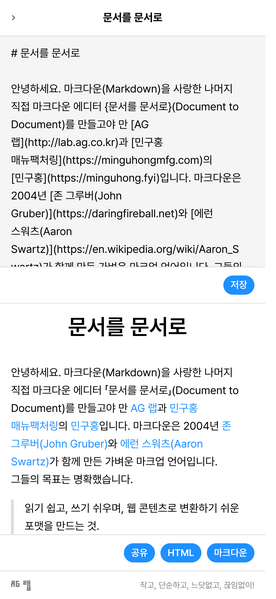
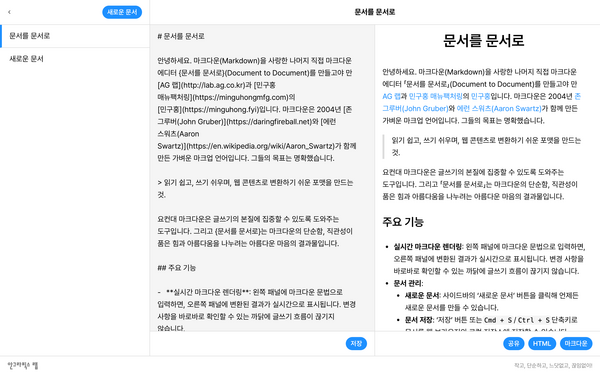
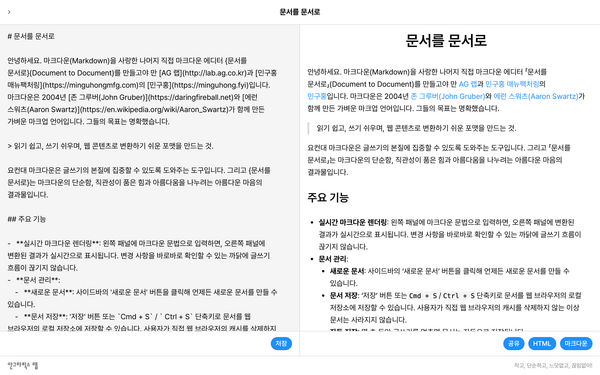
Document to Document automatically converts special characters typed on the keyboard according to their context. For example, ‘single quotation marks’, “double quotation marks”, 〈single angle brackets〉, 《double angle brackets》, 「single corner brackets」, and 『double corner brackets』 are important tools for indicating what a sentence quotes and the nature of its context. Editors and editorial designers inevitably pay close attention to even these small symbols. Like a perceptive assistant, this feature determines which punctuation belongs in a sentence. This delicate and charming automatic conversion is Document to Document’s most endearing feature.
When a document is downloaded as a Markdown file, its special characters mark the content’s structure and context. Using GREP regular expressions in typesetting programs such as Adobe InDesign, the whole document can then be structured quickly and accurately.
Documents as Documents
A document is more than something to look at or show. It becomes a “true” document only when it holds meaning, has structure, and can also be interpreted by machines. Only then is it easy for people to read, possible for machines to interpret, and sustainable in future systems. Markdown embodies this philosophy, and Document to Document is an editor focused on putting it into practice: easy to write in, encouraging attention to structure, and allowing meaningful content to accumulate naturally. This is the “future of documents” that AG Lab and I imagine.
Document to Document is a small tool that respects the writer’s intentions, does not interrupt the flow of work, and brings out the structure, rhythm, and meaning within text. I hope it becomes a dependable friend to those who love documents, in their writing, editing, and editorial design.