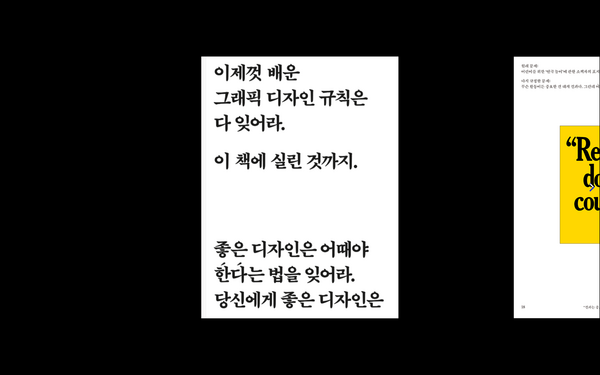
Forget all the rules you ever learned about graphic design. Including the ones in this book.
Original problem: A translator’s note. / Redefined problem: A translator’s note that can also serve as a press release.
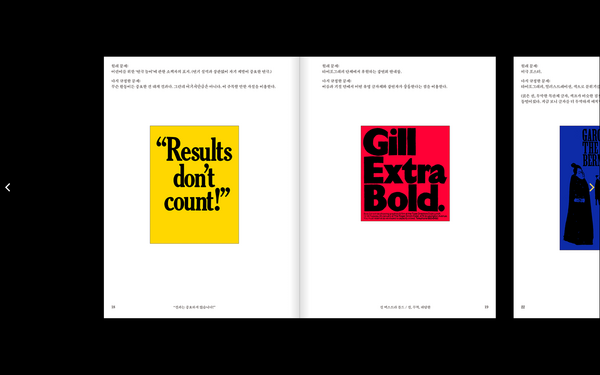
Written by Bob Gill—“graphic designer, copywriter, teacher, art director, illustrator, film director and lousy jazz pianist”—this book is a useful design textbook in many ways. Alongside relevant work, Gill carefully sets out the design methodology he developed over more than thirty years in several professions, introducing it firmly but without formality. Upon publication in 1981, it was adopted as a textbook by design schools in and beyond the United States, including Parsons School of Design, where Gill then taught. Its influence subsequently spanned eras and cultures, from leading American commercial designer Michael Bierut to Experimental Jetset, the graphic design studio once at the forefront of Dutch design—a phenomenon whose true nature remains elusive. This is not simply because Gill is a skilled designer. Before design, the book addresses a “problem” important enough to bring up abruptly on its front cover.
Gill regarded an assignment as a “problem to solve” and design as “the process of solving a problem.” He took this obvious approach one step further. “Before picking up a pencil,” he examined the problem from different angles, identified something unique within it, and “edited” it to bring out that uniqueness. Only then did he apply design techniques. He believed that if a problem was edited “properly,” the answer—in other words, the design—would emerge naturally. This is why most of the book concerns how he edited problems, rather than how many columns a grid should have or how typography should be adjusted. There seems little room here for “a sudden flash of inspiration.” Gill simply practiced in his own way the maxim, now so commonplace that its origin is hard to trace, that “the answer is in the problem.” His practice unfolds through brisk chapter titles that, merely recited, seem capable of encouraging students struggling with an approaching deadline.
“We discovered this book in the library of the Gerrit Rietveld Academy when we were students, and it immediately influenced us. What impressed us most was Gill’s consistent ‘problem and solution’ methodology. It is old-fashioned, solid, one-dimensional, didactic, archaic, and dialectical. Solutions often cause other problems, since no perfect solution exists. This tragic quality is what makes the methodology most beautiful to us.”—Experimental Jetset
As its title mischievously negates itself by telling us to forget “even the ones in this book,” it is useful for more than teaching design. A master of his field has selected work from over thirty years to fit its themes, so it may equally be regarded as a biographical portfolio, as British designer and design-book collector Jason Godfrey describes it in Bibliographic: 100 Classic Graphic Design Books.
Yet arranging Gill’s work in historical order is a futile exercise. The only way to distinguish his early work from his recent work is to look at the production dates. In his teens and twenties, he experienced the Great Depression and World War II, followed by the Cold War and the Vietnam War, directly or indirectly, yet a time quite different from reality flows through his work. What stands out is its startling inventiveness, its deadpan—and sometimes nasty—jokes, and its Sunday-morning ease. Readers may, of course, choose to see parallels with Monty Python’s Flying Circus, which ended its British run around the time Gill left London, or with stand-up comedian Andy Kaufman’s dreadful impersonation of President Jimmy Carter after Gill returned to New York.
Unlike the period when Gill was most active, design today has become simple enough to carry out with a computer and a few specialized programs. Advances in technology and its widespread availability have also changed design education. Even those who have never attended design school can, if they wish, readily learn design techniques with Google as their tutor. Perhaps only people who have taught and studied design “formally” deny this. Nevertheless, because the book deals with “communication,” the core of design that is difficult to find in software manuals or on Google, its lessons remain worth considering nearly forty years after publication. This applies both to diligent readers who, as the title suggests, refuse to follow its rules, and to clever readers who reject even that suggestion as another rule and decide to follow each one.
(It would be best to put what follows, including this sentence, in parentheses, since it cannot be used as a press release.
I first learned of the book around 2008. All I saw was the first edition’s front cover, by chance at an online bookshop, but it made a strong impression. The large sentence set in Cheltenham looked deliberately authoritative, while the title’s full stops—two of them—suggested a scheme to gently torment editors and librarians sensitive to form and systems. It felt like meeting a mischievous friend.
I did not actually hold the book and read it until around 2012. Some four years later, just as I was beginning to forget its contents, I encountered it quite often during a brief period as a student in New York, then met it again on returning to Korea.
Google’s neural machine translator spared me some of the labor of consulting dictionaries to check confusing words and phrases. Of course, weighing the context to preserve Gill’s sly tone remained the task of a solemn human. But I venture to imagine that in the near future, computers may largely take over even that—and even the writing of a translator’s afterword. Before that happens, I thank the relevant team at Google, everyone at Workroom Press and Spector Press who published the book, and especially Choi Sung Min, who advised me “through design” during translation and editing.
April 2017
Min Guhong)