Looking After Each Other
A Leaning Web: Where Our Senses Meet
If an exhibition seeks to lower its physical threshold, its website should face the same question. If everyone can go to the museum, should everyone not be able to access the website? This is not simply an ethical question of improving accessibility. It is a matter of living again, on the web, how different bodies meet, face one another, lean on one another, and live together.
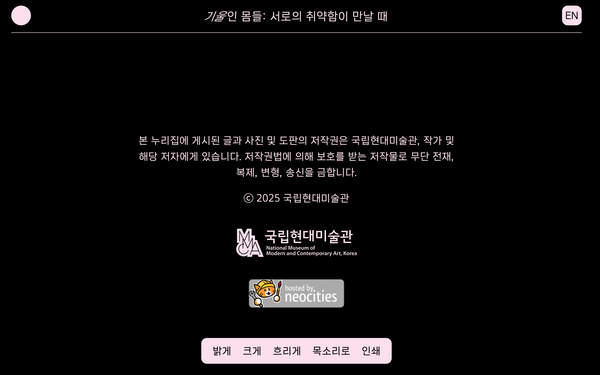
Hosted on Neocities, the exhibition’s website is a declaration in itself. Stepping outside the uniform formats and efficiency of commercial platforms, we experiment with ways to welcome the different conditions of bodies through the manual labor of building, furnishing, and maintaining a place called a “website.” Neocities is one of the few places where such experiments are possible today. If the word “website” still holds a sense of place, Neocities listens to it. Here, the web recovers a slower pace and the sense of the hand, becoming a space of contact.
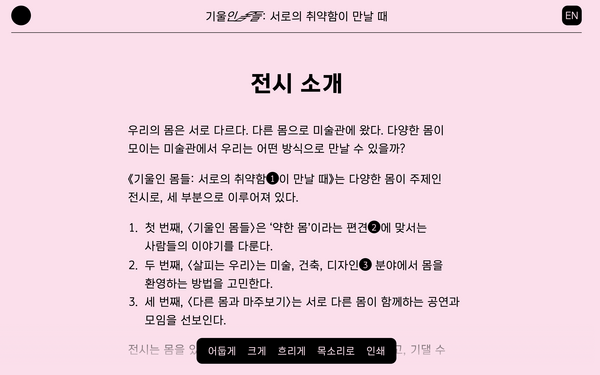
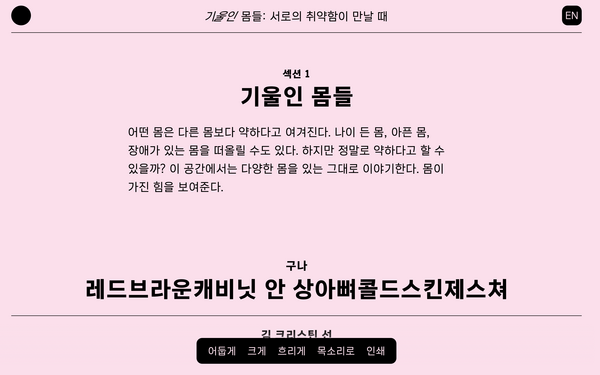
Some people cannot access the web because black text on a white background hurts their eyes, some because moving a cursor alone is not enough to explore it, and some because so much information moves that they cannot perceive the information itself. Making a website is therefore no different from making an exhibition space. Like a physical space, this website has routes through it. What is placed on the screen, what is hidden, and what is left still change the possibilities of access and the rhythms of encounter.
Neocities allows us to work directly with such a space. Google Drive, Notion, and Instagram, however many people they reach, do not leave users in charge of how the space is handled. On Neocities, however, one can construct “my website” directly with the pliable language of HTML. For some, this may mean a structure for screen readers; for others, reducing the density of excessively visual information. It is also possible to organize a site for access by keyboard rather than mouse, voice rather than hands, or touch rather than sight.
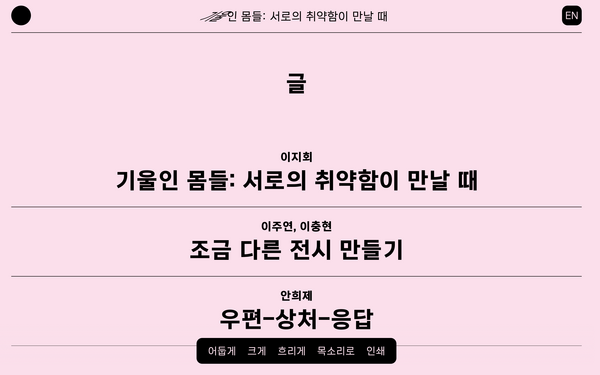
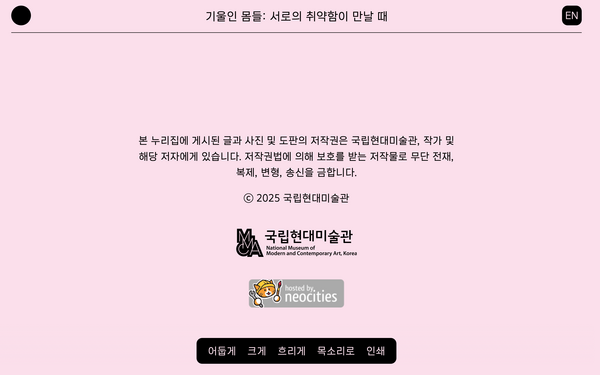
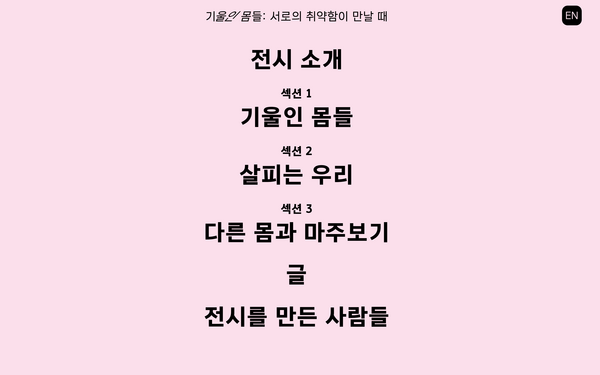
Made by Min Guhong Manufacturing, this website consists largely of a single page. Read slowly through scrolling and clicking alone, its structure flows with rhythm rather than information. The page has a button to invert text and background colors, controls to enlarge or reduce the text, and a function that blurs the whole screen so that only the writing stands out. A text-to-speech, or TTS, function also reads the text aloud clearly. Most importantly, some of the text leans slightly toward the position of the user’s cursor. When the body leans, the letters lean with it. This is less a reaction than a form of companionship. The fact that sentences on the screen are not fixed signs, but lean in response to the movements of you, here, now, precisely overlaps with the way of meeting this exhibition describes. All these elements might be called by a word more delicate than “accessibility.” They assume differences in perception and actively invite those differences in. In this sense, the website is both a space that can speak for itself and a space that listens to another’s rhythm.
What matters is that this website will not disappear. After the exhibition ends, even when no performances or discussions take place anymore, this space remains on Neocities. Whether someone visits two days or ten years later, we can still address this website. Unless the Neocities server is blown up, the website is eternal. Even after withdrawing from the physical space, we can remain here, quietly keeping the sentences of sensation open and waiting.
And so this website leans a little, like someone’s handwriting, and sways gently. As a body leans, so can a website. In that small sway, we meet one another. This small exhibition space itself becomes one of “the ways we meet.” Hoping that, if this looks rather beautiful, our web might grow a little wider too.