Min Guhong Manufacturing Operational Guidelines
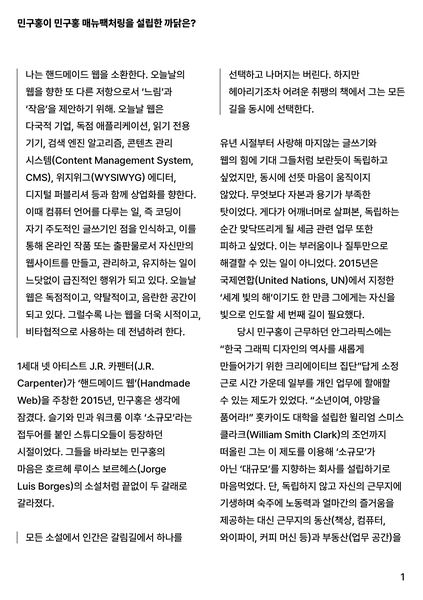
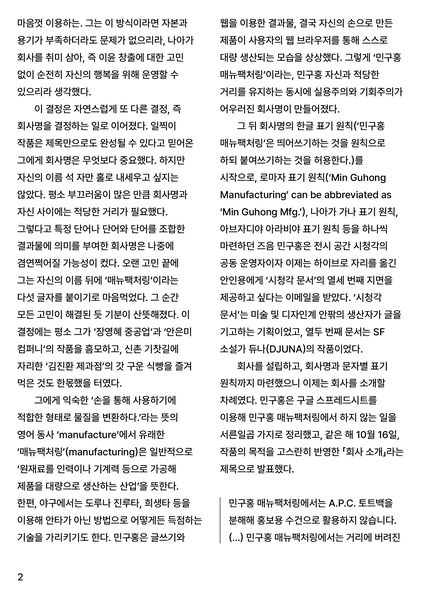
Some companies explain themselves through a logo. Others write visions and missions, hang up mottos, list their members, and hold shareholders’ meetings. Min Guhong Manufacturing explains itself through none of these. Instead, it repeats a question: “What is this company?” It exists only by declining to give a definitive answer. Min Guhong Manufacturing Operational Guidelines is both the result and the starting point of that question. Though called guidelines, the book does not explain how the company operates. It is closer to a device for describing a company that believes the act of operation itself is suspended, like the gap between the two syllables of the Korean word unyeong.
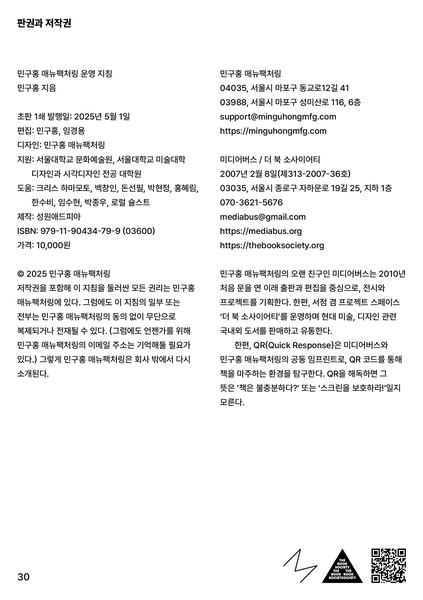
The book appeared unexpectedly. In 2025, when Min Guhong Manufacturing reached its tenth anniversary, its operator planned no particular celebration. As in every other year, he was insensitive to the feeling of commemorating something and indifferent to numbers. Then an email arrived from graduate students in the Department of Design at Seoul National University’s College of Fine Arts. “Hello, we would like to hold an exhibition.” Min Guhong Manufacturing is so sensitive to unexpected proposals as to seem insensitive, and gladly responded. If someone else commemorates an occasion for you, it ceases to be a commemoration and becomes an extension of daily life. Thus, alongside the exhibition, without any plan but as part of it, Min Guhong Manufacturing Operational Guidelines was published.
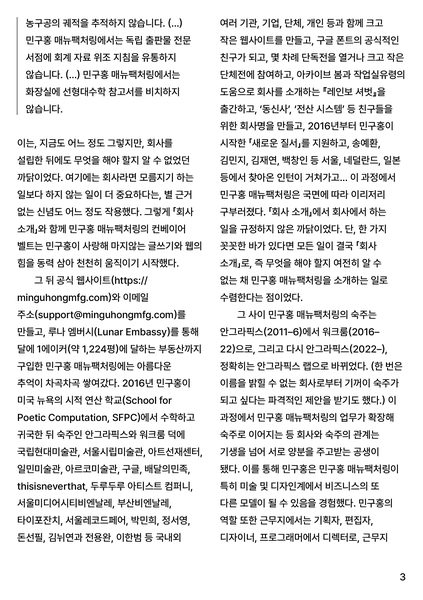
The book consists of twenty-seven entries, including “Company Overview,” “Parasitism and Symbiosis,” “Products and Artworks,” “Design,” “Constraints,” “Outside Directors,” and “Plans for Plans.” Their names are businesslike, but their accounts approach literature. Hovering somewhere between poetry and essays, technical writing and self-introduction, these entries do not instruct. Rather, they are themselves a product, sentences that constitute the company. This company insists on jokes rather than following norms, and records the process of revision rather than completing a manual. “If guidelines are unnecessary, that itself can be a guideline,” says Min Guhong Manufacturing.
Min Guhong Manufacturing grew up on the web. Born on an accessible platform, it spreads through hyperlinks and takes shape inside browsers. These guidelines, too, were therefore written between two languages, two web browsers, and two worlds. Korean and English translate one another, but more often pass one another at an angle. In the process of saying the same sentence differently twice, the company’s identity expands rather than becoming fixed. Translation is another form of introduction, not explanation, and bilingualism is the polyphonic way the company has chosen to describe itself.
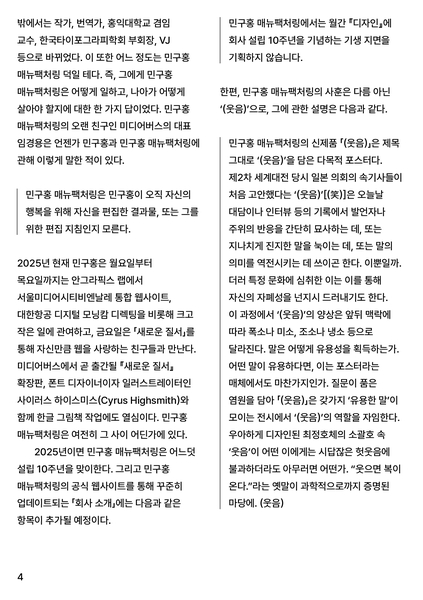
Min Guhong Manufacturing has neither an office nor a logo. As evidence of its existence, the company chose the repetition of words rather than physical space. Each time it says, “This is Min Guhong Manufacturing,” the company is born again; each time it says, “It is not a company right now,” the company collapses. In place of a logo is a repeated name; in place of a manual, a web browser that opens; in place of a company motto, a printed “(laugh).” Min Guhong Manufacturing Operational Guidelines is an archive of these repeated names and forms, and at the same time a scenario still in progress.
The book addresses concrete failures more than concrete practices. Imagining a sentence-based fashion brand in collaboration with Supreme; aspiring to publish a poetry collection titled Company Introduction with Minumsa; planning a hotel that can be entered only with a single cherry. None of these has been pursued, nor will they be. Yet Min Guhong Manufacturing says: “Plans become an ethic and the company’s language through being spoken rather than realized.” Plans that are more honest because they remain unrealized: this is another motive for the book.
The exhibition at Seoul National University was not an exhibition introducing the company, but one introducing the phrase “company introduction.” Letters, contracts, poems, website screenshots, web-based products, and this book were placed together. Products in different forms point to one another and say, “This is Min Guhong Manufacturing.” Among them, Min Guhong Manufacturing Operational Guidelines is the book that speaks most quietly to the audience. A company that exists only in the moment of speaking. A set of guidelines constituted by the entirety of that speech.
This book is the company’s beginning and end. It is also a device that keeps the company from stopping. A company operated only through words, sustained only by plans that will never be realized, embracing quiet jokes as if they were a corporate motto. Today, too, Min Guhong Manufacturing updates its guidelines and introduces itself again. If the day comes to close the business, the final update will read: “Immediately after announcing its closure, Min Guhong Manufacturing adds one more guideline.”
Min Guhong Manufacturing Operational Guidelines. This book is a way of dreaming a company rather than a company manual. And that dream is not yet complete.
An Unexpected Company, an Unexpected Exhibition, Unexpected Guidelines
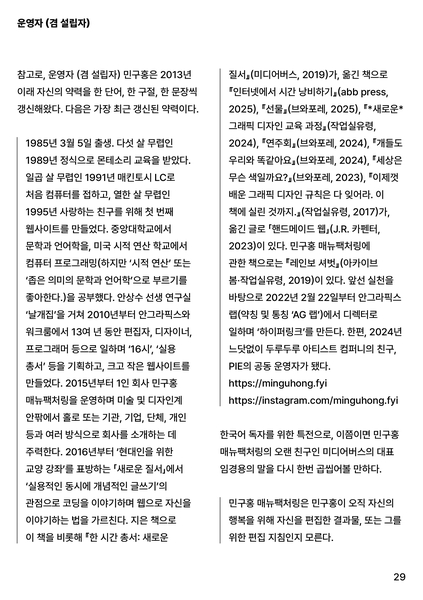
Min Guhong Manufacturing may be the result of Min Guhong editing himself solely for his own happiness, or the editing guidelines for doing so. —Lim Kyungyong, director of Mediabus
An Unplanned Commemoration, Guidelines Written Along the Way
In 2025, Min Guhong Manufacturing found itself reaching the tenth anniversary of its founding. Yet the company is too indifferent to be sensitive to numbers. How many years, which occasion, even which numbered product: none of it matters. As always, the company has ignored commemorations with an attitude of “Must we…” or “Must we?” There were therefore no congratulations, parties, or even press releases in the plans. Then one day, an email from graduate students in the Department of Design at Seoul National University’s College of Fine Arts arrived at support@minguhongmfg.com. “Hello. (…) We would like to hold an exhibition about Min Guhong Manufacturing and the company’s products.” It was an unexpected proposal. And Min Guhong Manufacturing is so sensitive to unexpected proposals as to seem insensitive. Its operator, Min Guhong, considered it for a moment. If someone else would commemorate the company’s tenth anniversary—or believed they were commemorating it—after the company had decided not to, there was no reason to refuse. Thus, the exhibition in the Department of Design unexpectedly became a tenth-anniversary exhibition for Min Guhong Manufacturing, and alongside it, incidentally and unexpectedly, Min Guhong Manufacturing Operational Guidelines was published. It was a moment when nothing had been planned but everything began to look like a plan.
Guidelines You May Disregard, or Need Not Follow
Min Guhong Manufacturing Operational Guidelines is a literary work disguised as a guidebook. Or so it seems. It contains no rules or procedures to follow. Somewhere between poetry and fiction, fiction and nonfiction, it asks: “Do we really need guidelines?” It answers itself: “If guidelines are unnecessary, that itself can be a guideline.” The book does not demonstrate how to operate a company. Instead, it repeats the question, “How should a company introduce itself?” Becoming a company at the moment of speaking, returning to a state of not being a company when silent. Its guidelines are a record of speaking oneself, speaking again, and occasionally forgetting, rather than fixed norms. They were therefore written so as not to be completed. Yesterday’s sentence is revised today, and today’s joke becomes tomorrow’s philosophy. To someone who has not experienced Min Guhong Manufacturing, the book might look like a practical manual for running a company. In fact, it is a company introduction that continually fails and is deferred.
One Company Speaking Two Languages
Since its founding in 2015, Min Guhong Manufacturing has grown on the web. It has introduced itself in a free space without borders, time, or form. These guidelines were naturally written in two languages, Korean and English. What matters here is less translation’s accuracy than the gaps in which the languages reflect, diverge from, and resonate differently with one another. Korean’s spaces and rhythms cross with English’s tone and concision, speaking the company in two rhythms. Bilingual composition is not a formal choice but a way of introducing the company that Min Guhong Manufacturing has practiced for ten years: always saying one thing in two or more ways, repeating itself while revealing itself differently. This book is another prototype of that experiment.
Without an Office or Logo, Through Repeated Names and Sentences
Min Guhong Manufacturing has no visible emblem. It has no logo or dedicated typeface, and its motto is “(laugh).” Instead, it has a repeated name and sentences that introduce itself. Its products may be websites or books, and sometimes unplanned plans or work that has not begun. What matters is not what the company made, but how it said it and how those words remained. Beginning with “Why Did Min Guhong Establish Min Guhong Manufacturing?”, Min Guhong Manufacturing Operational Guidelines consists of twenty-seven entries, including “Company Overview,” “Parasitism and Symbiosis,” “Intentions for Randomness,” “Plans for Plans,” and “Guidelines on Guidelines.” Each entry reveals the company’s attitude and tone rather than imposing strict discipline: how it speaks itself, records failure, and passes by like a joke.
Plans More Honest for Remaining Unrealized
At Min Guhong Manufacturing, plans need not be realized. Indeed, unrealized plans may be the device that explains the company best. “Plans for Plans,” one of the book’s final entries, includes plans to launch a sentence-based fashion brand with Supreme, publish a poetry collection titled Company Introduction with Minumsa, acquire a private Korean Air aircraft, operate a hotel accessible only with a single cherry, and even hand the company over to Laurel Schwulst or intern Baek Changin. None has a schedule, budget, or strategy. They exist simply by being imagined, spoken, and repeated. For the company, a plan is not “something to do someday,” but a possibility that may never be carried out. Plans become an ethic and the company’s language through being spoken rather than fulfilled. This book itself may have been a plan that could have remained unrealized. Instead, it appeared in the world unexpectedly and along the way. Today, too, Min Guhong Manufacturing makes new plans, setting aside the thought of realizing them for a while.
Exhibition and Guidelines: A Structure of Mutual Introduction
The exhibition at the Department of Design in Seoul National University’s College of Fine Arts does more than introduce the company or its products. It is more accurate to call it an exhibition introducing the concept of “company introduction.” It places this book alongside the company’s products, including unexpected love letters such as Dear Messrs. Department of Design, College of Fine Arts, SNU and Dear Messrs. Minumsa. The structure in which exhibition and book, company and guidelines, space and language reflect and introduce one another is a miniature of the experiment the company has persistently repeated for ten years. Declaring that it will not commemorate, yet gladly commemorating; carrying out unplanned things as though they were planned. It is the moment when Min Guhong Manufacturing marks its tenth anniversary in the way most like itself.
A Company That Exists at the Moment of Speaking
Beyond a book, Min Guhong Manufacturing Operational Guidelines is a narrative device showing how a company maintains itself, wavers, and describes itself again. Reading slowly, the reader comes to reconsider what on earth Min Guhong Manufacturing is. It may be neither an office, a logo, nor numbers. Perhaps it is a company that exists only at the moment of speaking. Today, too, it smiles quietly, in something like the mood of “(laugh).”