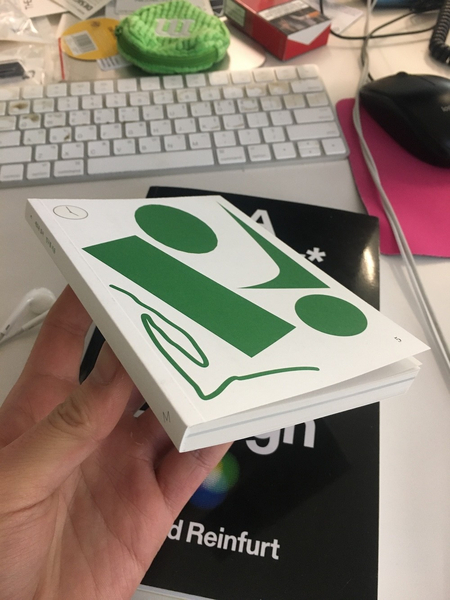
One-Hour Series: New Order
New Order is the fifth book in Mediabus’s One-Hour Series, begun in 2017 with Yoon Wonhwa’s Can Documents Re/Produce Time? It condenses the general education course of the same name that Min Guhong, a Workroom editor and the operator of Min Guhong Manufacturing, has held alone or with like-minded colleagues, regardless of time or place.
Broadly composed of sharing—lectures and conversation—practice, exercises, and critique, the course explores new orders of information using computer languages, especially HTML, CSS, and a little JavaScript. Students make a list of their interests (Order 1), give it a new order and turn it into a website (Order 2), then give it yet another order and present it in a particular space (Order 3). Through a few successes, students become familiar with failure and learn to guide the transformations of media at each stage.
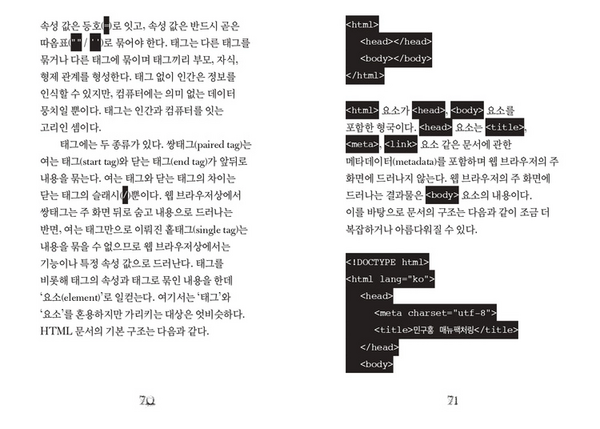
The book follows the course’s sequence. Beginning with lists, it moves through HTML and CSS, the principal computer languages that make up the web. Rather than introducing every detail of the languages, however, it focuses on principles, approaches, and things to ponder. As the author says, “Fixing constantly changing technology in print is an unnecessary undertaking.” What matters is “understanding the principles and learning how to apply them in practice.”
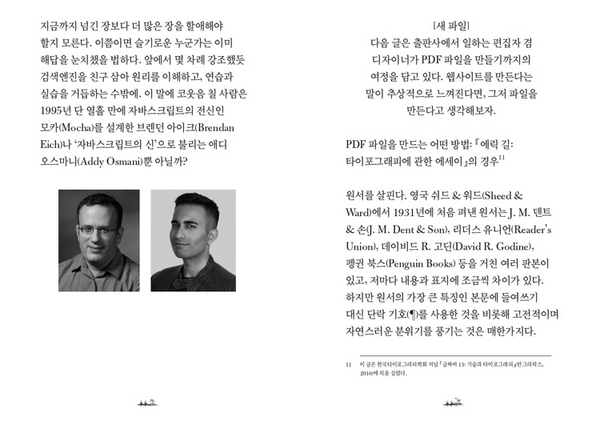
If a school is a place where one can ask questions without feeling awkward, a book cannot be a complete school in itself: it prompts curiosity but has no teacher physically present to answer. The author, who received formal Montessori education as a child, has drawn on that experience to devise a few simple devices to compensate for this inherent weakness. With the attitude of an elementary educator, he uses standard terminology wherever possible, repeatedly returns to what has already been said, and provides exercises and practical tools related to the content throughout. Readers may thus approach their own new order by making or imagining their own websites, in reality or in their minds.
A Literary Work in the Form of a Practical Guide?
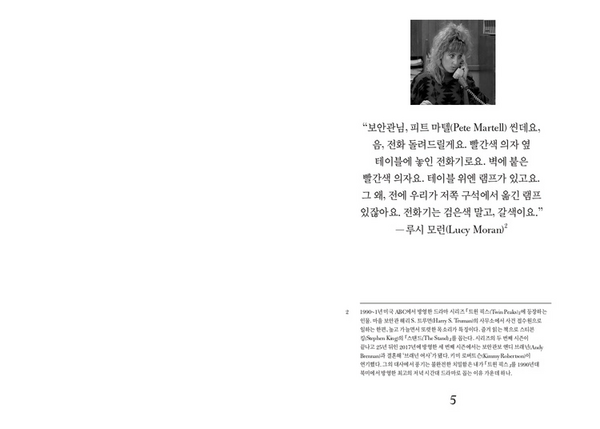
As a condensed course, the book can function as a textbook. Yet its speculative information masquerading as knowledge, its adjectives and adverbs used to emphasize nouns and verbs, and its occasional metaphors and metonymies attempt to keep their distance from that function. I venture to say that treating the book solely as a practical guide risks missing something very important. Let it be said in advance, then: if any passage reads as educational, that is by no means the author’s responsibility. One suggested way of reading the book fully is to recall, in each chapter, its epigraph—a related song or poem at the beginning of a book—namely the historic first lines spoken by Lucy Moran in the American television series Twin Peaks:
Sheriff, it’s Pete Martell. Um, I’ll transfer the call. To the telephone on the table beside the red chair. The red chair against the wall. There’s a lamp on the table. You know, the lamp we moved from that corner before. The black telephone, not the brown one.