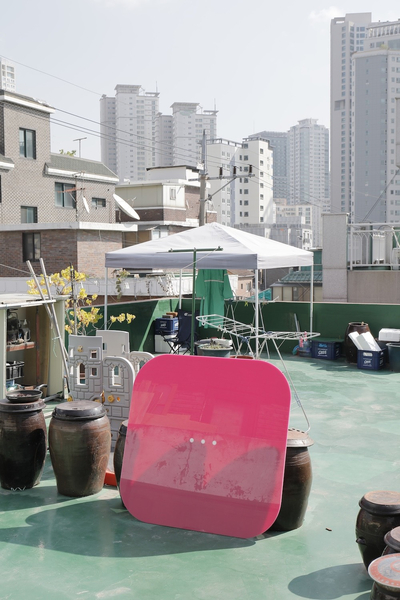
Rainbow Sherbet
Original problem: Why should ○○ be in an exhibition space? / Redefined problem: (If nothing needs to be in an exhibition space anyway,) why should ○○ be in an exhibition space?
Yoon Yul Lee
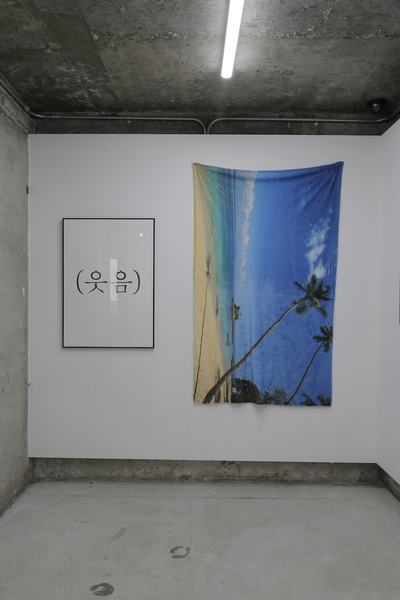
Most exhibition introductions are written to explain why a particular medium, artist, or work should be there—in the exhibition space. In this respect, the introduction to a design exhibition I saw recently was memorable. Beginning with “Why should graphic design be in an exhibition space?”, this nimble text took a long, roundabout route to saying that neither I nor you nor, ultimately, anyone knows why, so for now it would release whatever converges on the most recent into a nonstandard place. Designed to be accessed only on the web, the document prevented users from scrolling. Strictly directed down (↓), down (↓), I frequently forgot what I was reading, and by the time I left the exhibition, even the few words that had remained in my head were gone. I felt no frustration or resentment. Rather, I wondered whether this device, while fulfilling the traditional duty of an exhibition introduction, had used design’s authority to erase the fact that a system or tradition had posed a question and someone was answering it.
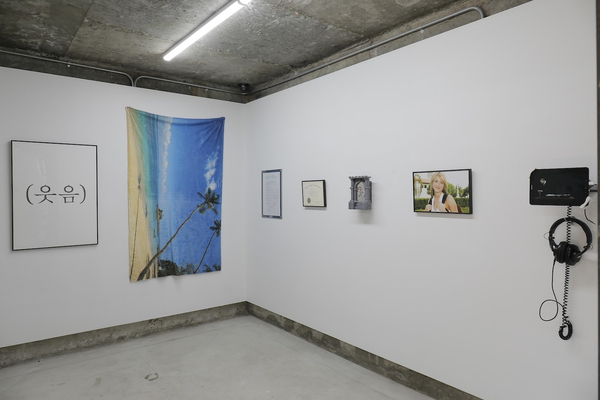
Today, while considering why Min Guhong Manufacturing should be in an exhibition space, I suddenly recalled that experience. Perhaps this is because Min Guhong, too, is no trained professional artist, but an editor often mistaken for a designer. Taking a little advice from the book he translated and edited, Forget all the rules you ever learned…, I decided to reconsider this “problem” with a different editorial technique. Today, thanks to artificial intelligence, personal devices, and fast internet access, art’s powers have been leveled in various ways. Not only the work of artists and curators—even criticism has long been subject to this. Systems, platforms, frameworks, templates, boilerplate… The so-called contemporary spends its time devising systems. So they operate naturally and nimbly. So they can encompass chance and improvisation. So that by combining small differences without expending energy on production, they can appear to be “almost everything.” Of course, we—the many visitors who make a point of seeing this exhibition—have been trained to distinguish the details of artworks created with good eyes and good hands. Yet even what makes those details stand out is usually a relationship the maker mediates and invents anew (if that seems a little dated, let us just write “gesture”), a visuality, or a new role for an object. So, if we must again ask why ○○ is in an exhibition space, why should a video of children crossing the sea by rowing with shoes be there? To remind us of revolution while assuring us it will never happen? What about the gestures of contemporary dancers that have occupied still-conservative/influential exhibition spaces since postmodernism, or the noise of engineers putting on extravagantly otherworldly airs?
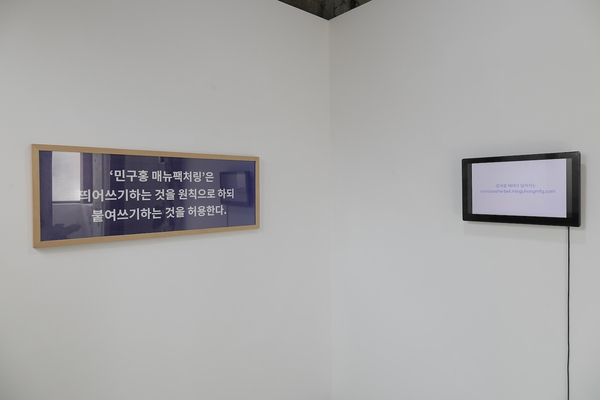
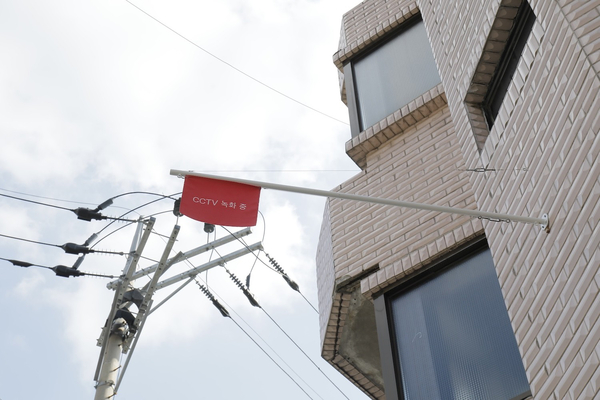
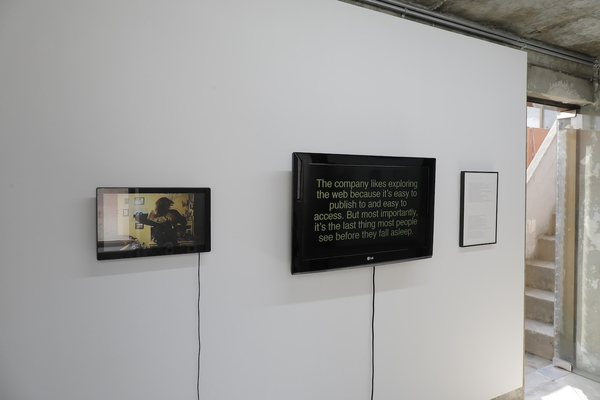
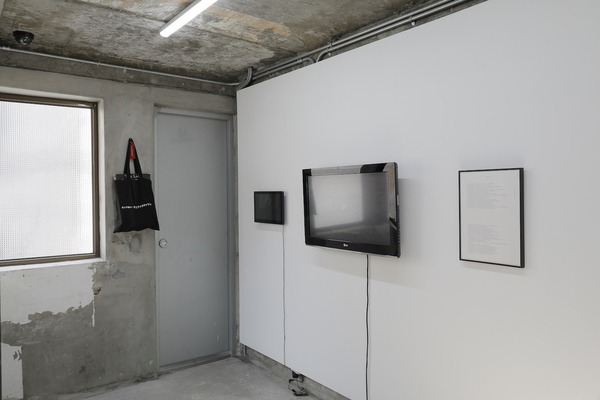
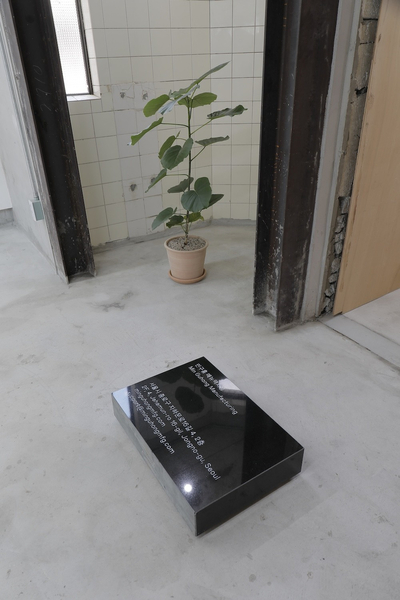
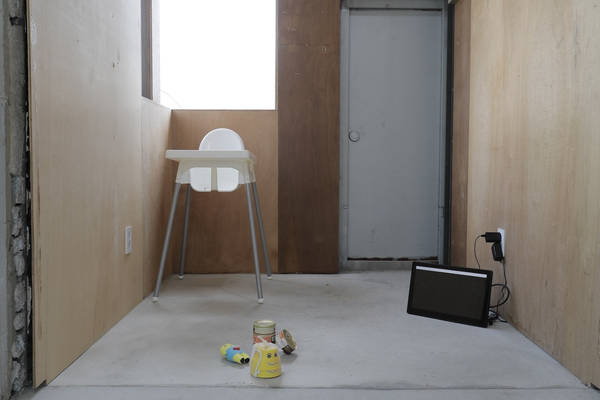
Exactly what Min Guhong Manufacturing does is not known. Through material presented in the exhibition /documents at Audio Visual Pavilion in 2015, however, its owner introduced thirty-seven things the company officially does not do. For instance, it does not breed pigeons for organizing files, or manufacture biochemical weapons, eavesdropping equipment, or shower curtains. After Ahn Graphics, the company now covers its operating costs with a salary from Workroom Press, gaining access to its host’s movable and immovable property in exchange for labor and a measure of enjoyment. Its parasitism stems above all from a lack of capital and courage, but this has allowed it to devote itself to customer happiness and employee welfare without worrying about profit. Another, less well-known fact is that the company is building a partnership system based on MOUs. Another variation on expanding parasitism, this quasi-outsourcing allows the company to focus efficiently on its core work while quickly acquiring the various technical forms—or tastes—accumulated in the present. (I know two similar companies with well-developed strategies of this kind: one is Jeski Social Campaign, which multiplies by consuming clients; the other is Amway, a powerhouse in multilevel marketing.)
Editing is now everywhere. The iPhone’s built-in Mail application brings this symptom into everyday life at once. Sometimes it becomes an intense editorial paranoia, mixing high fashion with street fashion, the white cube with ruins, and the aesthetics of art with those of industrial products. Every Min Guhong Manufacturing product has passed through such a filter. (“Manufacturing” means processing raw materials with human or machine power to make products. In baseball, it refers to somehow scoring runs by means other than hits. The company’s name reveals its owner’s intent to realize the functionalism and opportunism inherent in the word.) The discipline of the editing process is therefore the only thing that matters to the company. Along with the facts that rainbow sherbet originated in a three-nozzle design conceived by Emanuel Goren in Philadelphia in the early 1950s, and that the term is slang for a drug mixing two strains of marijuana, the rule that its Korean spelling should be ‘레인보 셔벗’, rather than ‘레인보우 샤베트’, is an important company guideline. Traces easily devour messages, and jokes easily become overinflated. The company therefore rejects unnaturalness and kitsch, the worship of material or industrial spectacle, magic and totems, and everything infantile or halfheartedly wicked. It always does its best, but spends most of its production time erasing the traces of that effort. (Perhaps this is because it has no interest in expanding its business into biennales.) It is extremely difficult to summarize in a phrase the appropriate configuration in which practicality, elegance, and nastiness issue from their respective nozzles.
Here, then, is an element the contemporary has acquired by becoming a time different from what came before. And we struggle to become a more suitable interface, nourished by a little boredom and persistence. Erasing today with another today.
(This heap of writing contains twelve sentences used without their authors’ consent. I recommend burning the page after reading it, and introduce below a useful Min Guhong Manufacturing product that can help.