Since it’s a company focused on introducing itself, the numbers on the clock don’t really matter
Humanity has long devised sundials, water clocks, fire clocks, and other clocks to gauge the time and its passage. Was it because people were more curious about when to put food into their stomachs, when the cherry trees would bear fruit, and when to water a potted Ficus umbellata so it would not wilt than about the moment of their own death?
As of 2021, Min Guhong Manufacturing is known to have two kinds of clock. One is encountered mainly by visitors; the other, by the company’s staff.
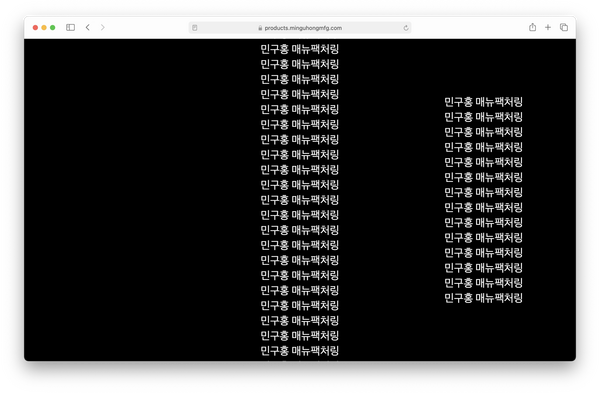
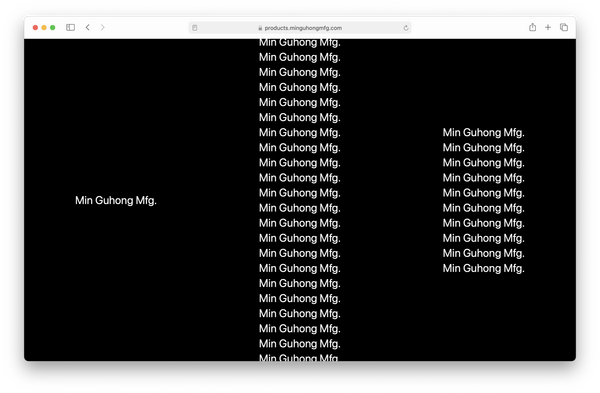
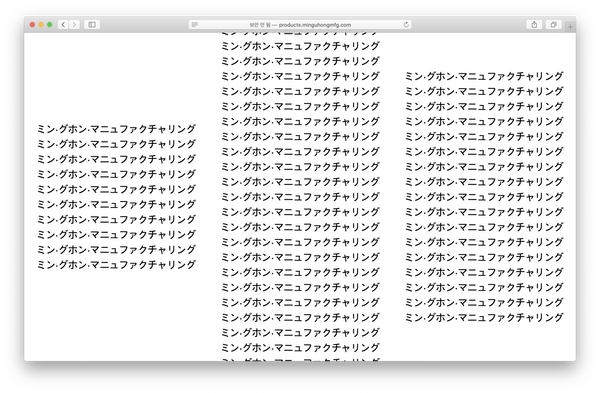
The first clock sits in the lobby and in corners of the company’s other spaces, telling time through the company’s name instead of numbers. The name changes every second according to the writing guidelines established for customers using three different scripts. “‘민구홍 매뉴팩처링’ should, in principle, be written with a space, but may be written without one.” (Hangul writing guidelines.) The guidelines are as follows:
- Hangul: ‘민구홍 매뉴팩처링’ (standard), ‘민구홍매뉴팩처링’ (permitted)
- Latin: ‘Min Guhong Manufacturing’ (standard), ‘Min Guhong Mfg.’ (permitted)
- Kana: ‘ミン·グホン·マニュファクチャリング’ (standard), ‘ミングマ’ (permitted), ‘ミンマニ’ (permitted)
At 1:23:45 a.m., the clock displays the company name sixty-nine times. Visitors versed in mathematics can readily deduce that it will appear 142 times at 12:59:59 a.m., and just once a second later, at one in the morning. Judged by the original purpose of a clock, it may not be easy for visitors to determine the time at a glance, but it certainly suits a company focused on introducing itself. “Honestly, I was moved. The fact that a company would manufacture and sell the guidelines it had made for writing its own name correctly gave me confidence in that company. (…) The more first-rate and global a company is, the more it ensures that people around the world can write and pronounce its name consistently.” (Song Seungeon, Rainbow Sherbet, Workroom Ghost, 2019.) Another intended function of the clock is to teach the correct spelling of the somewhat complicated company name, particularly to customers who have misspelled ‘매뉴팩처링’ in its Korean name as ‘메뉴팩처링,’ ‘매뉴팩쳐링,’ ‘마누팩처링,’ or otherwise.
For reference, the spot occupied by the clock was originally intended for a monitor playing Christian Marclay’s The Clock, first presented at White Cube in London on October 5, 2010, on a continuous loop. This video assembles scenes featuring clocks from some 12,000 films and television dramas around the world, beginning with people heading to a bar and ending with Big Ben exploding in James McTeigue’s V for Vendetta, and synchronizes them with real time. It is a film with a narrative of its own, an audiovisual summary of the history of cinema and clock design, and, as its title suggests, a clock in any case. But the company encountered several unexpected problems.
The first was that the video’s twenty-four-hour running time made its file excessively large. Nowadays, a video’s duration is usually directly proportional to its file size, as if proving modern physics’ proposition that time accumulates rather than flows. Tragically, the company had no device capable of storing that much data. (The files running the present clock total only about 143 kilobytes.) The second problem was that playing the video required a large screen measuring about 6.4 by 3.7 meters, IKEA sofas on which to sit comfortably and “appreciate” the clock, and even curtains around the screen to avoid disturbing that appreciation. This, too, was nearly impossible for a company parasitizing a graphic design studio and publisher for want of capital and courage. A corner of the lobby could not be devoted to a single clock.
“Time is Money.” So said Benjamin Franklin. If a clock exceeds its function and instead takes up its user’s time, if it makes the user curious about the displayed time itself, is it proper to call it a “clock”? And is a company that installs such a subversive clock in its lobby and other spaces frequented by unspecified visitors really a sound company? Such were the company’s reasons for ultimately failing to use The Clock as a clock.
The second clock sits on one side of the company’s office, using sentences instead of numbers to direct or suggest what to do or keep in mind at a particular time, rather than showing the time or its passage. The sentence’s angle is the only measure by which time can be gauged. Quoting the second hand, it tilts six degrees every second, then ceases to tilt when it passes 360 degrees. During the working hours agreed with the company, staff cannot help being conscious of the sentences on the clock. Tilting, yet not tilting.
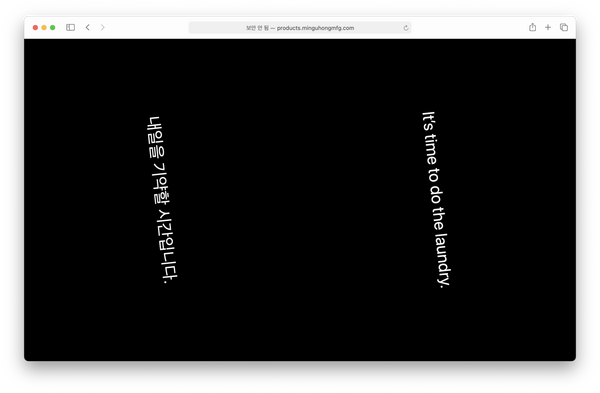
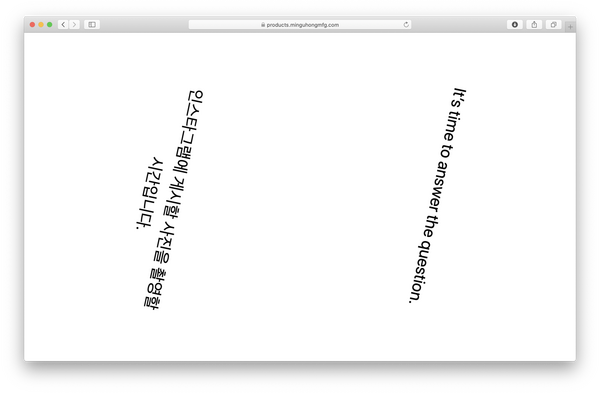
The sentences change every second, as if hurrying someone—or the company itself—along. There are things that should be done during agreed working hours. “It’s time to write an email.” “It’s time to edit a document.” “It’s time to refill your coffee.” “It’s time to smoke a cigarette.” There are things to keep in mind, too. “It’s time for Seoul real estate prices to soar.” At noon, lunchtime, the interval between sentences slows to two seconds. Did Douglas Adams, author of The Hitchhiker’s Guide to the Galaxy, not keep saying until his death, “Time is an illusion. Lunchtime doubly so.”? Under the contract, everyone has the right to relax during this time, and that relaxation should continue until one o’clock sharp. The sentences then resume their usual pace until seven in the evening, after which they change every sixty seconds, or once a minute. “It’s time to think about the person you love.” “It’s time to search for ‘Min Guhong Manufacturing.’” Until the next day’s agreed working hours arrive.
Meanwhile, the clock left the company to appear in This Event: Moving/Image, curated by Kim Haeju at the Seoul Museum of Art from August 12 to December 31, 2020, as an answer and a further question in response to “What should visitors do in a museum in the post-COVID era?” (Min Guhong Manufacturing is happy to exhibit the company or its products in museums and galleries whenever this offers an opportunity to introduce itself.)
“Exhibiting a clock in a museum supported by the noble taxes paid by Seoul’s citizens could easily cause problems, even if you include it under the name of ‘moving image.’ As you know, putting a clock in an exhibition space has traditionally been an unspoken taboo among curators. The reason is similar to why department stores have no windows. Museums and galleries want visitors to stay as long as possible, but a clock’s very presence constantly recalls the reality outside the white cube: thirst and hunger, deadlines, delivery boxes, and bedrooms. Moreover, surprising as this may be, this clock is actually a website stored and running on a web server. In other words, it is a public good that anyone who knows the address can easily view outside the exhibition—even on their own smartphone inside it. Visitors are likely to feel confused or disheartened to discover that the work before them, in a museum they spent time and money visiting, was already in their hands. Especially nowadays, when it is hard to visit not only museums but any place outside. You might even have to prepare a response to a complaint posted on the national petition board of the Blue House website. Would that be all right?” the company asked curator Kim Haeju. “Of course!” she said. Min Guhong Manufacturing loves courageous customers. And courage spreads and multiplies quickly.
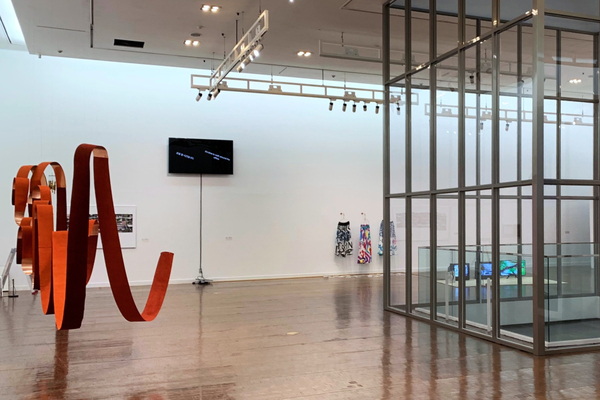
Min Guhong Manufacturing took courage, and the clock was displayed in a slightly larger, slightly less white space, among artworks instead of products, as an artwork rather than a product. The eighty-five-inch television displaying the clock was installed at the same height as the green sign marking the exhibition exit—about three meters above the coated wooden floor. During the exhibition, some sentences were changed or added to suit its location: “It’s time to check the exit.” “It’s time to maintain the social distance prescribed by the government.” Their traces remain intact in the database, even after the exhibition ended and the clock returned to its place. Thanks to the cancellation of all subsequent exhibitions, Min Guhong Manufacturing enjoyed the good fortune of introducing itself for three months longer than planned. Fortunately, the curator never had to prepare a response to a complaint. Rumor had it that some members of the company’s staff, visiting the exhibition outside agreed working hours, feigned surprise on seeing the clock.
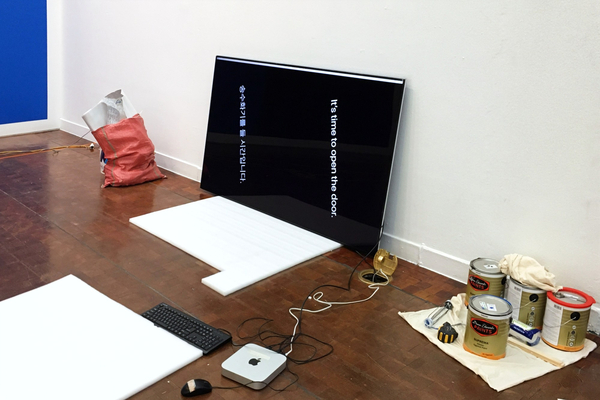
Thanks to a few lines of CSS, Cascading Style Sheets, and JavaScript, both clocks at the company manage to detect day and night and change their background and text colors. From six in the morning until six in the evening, they show black text on a white background; at other times, the reverse. For Min Guhong Manufacturing, it is enough for a clock to show whether it is day or night, rather than the exact time or its passage: whether one should be sitting at the office computer, or can walk along the Gyeongui Line Forest Park in Yeonnam-dong amid the cherry blossoms, even with a mask on.
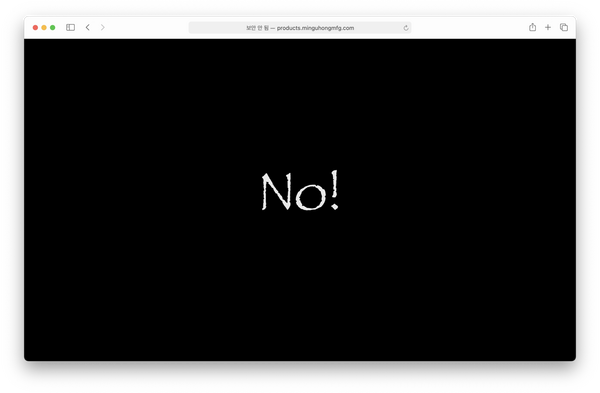
There is one more clock, for a particular day: “Is it Christmas today?” It gives a clear answer to anyone suddenly struck by the question, but is likely to be useless on Christmas Day itself—except, of course, to customers who must sit at a computer even on Christmas. “The product, taking the form of a website, determines whether today is Christmas and tells the customer. As a result, the phrase the customer usually encounters is ‘No!’ That is all. It is either this or that, never both at once. Is it Christmas today, or not? Is the manuscript completed, or not? Are the products mass-produced in factories in China and Vietnam, or not?” (Jung Jidon, thisisneverthisisneverthat, Workroom Press, 2020.)