thisisneverthisisneverthat
This Is Never That
Launched in Seoul in 2010, the fashion brand thisisneverthat took a proposition about the design it pursued—“This is never that”—as its name. It has released new collections each season, mixing 1990s culture with contemporary trends, while collaborating with various brands and musicians. Ten years passed after its launch, accompanied by incidents large and small. In that time, the brand gathered enough followers to be called a “phenomenon” in Korean fashion. This book, and website, thisisneverthisisneverthat, is both a record of ten years of the brand’s activity and a collaboration with the graphic design studio and publisher Workroom. In particular, assembling ten years of extensive material, including a year spent on the project, into not only a thousand-page printed publication but also a website is an attempt rarely seen in Korean street fashion—or fashion at large.
This: An Expanded List
The starting point for thisisneverthat’s spring/summer 2015 season was a photograph seen one day at an exhibition. The unexpected sight of fire burning on river water converged into an English phrase, “Lake on Fire,” and the products surrounded this phrase. The book’s front cover features, behind two stickers, a black-and-white photograph of the upper body of a model wearing products from that season. Like someone abruptly confronted with fire on river water, the model seems to have sensed that something has happened, yet wears an expression suggesting it has nothing to do with them after all.
Listing is a practical way to organize something, though it requires the arduous process of abstracting information. Once past the book’s paratext, readers first encounter a list densely filling the page. Made of black letters and silver lines on a white background, the list contains items, and the items contain lists in turn. The items are arranged in reverse seasonal order and in Latin and Korean alphabetical order according to specific codes assigned to products, lookbooks, videos, physical stores, offices, and other things produced around the brand. For example, this book’s code is WR20SPT001NA, and the website’s is WR20SPT002NA; the codes were generated through a system known only to insiders. The lists sit casually throughout the book in a particular order, yet the lists and the roughly 4,000 items they contain clearly and neatly reveal the brand’s history in themselves. But the items do not simply remain comfortably within the lists. Before and after the lists, they are grouped again by season, and their information expands according to particular rules based on importance into images that edit memories and into lists in other forms. This book, which begins with a list, is, in short, an expanded list.
The List…
Expands into images that edit memories and into lists in other forms.
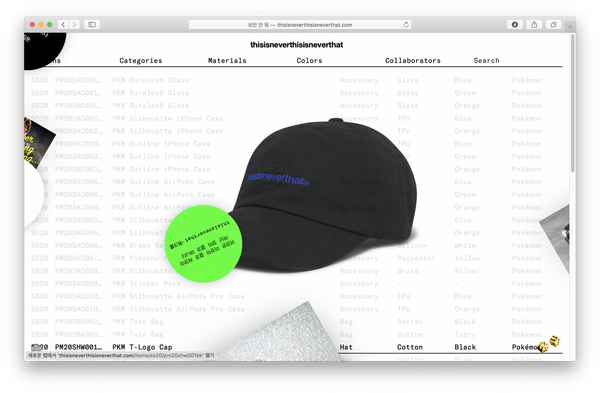
Meanwhile, the list has also left the book to take its place on the World Wide Web as an independent website ( http://thisisneverthisisneverthat.com ). Unlike the book, the website focuses on the list itself. Its list overcomes the inherent limitation of a printed list—that it cannot be changed once printed—and suggests both the possibility of re-editing the list and its items at any time, and the list’s principal purpose of helping users easily access information. For reference, although this website is another result of the project, before the book it also served throughout the year of work as an online tool for thisisneverthat and Workroom to organize the information to be included. In terms of the process, data first became meaningful information through the website, and the book then reused that information.
http://thisisneverthisisneverthat.com
http://thisisneverthisisneverthat.com / Technical support: Min Guhong Manufacturing
And once it has become meaningful information, it can of course be used anywhere.
That: A List That Generates Other Lists
If “a piece of writing is a complex list made of letters, words, phrases, sentences, and paragraphs” (Min Guhong, New Order, Mediabus, 2019), the list in this book generates three further lists as follows. Each is a list that could not exist without the list.
One is a list that makes the brand less distinct: Either/Or. Following an order received one day from Workroom—“We need a piece of writing that devises a situation in which ‘this’ has become never ‘that’”—the novelist Jung Jidon varies the Danish philosopher Søren Kierkegaard’s Either/Or to look at the brand from an unfamiliar angle.
Another is a list that delves a little deeper into the brand: This Is Never This Is Never That. thisisneverthat and Workroom exchange stories about the brand’s ten years and its present, from the origin of its name and its early days in Hwanghak-dong, Seoul, through a promotional strategy that actively uses social media, to the “post-COVID era” we face today.
The last is a list that expands the brand: Street Fashion and Youth Culture. In a Korean fashion world abundant in things to look at and wear but rarely things to read, columnist Park Sejin has steadily maintained the fashion blog Fashionboop ( https://www.fashionboop.com ). Through the origins of representative street-fashion items such as T-shirts, sweatshirts, mountain parkas, and the M-65, he surveys street fashion and youth culture and considers their futures. These are futures toward which thisisneverthat will proceed, or deliberately step aside from.
This Is Never This Is Never That
A T-shirt is flat, but becomes three-dimensional the moment it wraps around a human body. Paper is flat too, but becomes three-dimensional when letters and illustrations are printed on it and it is bound into a book. Both are flat, yet hold the possibility of becoming three-dimensional. Indeed, they are destined to become so. As it happens, through this book, fashion has become a book. Readers familiar with thisisneverthat and knowledgeable about fashion will naturally wonder: can a book, conversely, become fashion? What about reading and looking at a book? Or making one? This is also a question thisisneverthat and Workroom pose together to new readers, through a rather thick and heavy book. Whatever the answer, “it” is never “this,” nor is it “that.”