FAQ
- Anything to keep in mind?
-
Min Guhong Manufacturing hopes this FAQ will answer your questions about the company and the person who runs it. It brings together interviews, long and short, conducted since 2015, carefully compiled and then scattered into random order. Depending on when a question was asked, some facts may differ from those of today. Honorifics for people mentioned have also sometimes been omitted to suit the tone of the question. If you have read your way through the FAQ and still have questions, please tell us all about them at support@minguhongmfg.com. Min Guhong Manufacturing is ready to understand and acknowledge everything. Please look for a reply in the FAQ someday, though, rather than in your inbox.
-
Unlike the WD-40 Company, which has focused on producing the mineral-oil product WD-40 since its founding in 1953, your company handles a wide range of products: writing, software, food, keyrings, posters, and refrigerator magnets. How are products and their types decided?
They depend on the operator’s interests, circumstances, and partners, but sometimes even the type is constrained at the planning stage by internet search results—that is, by how easily we can understand the production process. The answer may lie outside the internet, but the company has no intention of investing more labor and time in this process than an internet search requires. Given the company’s nature, its freedom of movement is rather limited.
-
Then what is your favorite TV show?
That seems rather personal. I will tell you once we know each other a little better.
-
You studied computer programming at the School for Poetic Computation, or SFPC, in New York. I understand that poets, programmers, designers, mathematicians, inventors, and others came together to establish it, with Taeyoon Choi, an artist based in Seoul and New York, playing a central role. What did you learn there?
I happened to discover the school around the time I left Ahn Graphics, where I had worked for about five years. I liked its name, which combined ‘poetry’ and ‘computation,’ two words that seemed unlikely companions. I also liked that Kenneth Goldsmith, a poet I had long admired, had taught there. Unfortunately, he did not teach during my time there. At first I thought it was simply a school for trying strange things with computers, but the school I encountered was much stranger than I had imagined.
Conceptual and practical classes on art and computers ran from 9 a.m. to 6 p.m. Perhaps because New York’s subway operates twenty-four hours a day, special lectures and workshops sometimes ended late at night. I spent weekends at school as well, absorbing in a short time material that would take several semesters to learn and think through at an ordinary school. I took part especially enthusiastically in the classes of Nick Montfort, a poet and professor of digital media at MIT. The students were diverse, too: a white-hat hacker, a graduate student in criminal justice, an architect, a dancer, an electronic musician. For example, the friend who taught me coding conventions had worked as a baker in France. We spoke a few days ago, and lately that friend has been absorbed in making kaymak, a Turkish dessert.
It is not, however, the kind of school that kindly teaches you each technology from scratch. You need at least some familiarity with computer languages to follow the classes comfortably. A teacher would offer a hint needed to solve a problem, and students would use it as a signpost while wandering the internet, recognizing their desires and technical limits and devising ways around them. What matters is not the technology itself but which technology to use, and how.
As the school’s name suggests, programming has much in common with the way I learned to write poetry: there is a poetic subject, or input; a poem, or output; and between them, poetic perception, or a function. Attending SFPC made me feel this relationship more clearly. That is why I like to say I studied ‘literature and linguistics in a narrow sense’ there, rather than computer programming.
This was also when a movement centered in New York was beginning to rethink increasingly complex web technologies from the ground up. At the same time, graphic designers were actively discussing a ‘content-centered web.’ Meeting friends who were already putting into practice things I had long thought about gave me courage, too. Laurel Schwulst, who asks me to introduce her as my ‘best American friend,’ is someone I met then. She is around my age and a central figure in the movement I just described.
-
Please introduce two representative products from Min Guhong Manufacturing.
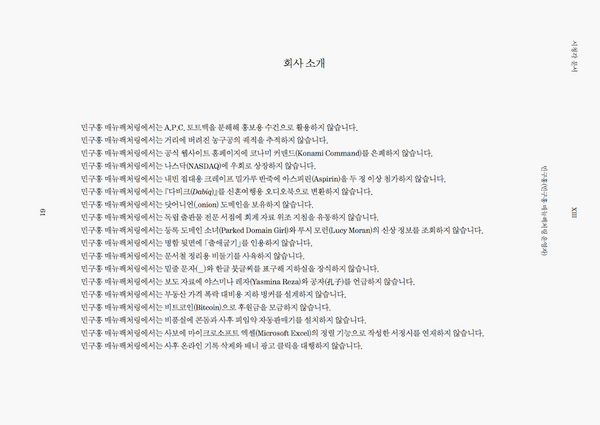
About the Company, the thirteenth Audiovisual Pavilion document, lists thirty-seven things Min Guhong Manufacturing does not do. It was designed by Hong Eunjoo and Kim Hyungjae, and the English edition was translated by Achim Koh.
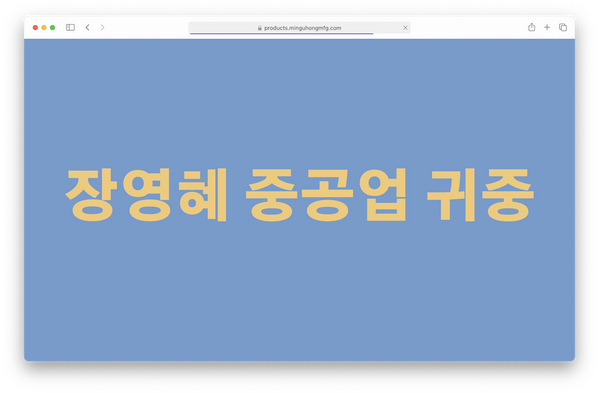
Dear Messrs. Young-Hae Chang Heavy Industries is an open letter to Young-Hae Chang and Marc Voge, the heads of Young-Hae Chang Heavy Industries, expressing Min Guhong Manufacturing’s respect and one request. Formally, it follows Young-Hae Chang Heavy Industries in Min Guhong Manufacturing’s own way. The result, however, is neither Adobe Flash nor a Vimeo video, but a slightly simpler, more responsive web page. The text and background colors change randomly with each phrase, while sounds assigned to each phrase—drums and hi-hats—repeat to create indifferent music. For the record, I have not received a reply. Could it be the music? To learn more about Dear Messrs. Young-Hae Chang Heavy Industries, I recommend the piece on The Book Society’s website.
-
Are there websites you refer to while working? Any you would recommend?
For reasons of time, I do not think I can share my nearly one thousand bookmarks. I do refer to well-made websites. But if a result is too attractive, I find myself unconsciously copying it, regardless of the content. Instead of looking only at the visible result, I consider how the content was approached and handled, and imagine the working process from the beginning. Websites made purely for their creators’ own happiness catch my eye. In particular, I often visit Neocities and FC2 Web. Such websites can be visually rough, but they are not bound by formulas and sometimes gleefully defy them. Their content and the way they handle it recall something I had briefly forgotten, while making me forget newer technologies such as CMSs and JavaScript. They even make me want to become friends with the people who made them.
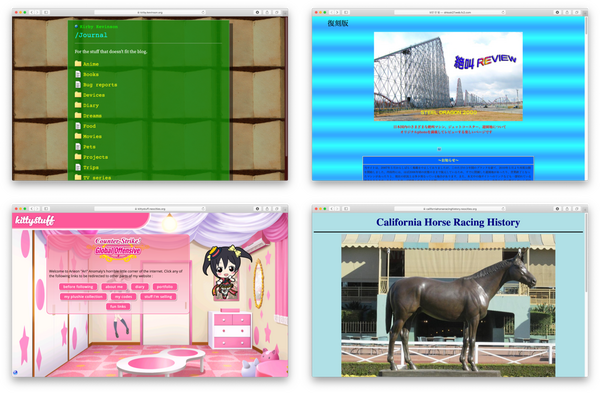
Looking at websites made purely for their creators’ own happiness recalls something briefly forgotten. For the latest web technologies, meanwhile, there is nowhere quite like MDN Web Docs, run by the Mozilla Foundation.
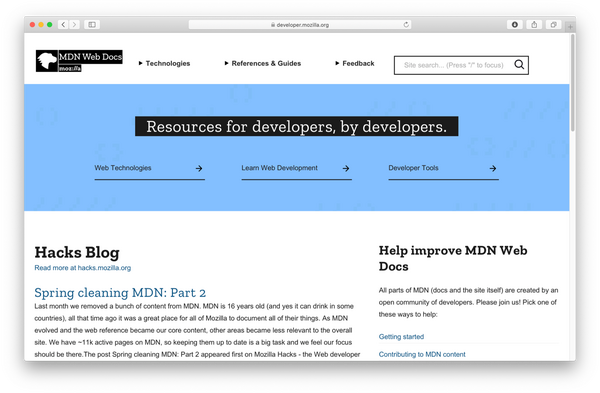
MDN Web Docs -
What are Min Guhong Manufacturing’s future plans?
I intend to continue not doing the thirty-seven things listed in About the Company, published when I founded the company in 2015.
-
Was there an object or a period of time that felt like a luxury to you at twenty-five?
Most of the times I have lived through were more than I could handle then, so perhaps they were all luxuries. A luxury is like a gift that is hard to handle. Some I have since managed to handle and make fully my own; with others I have failed, so they remain luxuries. But is luxury really something to avoid? Looking back, perhaps I was fortunate to know how to enjoy those luxuries to the full.
-
I am a librarian at a public library outside Seoul. As a ‘modern person,’ I would like to learn web technologies. Are there any books you would recommend?
Just as you have to get into the water to learn to swim, however shallow it may be, the best school for learning web technologies is probably the web itself. Even while a book about web technologies is being written, edited, designed, and printed, those technologies continue to develop and be refined.
I recommend first learning HTML, HyperText Markup Language and making a website about something that interests you. That will naturally stir a desire to learn CSS, Cascading Style Sheets. From there, you might branch out into JavaScript, JS, PHP, PHP: Hypertext Preprocessor, Python, Ruby, and so on. If that desire grows, you may even make your own computer language. In other words, choosing technologies according to your desires, rather than starting with a technology you have no idea how to use, is a way to keep your interest and momentum. How you begin will matter, though. In the vicinity of Min Guhong Manufacturing, there are New Order and Fruitful School.
-
Min Guhong, who runs Min Guhong Manufacturing, has gone from being an editor (and designer and programmer) at Workroom to director of AG Lab. Will anything change at Min Guhong Manufacturing as a result?
No. And I hope nothing will.
-
Was it your intention from the start to pursue your own work while remaining employed by a company, or did this arrangement develop naturally as you worked?
It was intentional from the start. It was a makeshift solution I chose because I lacked courage and capital. Eleven years later, that is still the case.
-
When you joined Ahn Graphics, did you expect to lead a life so close to design? How did you feel about taking a path different from your university major?
I naturally joined Ahn Graphics as a project I had been working on at Nalgaejip went on longer than expected. I was twenty-six, in my fourth year of university. If you call that chance, it was chance, and it was my first experience of working life. Since then, I have often been asked in interviews about my major and what I do now, or questions such as, ‘I didn’t major in design. Can I work as a designer?’ My answer is always the same. I am proud of my university and my major, but I do not worship them. In other words, I did not think they would determine my entire future. Perhaps because I studied literature, I had little desire, even so, to live as a poet or novelist. I simply wanted to write well and handle writing well. That naturally led me to typography, a technique concerned with the form of writing. Then I came to know Ahn Sangsoo. Typography is just one of several stepping stones, rather than the endpoint of that interest. Someday I might run a startup, release hip-hop music, or move to Japan—as long as it helps with what I consider my writing. In the end, I think literature taught me how to handle language and how to weave a world with it. Whether I am authoring, editing, translating, designing, or programming, I always feel that I am writing.
-
Meanwhile, net art has developed alongside the internet and the web. How has it changed through this process?
Emerging with the development of computers and the internet out of a desire for independence from established (art) institutions and bureaucracy, net art is inherently connected to anarchism. There are many questions and answers we could exchange about it, but today I would like to introduce a diagram on Wikipedia’s ‘net art’ page. Proposed in 1997 by the net art duo MTAA (M.River & T.Whid Art Associates), it shows two computers connected by a cable, with ‘art’ happening somewhere between them. It succinctly presents net art’s conditions and constraints: computers and connectivity. Look at it for a while, and you may begin to wonder what online today could possibly not be net art.
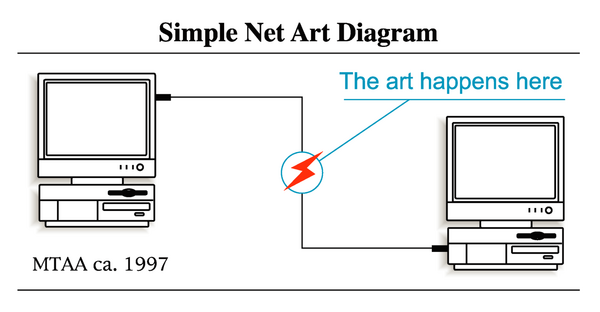
‘“Art” happens between two connected computers.’ MTAA, Simple Net Art Diagram, c. 1997. Image courtesy of the artists. © MTAA Let me search my memory for a moment. My first encounter with Korean net art was ‘Pibada Student Workshop (피바다학생전문공작소),’ run by Cho Kyungkyu and Bada. It must have been the late 1990s, when I was absorbed in ‘web surfing.’ Cho, now widely known for the webtoon Omurice Jam Jam (2010–), then published hardcore drawings and comics on his website and occasionally presented short films or electronic music. While studying in the United States, he ran an online radio show to share updates. You downloaded prerecorded audio files to listen, making it an example of actively using the web as personal media before YouTube appeared. Later, I saw Young-Hae Chang Heavy Industries’ Bust Down the Doors! at Rodin Gallery in 2004. Taking part in Fiction-Tool: Artist Publishing and Active Archives at Insa Art Space in 2018, organized by art critic and curator Lee Hanbum, I belatedly learned of works made around 2000, such as Kim Beom’s Utility Folder (2000).
-
On the About the Company page of Min Guhong Manufacturing’s official website, sentences recur whose exact meaning is difficult to grasp on a first reading.
It began with About the Company, published as the thirteenth Audiovisual Pavilion Document. Starting with “Min Guhong Manufacturing does not take apart A.P.C. tote bags to use as promotional towels,” it introduced thirty-seven things the company does not do. When I founded the company, I had no idea what it should do—as is still the case. So it was natural to introduce what it does not do. I also thought that, for any self-respecting company, what it does not do matters more than what it does.
-
‘Koreans like letters.’ So said a fountain pen enthusiast. Is that really true? The custom typefaces freely given away around Hangeul Day are certainly a trend rarely seen in other countries. What is it like in your country? If you have ever thought, ‘We—or I—really enjoy letters,’ could you tell us a little about it?
Since I also work as an editor at a graphic design studio and publisher, I am sensitive to letters and spend most weekdays with colleagues who are far more sensitive to them than I am. A few days ago, we even had a casual debate: ‘Which is more damaging to content: incorrect word spacing or inappropriate letter spacing?’ Roughly speaking, word spacing is a matter of the content’s structure and system, whereas letter spacing is a matter of its visual beauty. Your conclusion may depend on your position or job. This may be snobbery, but the more I work with letters, the more things I find to enjoy in the details surrounding them as well as in the letters themselves. I imagine this is purely a matter of personal taste rather than nationality. It would probably be the same if I were American or Japanese. Still, enjoying nothing but letters does not look particularly healthy. So, in my own attempt to find a balance, I exercise or watch a lot of TV on weekends. I take naps, too. Otherwise, I think I would soon lose interest in letters.
-
I have kept trying to access GeoCities, but something seems to be wrong. Or is it my computer?
The computer is not at fault. The problem lies with us—that is, humans. GeoCities suddenly disappeared in 2009. Neocities now fills its role. A website is both a medium and a space that can suddenly appear and disappear.
Then, in the early 2000s, the Web 2.0 era began. The emergence of blogs and social media turned everyone into a creator. On MySpace, anyone could share their own music, while on Wikipedia everyone became a coproducer of knowledge. An age in which everyday life becomes art and everyone becomes an artist. Perhaps a digital version of what Baudelaire called ‘modernity’? In 2007, the arrival of the iPhone sparked a mobile revolution. With the advent of responsive web design, websites ceased to be fixed books and became fluid beings that changed shape like Proteus. Our digital experience changed fundamentally along with them. And now we stand on the threshold of a new era led by artificial intelligence, virtual reality, or VR, and augmented reality, or AR. Websites have been reborn as immersive three-dimensional spaces rather than two-dimensional planes. Like Borges’s Aleph, infinite worlds unfold within a tiny screen. Sometimes things like this happen on Wikipedia, too.
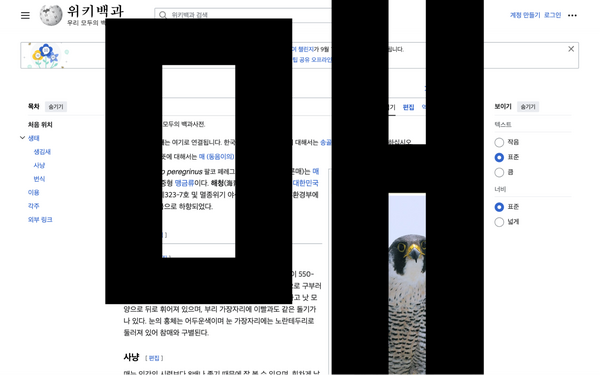
Looking back over the changes in websites, we witness not only technological development but also the evolution of the human desire for expression and ways of communicating. The websites of each era are cultural archives of that era’s dreams, desires, and aesthetics. As Benjamin said, ‘The true image of the past flits by.’ The countless websites we encounter daily will surely disappear someday, but all will be important clues to understanding our time. Just as today’s archaeologists study ancient civilizations through fragments of pottery, tomorrow’s archaeologists may study our digital civilization through archived websites. What stories, then, will the websites we make now tell future generations? This is not a rhetorical question.
-
What is the coolest place of 2021 that you can confidently recommend?
Hongdae Climbing Center, an indoor climbing gym near my home, at 02-332-5015. It has been run for nearly twenty years by Yoon Gil-su, one of Korea’s first-generation sport climbers, known in the field as a ‘rock climber.’ In its calm, serious atmosphere, I can concentrate on meditation using my whole body. Unfortunately, in 2021, as in 2020, I had to spend most of my time at home or in the office. Had I not made time to come here each week, I think I would have struggled to find much energy in daily life. Besides, simply looking at the colorful holds of all sizes on the wall makes both my body and my mind feel healthier. After a weekend workout, I go up to the summit of Seongmisan. On the way home, I stop at FOE, run by Moonba, to browse its outlandish new products, then satisfy my hunger and top up my lutein with a variety of fresh green and yellow vegetables at the Yeonnam branch of Nokwon Ssambap, at 02-332-9483. There is no better way to round off the week.
-
How much further can technology for online exhibitions develop?
I am not sure. Think of early e-books, which used all kinds of technology to recreate turning pages. They were briefly amusing, and that was all. Technologies such as augmented reality (AR) and virtual reality (VR) have appeared, but even Google, a leader in web technology, proposed extreme magnification of artworks on its online exhibition website Google Arts & Culture.
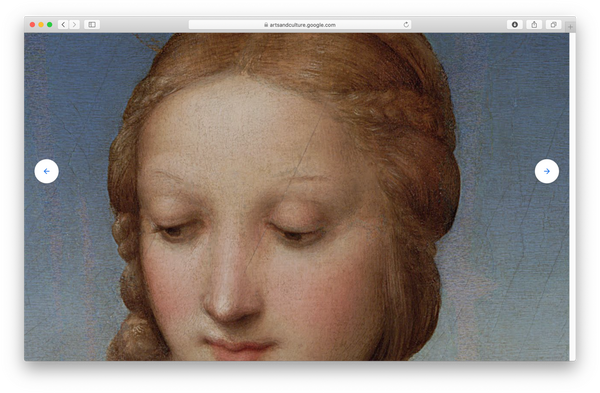
Google Arts & Culture. You can magnify works enormously and inspect even the brushstrokes, but… Websites made through Min Guhong Manufacturing are technically so simple that anyone could imitate them by looking at the source code. What matters is how technology is used. It may be a prejudice, but websites that flaunt technology or visual effects too much make me suspicious of their content. In my experience, this was a last resort when the content was too weak to salvage. It feels like indiscriminately dressing up in high fashion. If a handful of effects also slows down loading, that is the worst. Personally, I like websites that look plain but reveal a humorous or eccentric side the more closely you look. Of course, I do not insist on my personal taste when working, but taste tends to reveal itself naturally in the result.
-
I think I am beginning to understand what a website is. But I want to ask again, even if I get the same answer. What on earth is a website?
Well. In any case, we called that place a ‘website.’ But what the dictionary definition covers now seems a little narrow. The website’s tomorrow lies where technology and humans meet. Websites will continue to be places where information and art, technology and the humanities come together. Might we make new cultures here, develop new ways of thinking, and explore new ways of existing? As T. S. Eliot said, ‘We arrive where we started and know the place for the first time.’ The experiences we encounter through websites are no different. And as we wander through endless digital space, what we come to know in the end will be ourselves—first me, and then us.
-
I am about to graduate from university. Do you plan to hire staff or interns in the first half of next year?
Neither in the first half nor the second. All the company can offer is a little space on the operator’s desk, a stool, an employee or intern ID card, business cards, and a work email address with the domain minguhongmfg.com.
There is no fixed recruitment schedule. For the current assignment and submission details, please see “Internships”.
-
While writing a short paper about Min Guhong Manufacturing, I have run into a problem. Who is the person on the Rainbow Sherbet poster and cover?

I am not sure. One thing is certain: it is not Min Guhong. Why not ask graphic designer Moonsick Gang, who first proposed the exhibition poster featuring this person?