Ghost in the Machine
Around four in the morning, an email arrived at Min Guhong Manufacturing. It would probably be a request for technical support. It might also propose an event introducing the company, or be a love letter expecting no reply. But there was no way to know yet. However important or urgent the matter, the company does not even read emails that arrive outside its agreed working hours of ten in the morning to seven in the evening on weekdays. This is a company rule of sorts. The time before and after agreed working hours requires a logic of its own. The sender—whether an institution, organization, business, or individual—would therefore have to wait at least six hours for a reply, regardless of the scale or purpose of the matter. The reply might arrive a day or two later, perhaps only after the matter had lost its relevance or someone had filled out the sender’s death certificate. There are endless things to do while waiting for a reply. But it was around four in the morning, and Min Guhong Manufacturing recommends briefly suppressing the desire for a reply and falling asleep instead. Even after wandering through a nightmare, the weariness will have become a memory upon waking, and the mind will be a little clearer than yesterday. A story begun between ten in the morning and seven in the evening will also become a little clearer, like that refreshed mind.
Their names were An Jungju and Jeon Sojung. Some things must be disclosed even though one did not choose them. Even if it makes one scratch one’s head, there is no getting around it if the story is to begin properly. Both artists, they were conceiving a work to be presented at the National Museum of Modern and Contemporary Art. The only thing decided about the work was its title, “The Ghost in the Machine.” It was presumably one of the many things they had decided, but even this remained a working title. They hoped the work would primarily be an attempt to look into a machine—the museum and Bamseom—through the eyes of a ghost: an AI-operated drone. To support it, they planned to prepare a few theatrical devices, including a large monitor, film, scaffolding, air bags, speakers, tape, a fish tank, and an aerator. A net would stand between the work and its viewers, protecting the work while separating it from them and limiting their desire and happiness. Viewers would thus be unable to approach the work and could only follow the drone’s perspective. The hidden intention was to establish a situation in which the drone became a proxy for the viewers, or a small moving museum—and, beyond that, the viewers themselves became the drone without noticing. Of course, until the working title became a title and acquired authority, their ideas, plans, and intentions would remain unreal.
They needed two more machines to materialize their idea. One was a machine called “Min Guhong Manufacturing.” They had followed the successes and failures, statements and reversals of the company abruptly founded in 2015, and now explained why Min Guhong Manufacturing was, or could be, a machine in a document of some ten pages that doubled as a contract. The document was A4: 210 by 297 millimeters, with body text 3.5 millimeters high and margins of 18 millimeters on every side except the bottom, where the margin was 27 millimeters. Formally, the document was flawless. It had clearly passed through the hands of a graphic designer deeply absorbed in microtypography. But although the itemized sentences appeared rational and logical, closer inspection revealed improvised aspects, and some looked like encrypted messages comprehensible only to the machine or to a curator close to the artists. The illustrations inserted here and there to aid understanding were closer to placeholders. Still, the machine’s purpose was clear in a footnote on the final page, set at 75 percent of the body text size, or 2.625 millimeters. It was also the most important reason they had sent an email to Min Guhong Manufacturing at around four in the morning. They wanted the machine—Min Guhong Manufacturing—to translate their work into another machine, a website, while they simply watched the process. To materialize their idea, they needed to experience the ghost’s perspective themselves. The website, however, had to refer to the museum’s official website. The document concluded with words from the British mathematician and pioneer of computer science Alan Turing: “The question is, ‘Can machines think?’ I believe this question is not even worth discussing.”
They added that they would provide a budget for the work in accordance with the museum’s terms, and even offer an opportunity to introduce the company at the museum in some form. The budget was substantial. It covered not only the office to be used during the work but even lunch, dinner, and the snacks in between. From a company’s perspective, a budget is no different from a customer’s love. However sufficient it seems at first, it always proves insufficient in the end. But introducing the company in various ways matters as much to Min Guhong Manufacturing as the budget, so these were reasonable terms for a machine producing another machine.
The office prepared in the museum’s basement was a cubic space ten meters high and ten square meters in area. It was a bunker used during the days of the Defense Security Command; its exact purpose was unknown because the relevant documents had been burned when the organization was dissolved in 2018. To reach the office, one had to follow a staff member up and down musty stairwells and pass several restricted areas requiring identification. At the center of the office, entirely painted in glossy white, stood a desk and chair designed for work. An AI-operated drone flew around them, and a CCTV camera was installed at each corner of the ceiling. Five eyes in all would watch the process of one machine producing another.
A Min Guhong Manufacturing Clock was installed on one side of the office. Min Guhong Manufacturing’s time would now flow here. The company began working as usual, and they began watching.
The first step was to mechanize oneself: establish rules for the countless choices ahead and resolve to follow only those rules. This process requires considering anticipated variables, even those unlikely to arise. If the rules leave no room for cramped subclauses, the inexplicable agonizing that accompanies choices disappears, and even chance can be controlled. The second step was to define the machine—the relatively less fluid of the working title’s two metaphors, “machine” and “ghost”—and identify what it could and could not do. The clearer the machine’s identity becomes outside the metaphor’s frame, the more room the ghost has to float; the firmer the machine’s structure, the more indistinct the ghost becomes, sometimes feeling uncanny depending on who encounters it. What is defined at this stage runs through those that follow. The third step was to use the second step’s results to list the content and derive and organize meaningful concepts and numerical values from each item. Provided the content has no problems, any content can be listed without difficulty, even a poem. At this stage, meaningless characters and images approach information and are put to use in subsequent stages. The fourth step was to give the third step’s result—the list—a new order, or context, using HTML, HyperText Markup Language, the most elementary and fundamental computer language of the web. Thanks to HTML, which emerged with the web around 1990, text can become hypertext. As the word “homepage” suggests, making a website is often compared to architecture. Conceptually, HTML determines a building’s spaces and the furnishings each will contain. After this stage, each element can be controlled as a module or component in the stages that follow. Care is required, however, since this stage can lead to the mistake of prematurely limiting the result’s appearance. The fifth step was to give the fourth step’s result a new order, or style, using CSS, Cascading Style Sheets. Here, “style” encompasses not only microtypography but also macrotypography and animation. At this stage, the website begins to become almost tangibly visible. The various values and units needed to assign styles can refer to the information organized in the third step. The sixth step was to add functions suited to the fifth step’s result. This is not essential, of course, if the fifth step alone is sufficient to introduce the content. The final step was to insert the museum’s logo somewhere on the website, preferably in a conspicuous position. Once the working title acquired the authority of a title, the logo would endow that authority with power. This might be the most important step of the project.
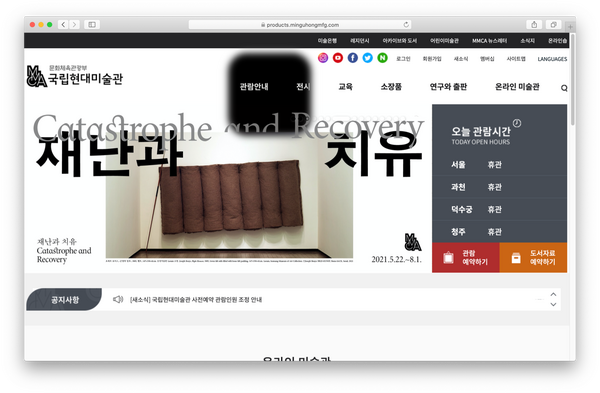
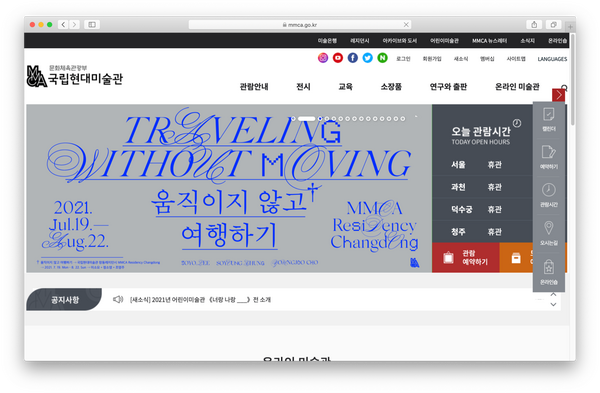
The American novelist Kurt Vonnegut generated the following three sentences for his novel Breakfast of Champions: “I came to the conclusion that there was nothing sacred about myself or any human being. We are all machines, doomed to collide and collide. With no better way available, we became fans of collisions.” Just as the preceding six steps interlock like machine parts, the meaning would not be conveyed properly if the order of the sentences changed. The website was completed while the AI-operated drone occasionally lingered over the keyboard like a pet. The seemingly familiar website was itself a machine, but when placed on the museum’s website it operated like a ghost. Like an AI-operated drone, the ghost gauges the width and height of the museum website and floats about, waiting for the user to click, touch, or scroll. The entire process of a machine producing another machine was recorded and stored. A ghost merely watches and says nothing. Having experienced the ghost’s perspective, they were able to materialize their idea and finally give the working title the authority of a title.