My Handmade Web
I first encountered the term “handmade web” in the summer of 2016, at the School for Poetic Computation, SFPC in New York. If my memory serves, it was during the second class taught by Nick Montfort, an American poet and MIT professor. As soon as class began, he introduced a website containing an essay. He said it was essential reading if you loved the web, or wanted to fall in love with it. The essay began like this:
The familiar term “handmade” generally refers to objects made by hand or with simple tools rather than machines. Such objects may be ordinary or rustic, like a clay ashtray, or exquisitely crafted to near perfection, like a pair of fine handmade shoes.1
Its author, J. R. Carpenter, is a Canadian-born, UK-based net artist and a professor at Winchester School of Art. She has been writing electronic texts since 1993, around the time the web became publicly available. In 1995, she released her first net artwork, Fishes and Flying Things, which ran in Netscape Navigator.
Welcome to this mini web para-site, where fishes and flying things that have buzzed through the night are expressed in a spirit of desire through descriptive narrative.
Beginning with this work made of stories and hyperlinks, Carpenter came to be regarded as a pioneer of net art alongside Olia Lialina. Her work has been presented at biennials, art institutions, galleries, and museums.
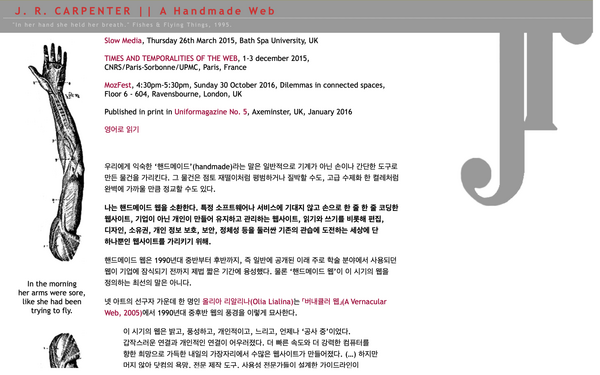
“Handmade web” is a term she advocated in an essay of the same name, presented at the Slow Media Conference at Bath Spa University in the UK on March 26, 2015. It is also a movement to see and practice the web anew. In brief, the handmade web encompasses one-of-a-kind websites coded by hand, line by line, without relying on particular software or services; websites made, maintained, and managed by individuals rather than corporations; and websites that challenge established conventions surrounding reading, writing, editing, design, ownership, privacy, security, and identity. Its charm lies in being small, unhurried, and unexpected. Until the arrival of Web 2.0, led by social media, the web itself was the handmade web. The handmade web loves the past, but it is less simple nostalgia than a lively, dissatisfied question directed at today’s excessively fast web, overtaken by corporate capital.
Through the handmade web, Carpenter critiques the complexity of contemporary web development and its excessive reliance on automated tools. At the same time, she argues that building websites by writing HTML, CSS, and other code by hand can strengthen personal creativity and expression and revive the web’s essential values. She puts this philosophy into practice on her own website, using HTML tags semantically to build a website centered on content. Underlying this is a belief that the handmade web can express individuality and creativity despite technical limitations, and contribute to diversity and freedom of expression on the web.
The handmade web offers an interesting insight into the relationship between technology, language, and meaning. Practicing it goes beyond the technical process of making a website: it is a creative act that expresses one’s thoughts and attitudes. This resembles writing, in which we organize and communicate our thoughts through language. In particular, Carpenter’s emphasis on the semantic use of HTML tags connects to how language produces meaning. Ludwig Wittgenstein said that the meaning of language is determined by its use. This resonates with a view of HTML tags as linguistic elements that construct the meaning of web content, rather than merely technical tools. How we use HTML tags can change a website’s content and structure, and even its meaning.
The handmade web is also an attempt to preserve personal linguistic expression and diversity in a web environment made uniform by technological progress and automation. This connects to Herbert Marcuse’s diagnosis of modern society as “one-dimensional.” He criticized technological progress for standardizing human beings and limiting thought.2 In this context, the handmade web proposes using technological language on one’s own terms to resist such one-dimensionality and create a space for personal expression. As an attempt to appropriate technology as a tool of human liberation, it can offer one way to secure human agency in the digital age.
In this way, the handmade web goes beyond an attitude or method for making websites to pose fundamental questions about the relationship between technology, language, and human beings. Carpenter’s practice treats the web as a field of expression and seeks to bring individual voices forward through technological language. It connects freshly with major themes in the philosophy of language, including language, meaning, and agency, while inviting humanistic reflection in the digital age.
New Order
As I have mentioned whenever the opportunity arises, the final assignment at SFPC was “Make Your Own School.” I proposed the Ricotta Institute, RI. It was a school where, over four weeks, students would make ricotta (cooking), write about it (writing, editing), publish that writing as a website (coding, design), and finally sell their ricotta (marketing). At the time, of course, it was only a joke.
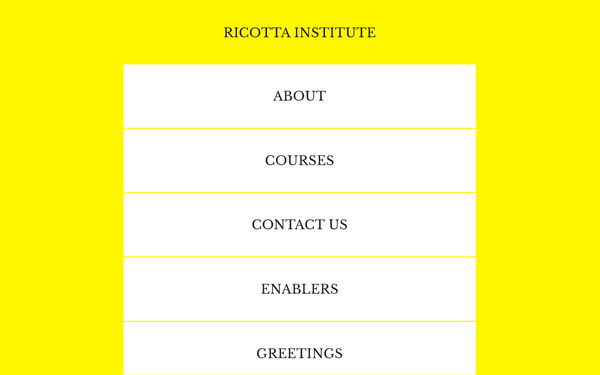
My experience at SFPC and the spirit of the handmade web led to New Order, which may be a prototype for the Ricotta Institute. As always, its beginnings were small and natural. “When you like something, and eventually come to love it, you naturally want to share that beautiful feeling with those around you.”3 On the day after Christmas in 2016, after returning to Korea, I gathered with colleagues and friends at the office of Workroom, where I was then working, to make our own websites. New Order, which sprouted from this private workshop, began to grow in 2019 with generous support from Studio Pie and Tastehouse, both run by young artists. It developed alongside Paju Typography Institute, the Department of Visual Communication Design at Hongik University, and WRM. The seed could not know what it would become or how far it would grow.

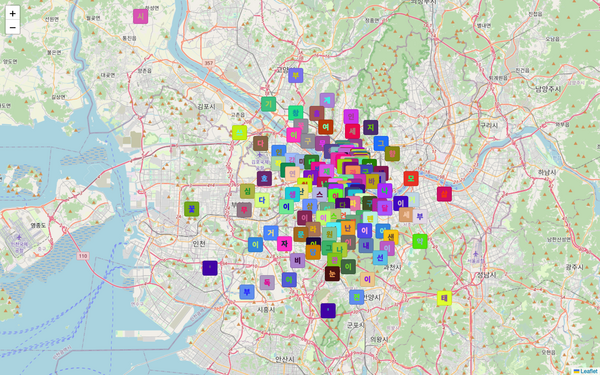
Before I knew it, I had been running New Order for almost four years. More than 400 “friends” had taken part: students, editors, designers, poets, artists, musicians, film directors, and religious practitioners. Through New Order, they made their own websites for the first time, stepping outside social media and gaining their own perspectives on the web. Websites became a medium for expressing their thoughts and feelings. New Order thus became a time and place for sharing the belief that the web should be a space for individual creativity and freedom. Its “friends” now use websites to give a new order not only to their work, but also to their lives and relationships. Collectives such as After New Order and Unknown Order have also formed, creating yet another new order for New Order. None of this would have been possible without the handmade web before New Order.
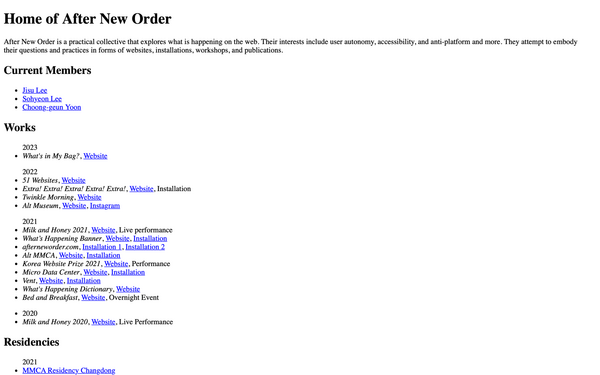
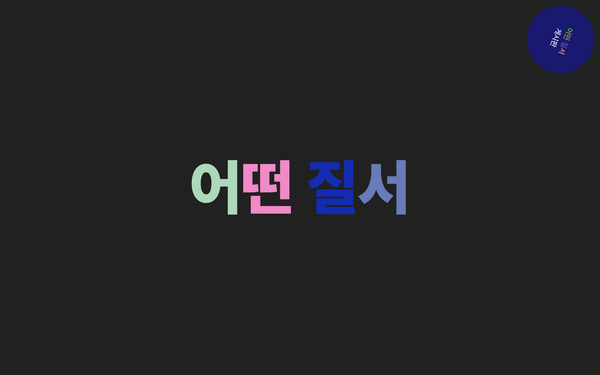
Every Friday, Studio Pie and Tastehouse, where New Order is held, bustle with “friends.” Their heartening practice gives me fresh energy. At the same time, New Order has led me to reflect on learning and teaching. A teacher’s role is to create more teachers, and ultimately colleagues, rather than unquestioning students. That is why, from the first class, we address one another by name, without titles.
The human touch is diminishing on the web we encounter today. Websites are automated or built from templates, while knowledge of how to make them remains confined to a small number of specialists. It may seem anachronistic to some, but New Order, following the spirit of the handmade web, emphasizes the value of making websites by hand, grounded in an understanding of the web’s history and values. It means not settling into established platforms, but exploring the web as a space and writing websites in one’s own language, side by side with technology. The results may be modest and small, but the thought and passion they contain are anything but slight.

My Handmade Web, Our Handmade Web
Since making my first website for a beloved friend in 1995, when I was around eleven, I have regarded making websites, and coding more broadly, as “writing that is both practical and conceptual.” I have also tried to build websites with basic technologies that I can fully control—even technologies that some will surely consider outdated. Yet each encounter with advanced technology has also stirred doubts and eroded my confidence a little. At such moments, the words of Lee Sumyeong, a poet I love and my teacher, have been a dependable support.
The term “modern poetry” does not refer to poems written in the present. A poem written in the past is modern if it never ages. What kind of poem does not age? One that has gone furthest in technique or form, or in the direction of poetic perception. Sometimes a poem seems to have gone too far for its own time, seems ominous and destructive of contemporary values. Yet such poems let us know that a pole exists; having become poles themselves, they are modern poetry. —Lee Sumyeong, “The Foundations of Poetry”4
Replacing “poem” with “website” in her sentences did not feel particularly strange.
A website that has brought its own world into such full bloom that later websites, even when using it as a foothold, can go no further can be called a modern website, regardless of its era. A modern website gives rise to imitation rather than development. —Min Guhong, “The Foundations of Websites”
Carpenter’s words, at once resolute and poetic, which I first encountered at SFPC, became another support. Friends with whom I have had direct or indirect exchanges—Laurel Schwulst, Chris Hamamoto, Elliott Cost, Rosa McElheny, and Mindy Seu, among others—also spoke of the handmade web for reasons similar to mine. I naturally came to understand that the way I had approached the web, moving among editing, design, and programming inside and outside art and design for more than a decade, was another handmade web.
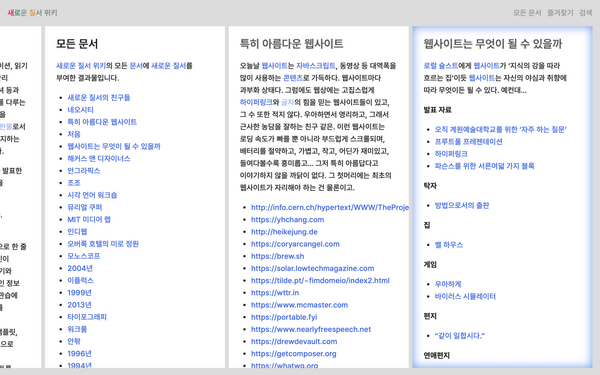
In the summer of 2023, recalling my time at SFPC, I translated Carpenter’s “A Handmade Web” into Korean. My reason was the same as my reason for starting New Order. “When you like something, and eventually come to love it, you naturally want to share that beautiful feeling with those around you.”5
Above all, I felt that the values and spirit of the handmade web remained relevant amid technological change. In today’s web environment, where personal expression and diversity are threatened, its message feels more urgent than ever. This practice was also a message of encouragement to myself. There are times when I run into technical limits and struggle to keep up with standards. Precisely then, I wanted to return my attention to myself and recall the precious pleasure of writing a website.
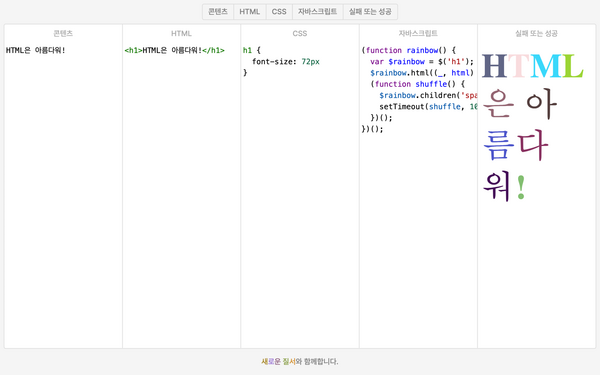
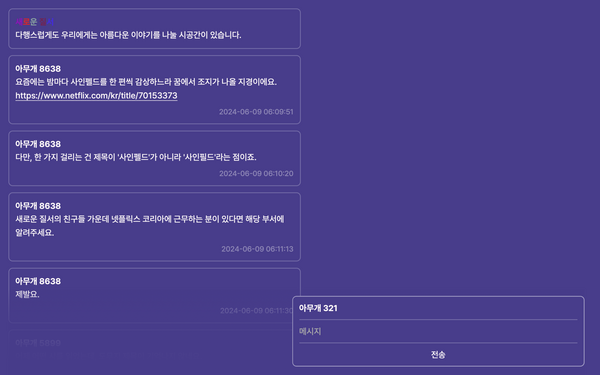
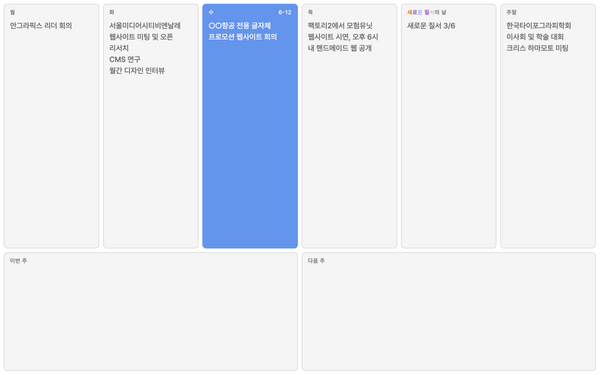
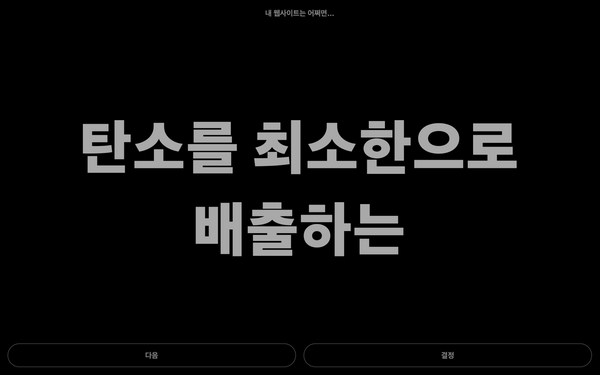
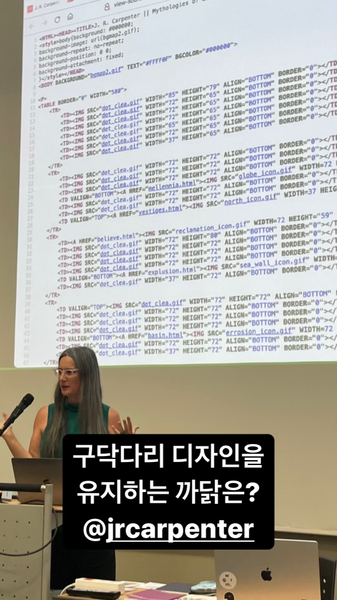
Carpenter’s spirit and practice of the handmade web have value as an attitude toward life and creation, beyond a way of making websites. As her website shows, steadily tending our own spaces for online expression without being swept along by technological change, and discovering our own language there, is a precious opportunity available to us. Incidentally, the complete Korean translation can be read only on Carpenter’s website. That is because she sent this reply to an unexpected email from a Korean person who wanted to translate her essay:
“That’s a wonderful idea. But I have one condition. I would like the complete Korean version to appear only on my website. Anyone who wants to read the full text must visit my website.”
Like the many websites she mentions in “A Handmade Web,” her website confronts us with a paradox of time as soon as we visit it. Some hyperlinks are even broken. There is no need to be surprised that its layout uses old-fashioned table tags or that it does not support mobile devices. What is most surprising is that the essay is still alive: connected to the internet, we can read it anywhere, at any time. Just as I find her website exceedingly beautiful, anyone who loves the web will willingly discover beauty there.
Old websites are not relics of a dead web. They are markers on the map of a web that is still alive, guiding us through yesterday’s web, today’s web, and tomorrow’s web. (…) I, too, should put off updating my website until its old-fashioned design no longer looks wonderful.
My thanks to Kwon Junghyun and Son Yeju for carefully refining a rough manuscript.
-
Quotations without footnotes were translated from J. R. Carpenter by Min Guhong and can be found in A Handmade Web. ↩
-
Herbert Marcuse, One Dimensional Man: Studies in the Ideology of Advanced Industrial Society, (Boston: Beacon Press, 1964). ↩
-
Min Guhong, “New Order: Yesterday, Today, and Tomorrow,” LetterSeed 23: Screen Typography (Paju: Ahn Graphics, 2023), 109. ↩
-
Lee Sumyeong, “The Foundations of Poetry,” Crossing (Seoul: Minumsa, 2019). ↩
-
Min Guhong, “New Order: Yesterday, Today, and Tomorrow,” 109. ↩